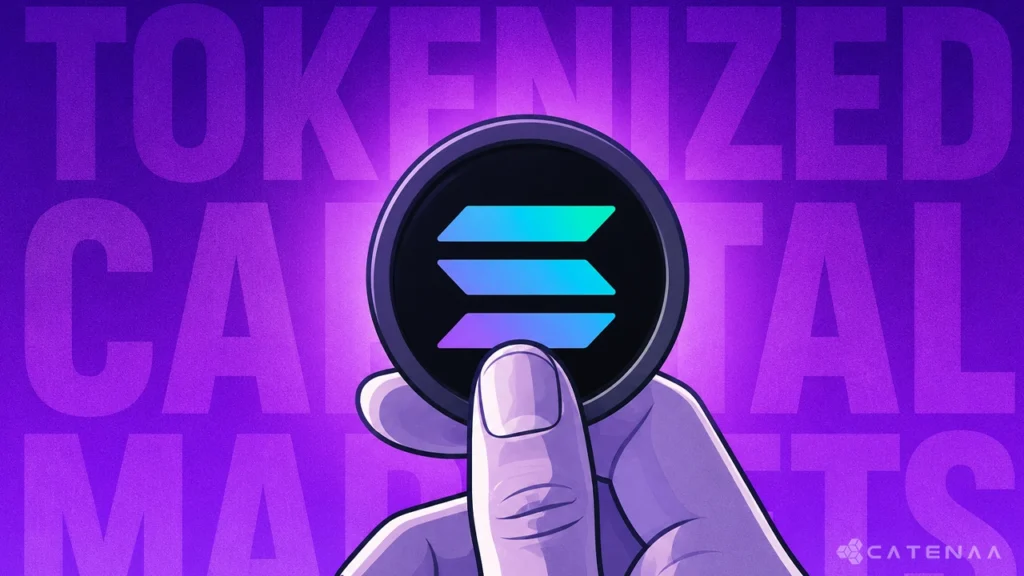


Catenaa, Monday, July 13, 2026- Solana is undergoing one of the most important transformations in its history, evolving from a blockchain associated with speculative memecoin trading into the leading settlement network for tokenized capital markets as institutional investors increasingly move traditional financial assets on-chain.
The shift became evident after the network recorded a quarterly all-time high of $5.77 billion in tokenized asset spot trading during the second quarter of 2026. While the headline figure marks a new record, the more consequential development is the changing composition of activity across the blockchain.
For the first time, tokenized equities have begun replacing memecoins as one of Solana’s primary sources of trading volume.
That transition reflects a broader change in the network’s economic foundation.
Previous growth cycles were largely fueled by retail speculation surrounding NFTs and memecoins, generating bursts of transaction activity that often disappeared as market sentiment weakened. The latest expansion is being driven instead by blockchain-based representations of regulated financial assets, including tokenized stocks and exchange-traded funds, attracting both institutional liquidity providers and professional market participants.
June illustrated how rapidly that transition is unfolding.
Tokenized equity trading exceeded $2 billion during the month, the highest monthly volume ever recorded by any public blockchain. On June 24, daily trading reached a record $644 million, with tokenized equities surpassing memecoins as a share of Solana’s spot trading activity for the first time.
During the week of June 15 through June 21, Solana processed approximately $1.298 billion of the world’s $1.324 billion tokenized stock trading volume, accounting for roughly 95% of global activity. The quarter concluded with another record as weekly volume climbed to $1.42 billion.
Those figures suggest that Solana is no longer competing primarily with other cryptocurrency networks. Increasingly, it is positioning itself as infrastructure capable of supporting segments of traditional financial markets.
Much of the recent growth has been concentrated around Raydium, whose concentrated liquidity pools have become the principal venue for trading tokenized equities through the expanding xStocks ecosystem. Products representing publicly traded companies and major exchange-traded funds now trade continuously on blockchain infrastructure rather than being confined to conventional exchange hours.
The migration reflects changing institutional priorities.
Rather than using blockchain solely for speculative crypto assets, asset managers and market participants are increasingly deploying regulated financial instruments on-chain to gain faster settlement, lower transaction costs and continuous market access. Solana’s sub-second transaction finality and consistently low fees have made it an attractive destination for those products.
The network’s leadership has become increasingly pronounced.
Industry data indicates Solana now accounts for approximately 97% of cumulative on-chain tokenized equity spot trading and has maintained that position for more than a year. The broader real-world asset ecosystem has expanded alongside those gains, with more than $2.8 billion in tokenized assets and approximately $1.2 billion in lending deposits now operating on the network.
Institutional adoption is also extending beyond native blockchain firms.
Investment products linked to major financial institutions, including tokenized liquidity funds and yield-bearing instruments, have chosen Solana as part of their distribution infrastructure. That trend suggests confidence is shifting from speculative applications toward blockchain networks capable of supporting regulated financial products at scale.
The timing is notable.
Asset managers continue filing applications for Solana exchange-traded funds while US regulators work toward comprehensive digital asset rules. At the same time, lawmakers continue debating legislation that could establish clearer legal frameworks for tokenized securities and blockchain-based financial markets.
Yet institutional adoption appears to be advancing ahead of regulatory certainty.
Rather than waiting for comprehensive legislation, financial firms are already building products around blockchain settlement infrastructure capable of supporting real-world assets.
For Solana, that may represent its most important evolution since launch.
The network built its early reputation on speed, low transaction costs and explosive retail activity. Its next phase may depend less on viral memecoin launches and more on becoming the settlement layer for tokenized stocks, bonds, funds and other regulated financial instruments.
If that transition continues, Solana will increasingly be measured not by speculative trading cycles but by its ability to support the digital infrastructure of global capital markets.
Tokenization converts ownership of traditional financial assets into blockchain-based digital tokens that can be traded and settled electronically. Unlike conventional securities markets, which operate during fixed trading sessions, tokenized assets can be exchanged continuously while maintaining transparent ownership records on distributed ledgers. Financial institutions increasingly view tokenization as one of the next major stages in capital market modernization. Solana’s recent growth suggests the blockchain is emerging as the preferred settlement network for tokenized securities, potentially reshaping its identity from a retail-focused crypto ecosystem into infrastructure serving institutional finance.