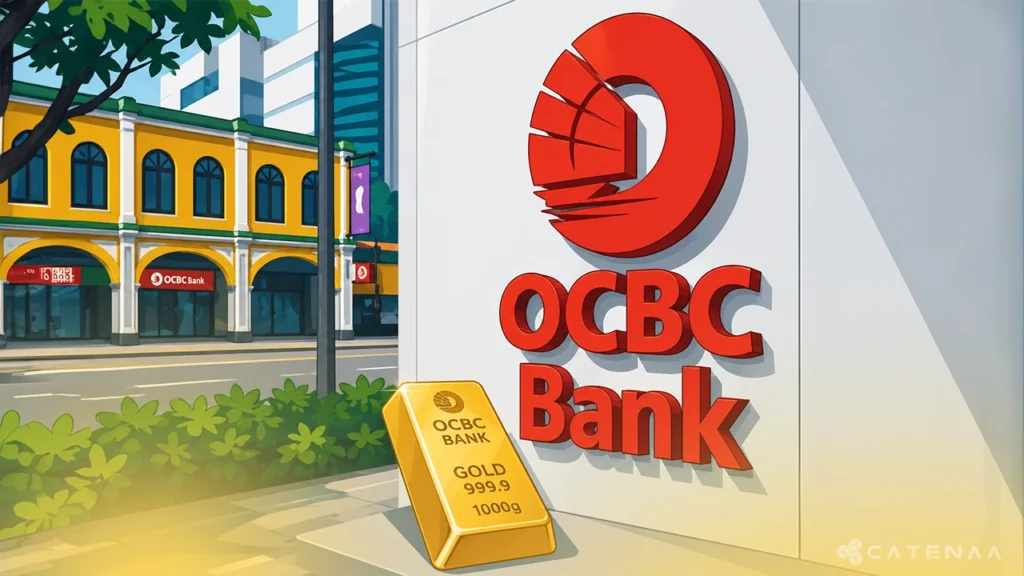


Catenaa, Saturday, April 25, 2026-Ethereum gained renewed institutional attention after a major Singapore banking group launched a tokenized gold fund on the Ethereum blockchain, signaling deeper integration between traditional finance and public blockchain infrastructure. The development is being closely watched by market participants assessing the pace of real-world asset adoption and its impact on Ethereum’s long-term valuation outlook.
The launch comes as global financial institutions accelerate efforts to tokenize traditional assets such as commodities, bonds, and funds. Tokenization allows real-world assets to be represented on blockchain networks, enabling faster settlement, broader investor access, and improved transparency in fund management.
Ethereum has become a leading platform for these experiments due to its established developer ecosystem and widespread use in decentralized finance applications. Over the past several years, banks, asset managers, and fintech firms have increasingly tested blockchain-based products, particularly in Asia, Europe, and North America.
Singapore has positioned itself as a regional hub for regulated digital asset innovation, with banks and financial institutions exploring blockchain applications under evolving regulatory frameworks. The latest move reflects this broader institutional direction.
OCBC, one of Singapore’s largest banking institutions, has launched a tokenized gold product called GOLDX on the Ethereum network. The fund is backed by physical gold and is designed to provide institutional investors with blockchain-based exposure to traditional commodity markets.
The product was developed in partnership with asset management and digital exchange entities, allowing investors to subscribe using fiat currency or stablecoins. Once subscribed, tokenized units are delivered directly to blockchain wallets, where they can be transferred or managed digitally.
The underlying gold fund reportedly holds hundreds of millions of dollars in assets under management. The structure is aimed at hedge funds, institutional investors, and asset managers seeking exposure to gold through digital infrastructure rather than conventional fund settlement systems.
The launch also reflects a broader trend of multi-chain deployment strategies. While Ethereum serves as the primary issuance layer, similar infrastructure developments in the sector often explore interoperability with other blockchain ecosystems to improve liquidity and scalability.
Banking executives involved in the initiative have emphasized that digital assets are expected to play an expanding role in financial services, particularly in areas such as settlement efficiency and asset tokenization.
The tokenized real-world asset market has expanded rapidly over the past year, reaching tens of billions of dollars in on-chain value. Growth has been driven by demand from institutions seeking to modernize legacy financial infrastructure and reduce settlement friction.
Ethereum remains a dominant platform in this segment, although competing networks are also capturing portions of tokenized asset issuance. The expansion of tokenized commodities such as gold highlights a shift in how traditional safe-haven assets are accessed and traded.
This trend aligns with broader global financial modernization efforts, where blockchain systems are increasingly viewed as settlement layers rather than speculative trading platforms. Central banks and regulators in multiple jurisdictions are also exploring digital asset frameworks, including tokenized deposits and central bank digital currencies.
The introduction of a tokenized gold fund by a major banking institution reinforces Ethereum’s positioning as foundational infrastructure for institutional blockchain adoption. Rather than functioning solely as a speculative asset, Ethereum is increasingly being integrated into regulated financial products.
For markets, the development supports the narrative that blockchain adoption is moving beyond crypto-native firms into traditional banking systems. This shift could influence liquidity flows into Ethereum-linked applications, particularly if additional banks follow similar models.
From a regulatory perspective, tokenized products raise questions about custody, settlement finality, and cross-border compliance. However, they also provide regulators with more transparent frameworks for monitoring asset flows compared to off-chain financial systems.
Institutionally, the adoption of blockchain-based gold products suggests growing confidence in public networks for high-value financial instruments. This may encourage further experimentation with other asset classes, including bonds and equities.
While institutional announcements often strengthen long-term adoption narratives, market impact typically unfolds gradually rather than immediately. Adoption cycles depend on regulatory clarity, infrastructure scalability, and integration within existing financial systems.
Ethereum’s trajectory will likely continue to be shaped by real-world asset tokenization and institutional participation rather than short-term trading dynamics. Additional launches of similar products across global financial centers could further reinforce this trend.
Market participants will be watching whether tokenized gold products lead to measurable increases in on-chain liquidity and whether institutional demand expands beyond pilot-scale deployments into broader adoption.




