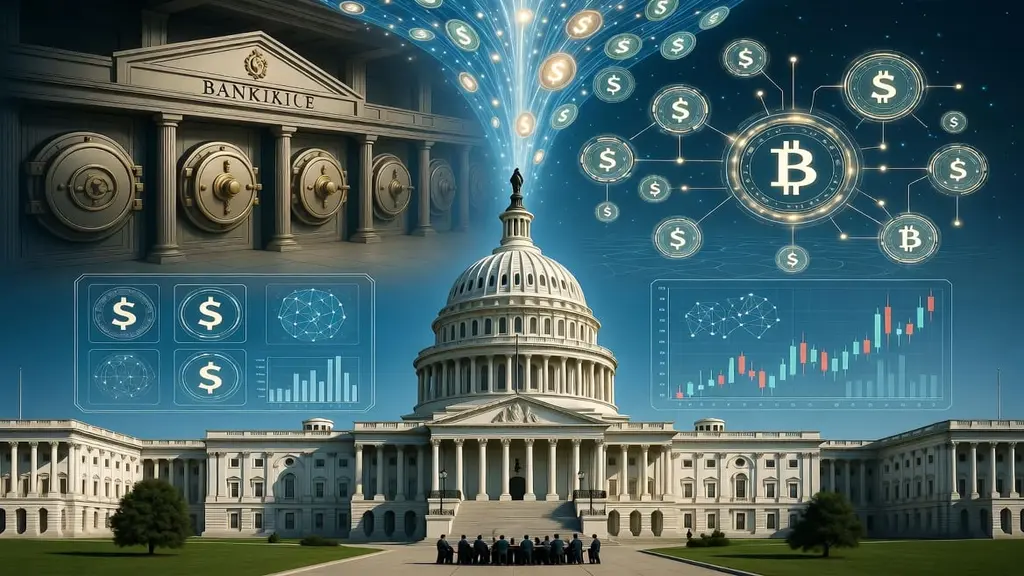


Catenaa, Sunday, May 03, 2026- A bipartisan deal on stablecoin rewards has broken a prolonged Senate impasse, clearing the way for movement on long-delayed US crypto market structure legislation and raising expectations for a committee vote in the coming weeks.
Lawmakers finalized an agreement on Friday addressing how digital asset platforms can structure rewards tied to stablecoins, a core dispute that had stalled the Clarity Act since early 2026. The compromise, led by Sen. Thom Tillis and Sen. Angela Alsobrooks, prohibits firms from offering returns that resemble interest on bank deposits, resolving a central concern raised by banking groups.((https://thehill.com/wp-content/uploads/sites/2/2026/05/050126.pdf))
Clear Limits on Yield, Flexibility on Use
The agreement bars digital asset service providers and affiliates from paying yield solely for holding stablecoins. However, it allows rewards tied to legitimate user activity, including payments, transfers, staking and governance participation. Regulators are expected to define permitted activities within one year, offering a structured framework while preserving room for innovation.
Importantly, the language allows rewards to be calculated based on factors such as balance and duration, provided they are linked to active use rather than passive holding. This provision gives crypto platforms flexibility in designing user incentives without breaching restrictions.
Industry and Banking Interests Converge
The compromise reflects a balance between competing priorities. Banking groups had warned that stablecoin rewards could draw deposits away from traditional institutions, potentially weakening lending capacity. Crypto firms argued that limiting incentives would slow adoption and reduce competitiveness.
The final language restricts passive yield while preserving activity-based rewards, addressing both concerns and enabling progress on broader legislation.
GENIUS Act Sets Foundation
The agreement builds on the GENIUS Act, signed earlier this year by President Donald Trump, which established the first federal regulatory framework for stablecoins. The law requires full backing with US dollars or liquid assets and restricts issuers from paying direct interest to holders.
The Clarity Act expands on this framework by defining regulatory jurisdiction between agencies and introducing new disclosure standards for digital asset markets.
New Compliance and Oversight Measures
Under the compromise, firms cannot market stablecoins as investment products or claim backing by the US government or federal insurance. Violations could result in penalties of up to $5 million per case. Federal regulators must also develop disclosure rules within a year.
In addition, key agencies including the Federal Reserve and Treasury will assess the broader impact of stablecoins on financial markets, bank deposits and Treasury yields within two years, creating a pathway for future policy adjustments.
Next Hurdles: Ethics and Illicit Finance
Despite progress on rewards, lawmakers still face unresolved issues. Provisions related to illicit finance and ethics, including concerns over potential conflicts of interest involving public officials and crypto ventures, remain under discussion.
These issues could influence the final shape of the bill as it moves through the Senate and toward reconciliation with a competing House version.
Race Against Legislative Time
The Senate Banking Committee has not announced a markup date, but pressure is building as legislative timelines narrow. Some lawmakers have warned that failure to advance crypto legislation soon could delay action indefinitely.
If approved, the Senate bill will need to be aligned with the House-passed Digital Asset Market Clarity Act before heading to the President for final approval.
Crypto legislations at a glance
As of May 2026, the United States is advancing six major crypto-related legislative measures, including one enacted law and five key bills or frameworks moving through Congress.
The cornerstone is the Guiding and Establishing National Innovation for US Stablecoins (GENIUS) Act [S.1582], passed by the Senate on June 17, 2025, the House on July 17, 2025, and signed into law on July 18, 2025, establishing the first federal framework for dollar-backed stablecoins with full reserve and oversight requirements.
Alongside it, the CBDC Anti-Surveillance State Act [H.R.5403], passed in the House on July 17, 2025, is expected to be enacted later in 2026 through the National Defense Authorization Act, restricting any Federal Reserve digital currency without congressional approval.
In the Senate pipeline, the Digital Asset Market Clarity (CLARITY) Act, passed by the House on July 17, 2025, is nearing a Senate vote, with expectations of passage by mid-2026, aiming to define regulatory authority between the SEC and CFTC.
The Digital Commodity Intermediaries Act [S.3755], advanced by the Senate Agriculture Committee on January 29, 2026, awaits further consolidation and a full floor vote. In parallel, draft market structure bills released by the Senate Banking Committee on January 12, 2026, and the Agriculture Committee on January 21, 2026, are being reconciled to establish a unified framework for crypto markets, exchanges and intermediaries, with projected alignment and passage timelines through mid-2026.
Together, these measures mark a shift toward a formal, comprehensive US crypto regulatory regime.




