


August 10, 2026 – The Saylor Bitcoin forecast is drawing attention as Bitcoin trades near $65,000. His 30% annual-growth assumption creates extraordinary long-term valuation implications.
In Summary
A 30% annual Bitcoin gain would compound today’s price to about $12.4 million by 2046.
That growth rate equals roughly 190 times Bitcoin’s current price over twenty years.
Strategy holds 842,138 BTC, equal to about 4.0% of Bitcoin’s maximum supply.
Strategy’s average acquisition cost remains above the current Bitcoin market price.
Institutional access has expanded, but listed Bitcoin products still show substantial volatility.
The forecast is a compounding thesis
Saylor has argued that Bitcoin could appreciate about 30% annually over the next twenty years. He outlined that long-term assumption in a recorded interview discussing Bitcoin’s expected annual return. That assumption sounds simple. However, compounding makes the outcome far more aggressive than many investors expect.
Bitcoin traded near $65,211 on August 9. Its market capitalization stood near $1.31 trillion. Those figures come from current Bitcoin market data. At 30% annual growth, Bitcoin would reach about $186,000 by 2030. It would approach $692,000 by 2035.
By 2040, the same model produces a price near $2.57 million. By 2046, Bitcoin reaches roughly $12.39 million.
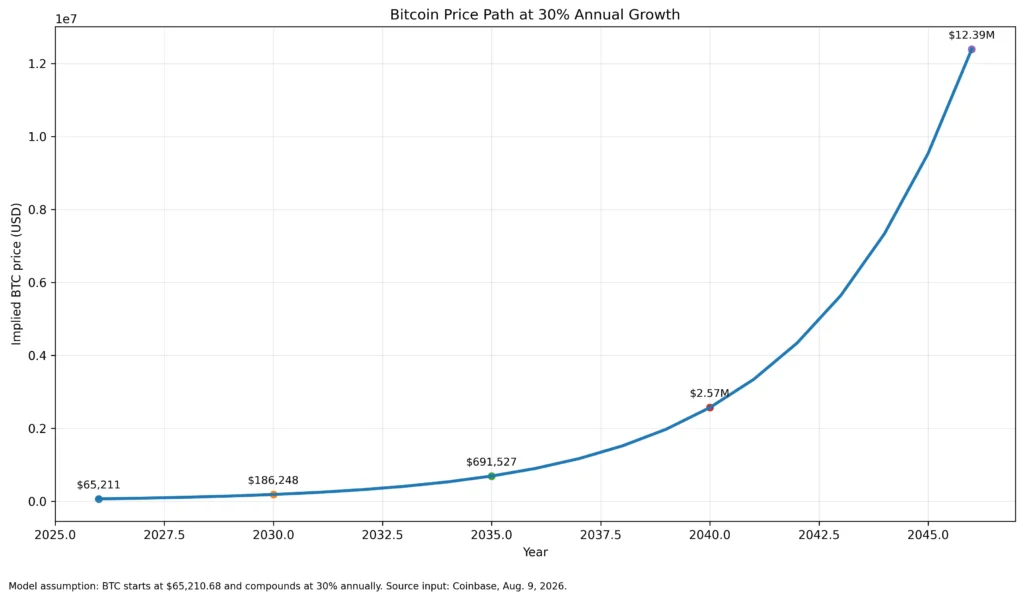
Therefore, the forecast represents an increase of about 190 times from today’s price.
The implied market value also becomes enormous. Compounding today’s market capitalization produces roughly $248 trillion after twenty years. Even modest changes in growth produce dramatically different results.
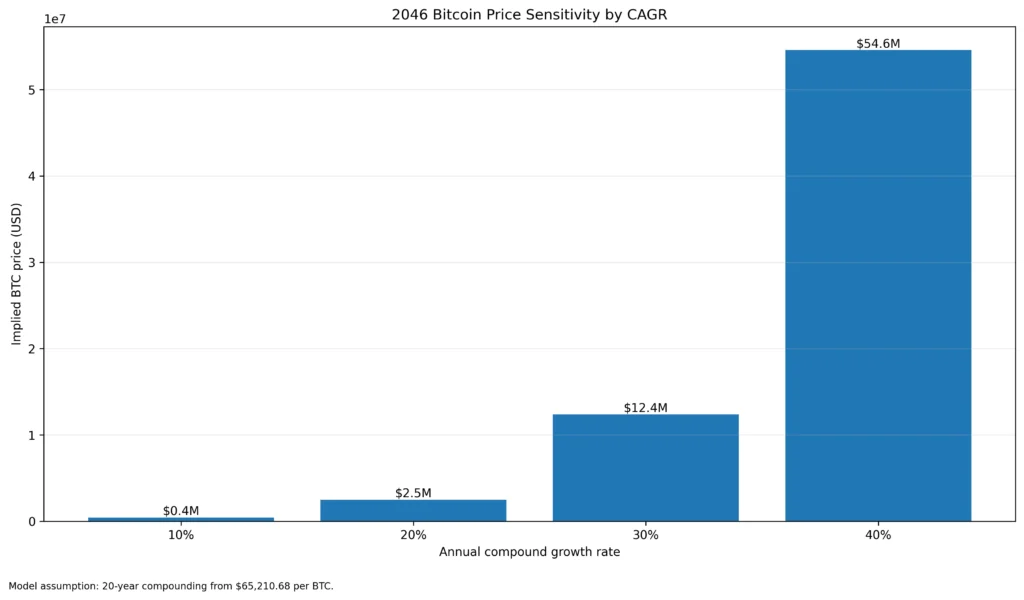
A 20% annual return gives roughly $2.5 million by 2046. A 10% rate produces about $439,000. At 40%, however, the model exceeds $54 million per Bitcoin.
Therefore, long-term outcomes depend heavily on the assumed growth rate.
Scarcity strengthens the bullish case
Bitcoin’s monetary design remains central to Saylor’s thesis. The protocol limits eventual supply to 21 million coins. New issuance also declines through scheduled halvings. These supply mechanics are documented in Bitcoin’s protocol information.
Strategy currently holds 842,138 BTC. That equals about 4.01% of the maximum possible Bitcoin supply.
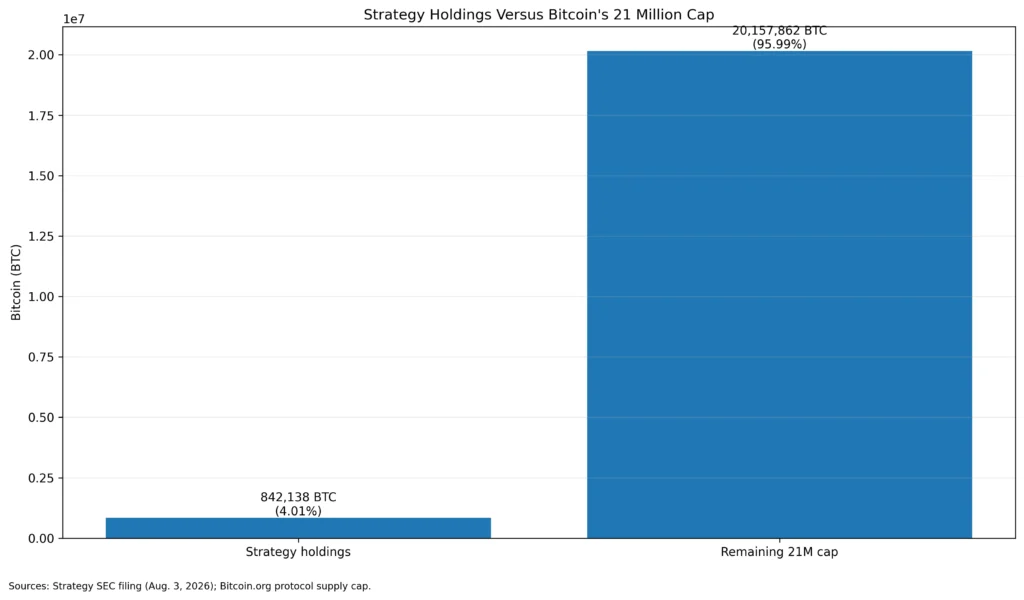
This concentration shows why corporate accumulation can matter when liquid supply tightens. However, scarcity alone cannot produce the projected return. Demand must rise much faster than available supply. For a 30% annual return, global capital allocation would need to expand for decades. That would require broader institutional ownership, deeper credit markets, stronger custody infrastructure, and sustained regulatory acceptance.
Strategy’s balance sheet shows the risk
Saylor’s bullish forecast also sits beside a more difficult corporate reality. Strategy reported 842,138 BTC as of August 2. Those coins carried an aggregate purchase price of $63.51 billion. The company’s average purchase price was $75,419 per Bitcoin. That remains about 13.5% above Bitcoin’s current market price.
At today’s price, those holdings are worth roughly $54.9 billion. Strategy also sold 1,638 BTC during the week ending August 2. The average sale price was $63,957. The company generated about $104.7 million from those sales. About $52.4 million supported preferred-stock dividends. Another $52.3 million funded preferred-stock repurchases. Those figures appear in Strategy’s latest SEC Bitcoin holdings disclosure.
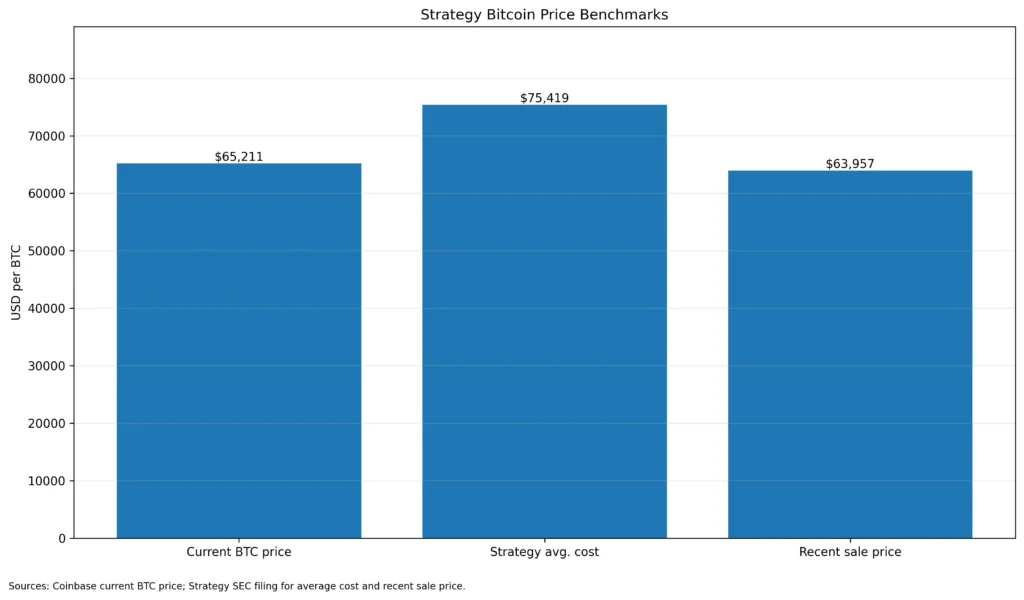
Therefore, even Bitcoin’s largest corporate holder must manage liquidity, financing costs, and capital structure pressures.
Institutional demand remains important
The bullish case is not based only on corporate treasury adoption. Regulated exchange-traded products have also expanded investor access to Bitcoin.
One major U.S. Bitcoin trust reported about $48.4 billion in net assets on August 7. However, its year-to-date NAV return was negative 26.39% through August 6. The figures are available through the fund’s official product disclosures.
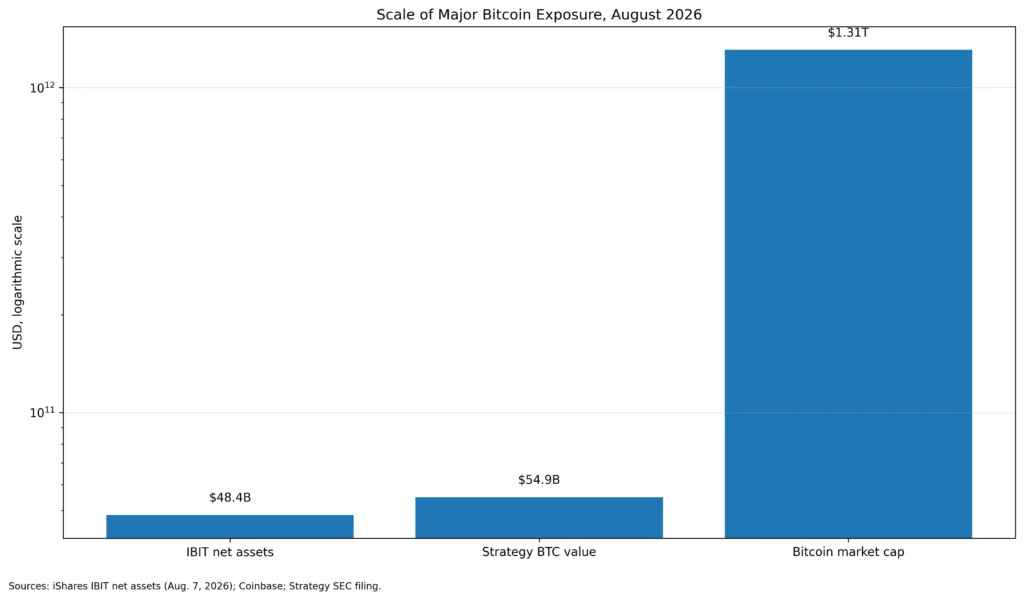
That contrast matters. Institutional access can increase demand, while volatility can still weaken investor conviction. Bitcoin must attract larger pools of patient capital if Saylor’s forecast is to become plausible.
What must happen next?
Three conditions appear essential.
First, Bitcoin must preserve its scarcity narrative while avoiding major protocol or custody failures.
Second, regulation must keep improving across major capital markets.
Third, investors must increasingly treat Bitcoin as strategic capital rather than a speculative trade.
The 30% forecast is therefore more than a price prediction. It represents a global adoption scenario. If adoption accelerates, compounding becomes powerful. If adoption stalls, the mathematics quickly breaks down.
For investors, the key question is not whether Bitcoin can rally again. The bigger question is whether global demand can compound for twenty consecutive years.