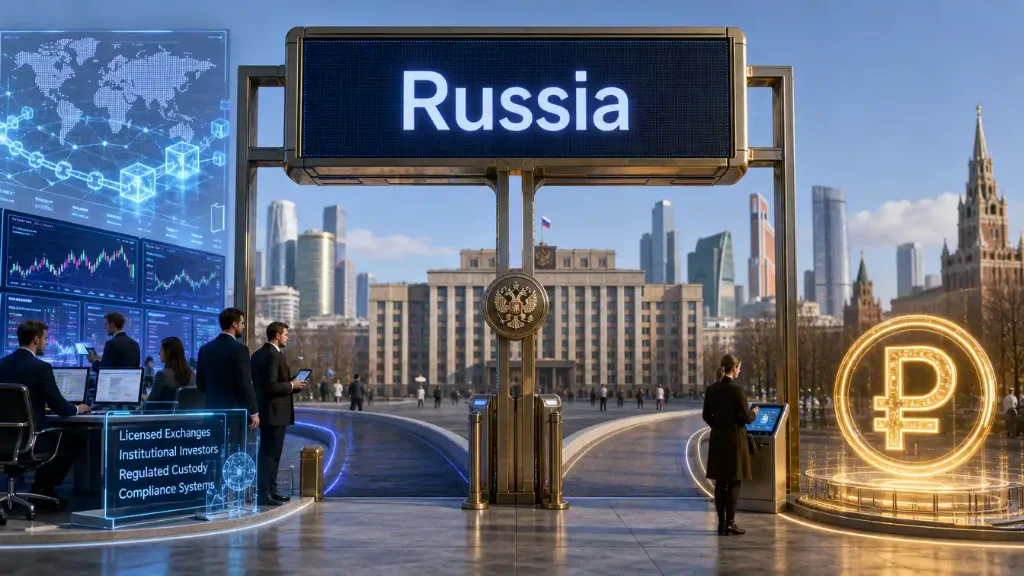


Catenaa, Thursday, July 23, 2026- Russia has drawn a clear regulatory line between cryptocurrency as an investment asset and cryptocurrency as money, approving landmark legislation that expands regulated retail crypto trading while maintaining the ruble as the nation’s only legal means of domestic payment.
The bill, passed by the State Duma, establishes a comprehensive regulatory framework for cryptocurrency exchanges, brokers and custodians under government supervision, while continuing Russia’s prohibition on using digital assets to purchase goods and services inside the country.
The legislation reflects an increasingly common regulatory approach worldwide, where governments embrace crypto as a financial instrument without allowing it to replace sovereign currencies.
The legislation creates a formal registration system for cryptocurrency exchanges, brokers and custodians, requiring digital asset service providers to join an official government registry before operating legally.
Existing market participants will receive approximately one year to complete registration under the new framework.
Retail investors will be permitted to purchase approved high-liquidity cryptocurrencies through licensed intermediaries after successfully completing mandatory knowledge assessments.
The law also introduces annual investment limits of 300,000 rubles per intermediary for retail investors, while qualified investors who meet regulatory requirements may trade without investment caps.
Banks will be required to block transfers involving suspected unauthorised cryptocurrency exchanges as authorities strengthen oversight of the domestic digital asset market.
Although the State Duma has approved the legislation, it must still pass the Federation Council and receive President Vladimir Putin’s signature before becoming law.
Russia’s latest legislation represents a significant evolution rather than a complete reversal of its cryptocurrency policy.
The country has gradually expanded the use of digital assets in international trade since 2024, particularly as Western sanctions complicated access to conventional cross-border payment infrastructure.
At the same time, domestic cryptocurrency payments have remained prohibited to preserve the ruble’s role as Russia’s national currency.
The new legislation extends that approach by formally recognising cryptocurrencies as regulated investment products while maintaining restrictions on their monetary use within Russia.
The legislation demonstrates that governments are increasingly distinguishing between cryptocurrency as a financial asset and cryptocurrency as money.
Rather than embracing unrestricted crypto adoption, Russia has chosen to regulate digital assets in a manner similar to securities and other investment products.
That approach aligns with broader international regulatory trends, where policymakers are becoming more comfortable supervising cryptocurrency markets while protecting sovereign currencies as the exclusive medium of domestic exchange.
The framework also strengthens institutional oversight by licensing intermediaries, imposing investor suitability requirements and expanding compliance obligations for financial institutions.
If implemented successfully, the model could provide Russia with greater access to regulated digital asset markets without weakening monetary control.
The legislation illustrates how cryptocurrency regulation is evolving beyond outright bans or unrestricted adoption.
Instead, policymakers are building financial market frameworks that integrate digital assets into existing regulatory systems.
Knowledge tests, licensing requirements and investment caps reflect a regulatory philosophy focused on investor protection rather than broad monetary reform.
The continued prohibition on domestic crypto payments suggests authorities remain committed to maintaining monetary sovereignty while allowing innovation within regulated financial markets.
Russia’s legislation is significant not because it legalises cryptocurrency trading, but because it clearly separates digital assets from sovereign money.
By opening regulated investment markets while preserving the ruble’s exclusive role in domestic payments, Russia joins a growing number of jurisdictions developing regulatory frameworks that treat cryptocurrencies primarily as investable financial assets rather than alternative national currencies.
The approach may increasingly become the template for digital asset regulation as governments seek to balance financial innovation with monetary stability.
Russia has taken an evolving approach to cryptocurrency regulation over recent years. Following international sanctions that complicated cross-border finance, the country introduced experimental frameworks allowing digital assets to facilitate certain international trade transactions. However, domestic cryptocurrency payments remained prohibited to preserve the ruble’s position as Russia’s legal tender. Globally, regulators are increasingly adopting similar distinctions between investment and payment uses of digital assets. Jurisdictions including the European Union, Singapore, Hong Kong and Japan have developed regulatory frameworks permitting licensed cryptocurrency trading and custody while maintaining sovereign currencies as the exclusive means of domestic payment. Russia’s latest legislation reflects this broader international trend toward integrating digital assets into regulated financial markets rather than replacing existing monetary systems.