

July 03, 2026 – Ripple USD has crossed a symbolic supply line. Most RLUSD now sits on XRP Ledger, not Ethereum. That change strengthens XRPL liquidity, but it also raises sharper questions about sustainable use.
In Summary
RLUSD on the XRP Ledger now holds the reported majority of the circulating supply.
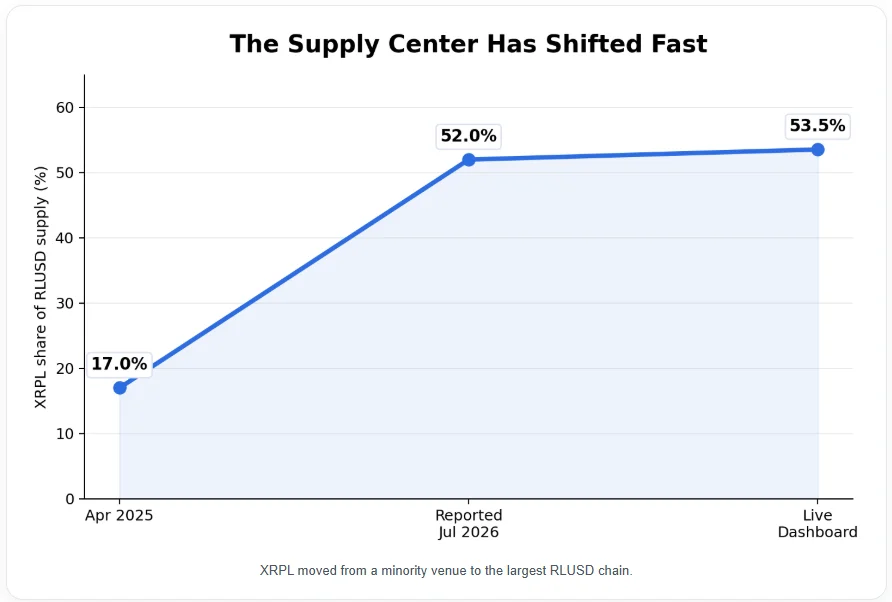
The XRPL share rose from 17% in April 2025 to about 51%-52%.
Live dashboards show about 846 million RLUSD on XRPL and 734 million on Ethereum.
More stablecoin liquidity can lift XRP Ledger trading, fees, and payment utility.
However, RLUSD remains small beside the broader stablecoin market.
RLUSD on XRP Ledger has moved from a supporting role to a majority venue. The latest market update says about 51% to 52% of circulating RLUSD now runs on XRPL. That marks a clear break from April 2025, when XRPL held only 17%.
This is more than a chain rotation. It gives XRP Ledger a deeper dollar liquidity base. It also tests whether RLUSD can become more than just an exchange-balance token. The next phase depends on payments, market making, and real institutional flows.
What Changed in RLUSD Supply?
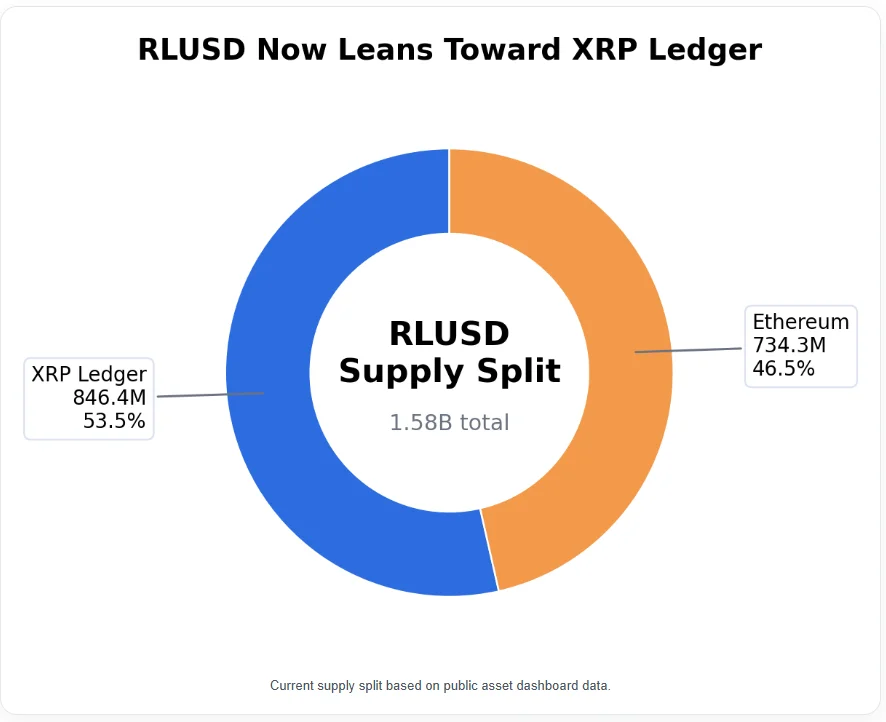
The live data looks even stronger than the headline figure. A public asset dashboard shows 846.4 million RLUSD on XRP Ledger. It also shows 734.3 million on Ethereum. That implies XRPL holds around 53.5% of the listed supply.
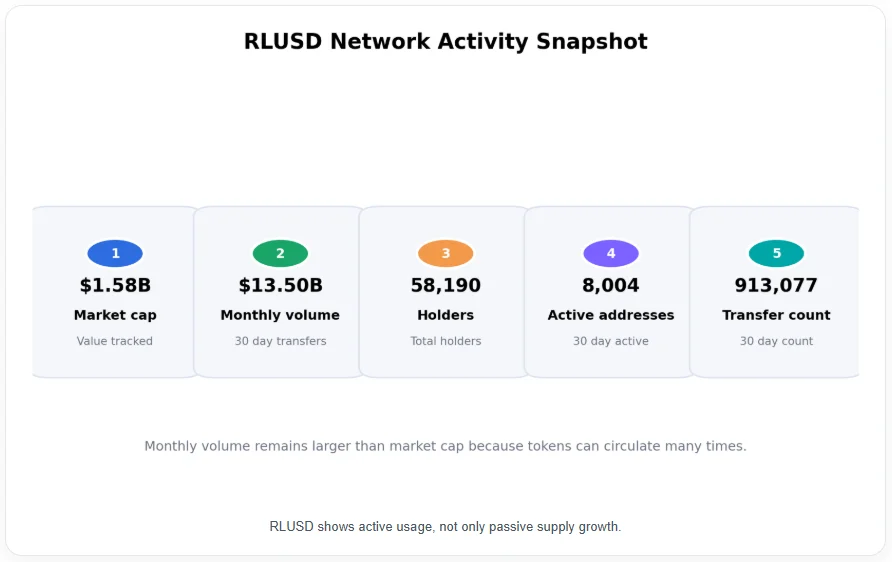
Meanwhile, total RLUSD supply stands near 1.58 billion tokens. The same dashboard shows a market value close to $1.58 billion. It also reports 58,190 holders and $13.50 billion in monthly transfer volume.
These numbers show two points. First, RLUSD has reached a meaningful scale for a young stablecoin. Second, velocity matters. Monthly transfer volume is much larger than market cap. Therefore, tokens are moving repeatedly across venues.
Why the XRP Ledger Shift Matters
Stablecoins need two things to become useful. They need trust in reserves. They also need fast and cheap settlement. RLUSD tries to combine both traits.
Ripple describes RLUSD as a dollar stablecoin that is issued on XRP Ledger and Ethereum. It says each token is backed by cash, U.S. Treasuries, and cash equivalents. It also presents RLUSD as redeemable for U.S. dollars at a 1:1 rate.
That reserve message supports institutional use. However, the choice of chain determines the user experience. XRPL offers a direct settlement route for dollar tokens. It also gives market makers a native XRP pair.
The network cost is important here. XRPL documentation states that a standard transaction currently requires a minimum cost of 0.00001 XRP. That fee is destroyed rather than paid to validators. As a result, higher RLUSD activity still creates XRP demand for transaction execution.
Ethereum Still Holds the DeFi Edge
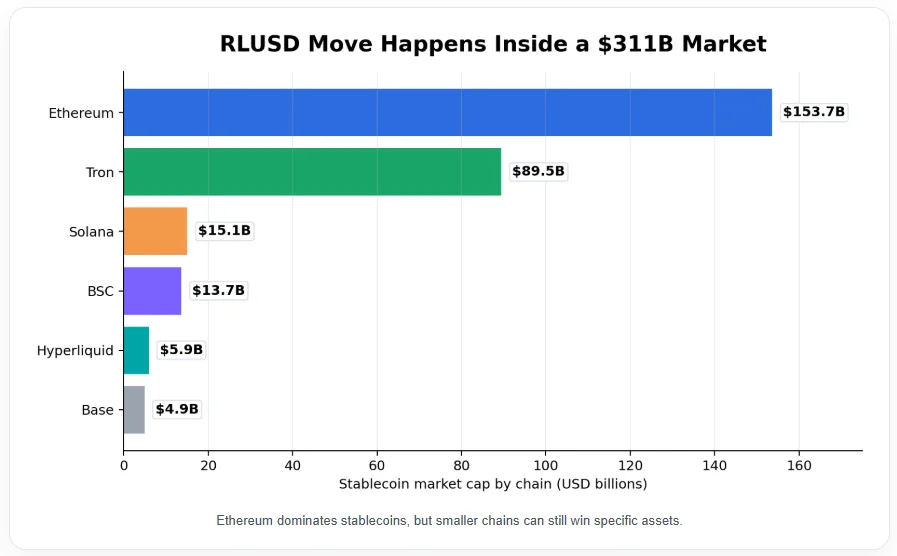
The shift does not mean Ethereum has lost its relevance as a stablecoin. It remains the largest stablecoin chain by a wide margin. Data across chains shows $311.1 billion in total stablecoin market cap. Ethereum alone holds about $153.7 billion.
That context matters. Ethereum still controls deep DeFi liquidity. It also attracts exchanges, lending protocols, and tokenized asset issuers. Therefore, RLUSD can benefit from Ethereum even as XRPL becomes its main supply base.
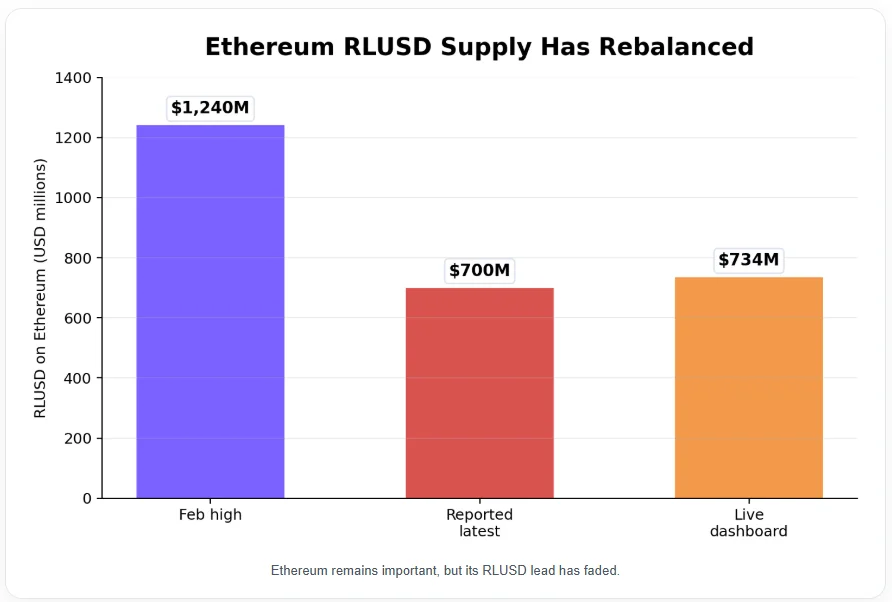
Still, the rebalancing is notable. The market update says Ethereum RLUSD supply fell from a February high near $1.24 billion to about $700 million. The current public dashboard shows around $734 million. Either way, the direction is clear.
Trading Volume Gives the Signal
Supply is only one side of the story. Volume reveals whether users actually move the token. The update says the RLUSD/XRP pair processed about $900 million in six months. It also says the pair accounted for nearly 90% of RLUSD trading activity on XRPL.
That is critical for XRP. It means RLUSD does not simply sit idle on the ledger. Instead, it can deepen order books and improve on-chain price discovery. Furthermore, more token movement can increase network fee burn.
However, investors should avoid one simple mistake. RLUSD growth does not automatically mean XRP price growth. The link is indirect. Activity can improve utility, but price still depends on liquidity, sentiment, supply, and broader crypto flows.
What Comes Next for RLUSD on XRP Ledger?
The next milestone is not another supply percentage. The real test is sticky demand. Exchanges can move balances quickly. Institutional payment flows are harder to earn, but they last longer.
Payment providers will watch three data points. They will track monthly active addresses. They will follow transfer count growth. They will also compare RLUSD spreads across XRPL and Ethereum venues.
Regulators will focus on reserves and redemption. That is why Ripple highlights cash and short-term asset backing. In stablecoins, credibility can matter more than speed. A fast dollar token still needs trusted reserves.
For XRP Ledger, the opportunity is clear. RLUSD can make the network more useful for settlement, trading, and tokenized cash flows. Yet the market remains competitive. USDT, USDC, and newer bank-linked tokens still dominate attention.
Market Outlook
The RLUSD supply shift gives XRPL a stronger stablecoin narrative. It supports the claim that the ledger can host regulated dollar liquidity at scale. It also gives developers a cleaner base asset for payments and trading pairs.
Even so, the bigger market will ask for proof. Real adoption needs repeat users, tight spreads, and reliable redemption. Therefore, RLUSD on XRP Ledger now has momentum. The next question is whether that momentum becomes durable utility.




