

June 24, 2026 – Luxembourg’s regulator handed Ripple a preliminary crypto licence. The decision pushes the firm toward a regulated rollout of payments across Europe.

In Summary
Ripple secured a preliminary CASP licence from Luxembourg’s CSSF under the EU’s MiCA rules.
The “Green Light Letter” still needs final conditions before full authorization arrives.
Once approved, Ripple can passport services across all 30 European Economic Area nations.
The new CASP licence pairs with Ripple’s existing EMI licence for full MiCA compliance.
The win lands just days before the strict July 1 MiCA deadline for crypto firms.
A regulatory breakthrough in Luxembourg
Ripple has taken a decisive step into Europe’s regulated crypto market. On June 23, 2026, the company received preliminary approval for a Crypto Asset Service Provider (CASP) licence. Luxembourg’s financial watchdog, the CSSF, issued the decision under the EU’s Markets in Crypto Assets (MiCA) framework.
The regulator delivered the news through a “Green Light Letter.” This letter signals clear intent, yet it is not the final licence. Therefore, Ripple must still satisfy remaining conditions before passporting begins. However, the milestone visibly strengthens the firm’s European ambitions. CoinDesk reported that the approval routes through Luxembourg, Ripple’s chosen EU base.
“It will enable Ripple to scale regulated cryptoasset services to financial institutions and businesses across all 30 countries of the European Economic Area.”
What the CASP licence unlocks
The licence matters because of one powerful feature: passporting. A single national authorization can travel across the entire bloc. Consequently, banks and fintechs in any member state could connect via a single integration.
Moreover, the system handles the full flow of funds. It manages collection, conversion, and payout for institutional users. As a result, corporate clients gain access to crypto asset and stablecoin payments without separate national filings.
Beyond payments, the approval opens a path to wider services. Ripple has flagged Europe as a priority market. Furthermore, the firm already counts major financial institutions among its clients there.
A combined licence strategy
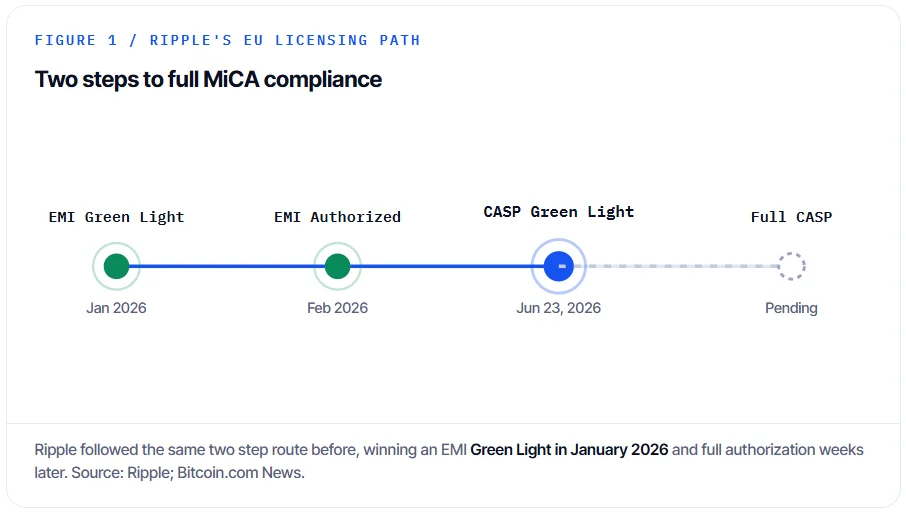
The pending CASP licence will not stand alone. Instead, it pairs with Ripple’s existing Electronic Money Institution (EMI) licence. Together, they form one regulatory stack for payments and digital assets.
Cassie Craddock, Ripple’s Managing Director for the UK and Europe, sees rising institutional demand. She points to cross-border payments, settlement, collateral management, and tokenised assets. These segments, she argues, are steadily shifting toward on-chain systems.
“Upon full approval, these combined CASP and EMI licenses will make Ripple fully MiCA-compliant.”
Policy chief Matthew Osborne praised Luxembourg’s regulator for its role. He called the jurisdiction a natural base for Ripple’s European operations. In his view, the country offers clarity and proven financial oversight.
Ripple’s global footprint by the numbers
Ripple frames the approval as part of a wider compliance push. The firm’s payments network has cleared more than $100 billion in volume. Additionally, it operates across over 60 markets worldwide.
The company also holds more than 75 regulatory licences globally. These cover payments, custody, liquidity, treasury tools, and its RLUSD stablecoin. Notably, RLUSD’s circulation surpassed $300 million in early 2026, according to DeFiLlama data.
A race against the July deadline
Timing makes this win especially valuable. The EU’s MiCA transition period expires on July 1, 2026. After that date, unlicensed crypto firms breach EU law and must stop serving clients.
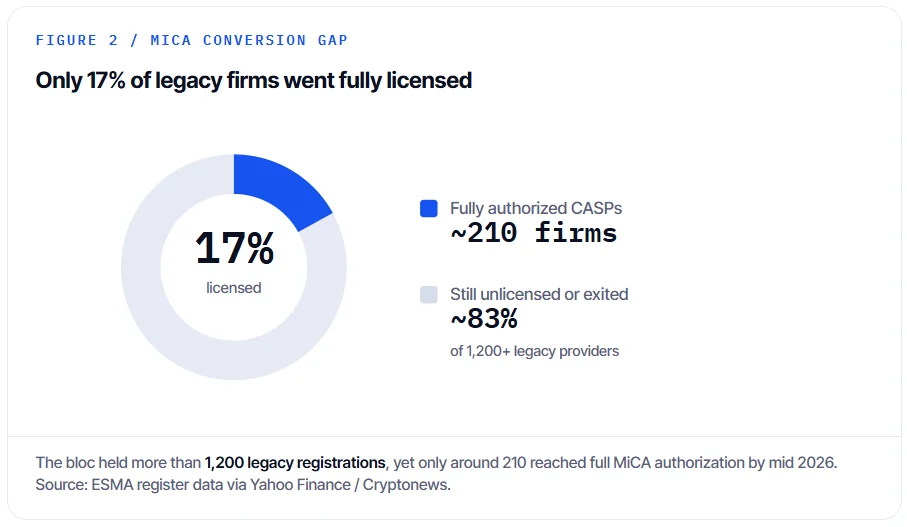
Most firms remain unprepared, however. Only about 210 of more than 1,200 legacy providers have converted to full CASP status. In short, roughly 83% stay unlicensed as the cutoff nears.
Against that backdrop, Ripple gains a clear edge. The firm joins a small group of compliant players. Meanwhile, many rivals are still waiting or planning to exit the market.
The cost barrier explains much of the gap. Full authorization can run from €250,000 to €500,000 per firm. As a result, smaller operators often choose to leave rather than comply.
Trading rights stay rare
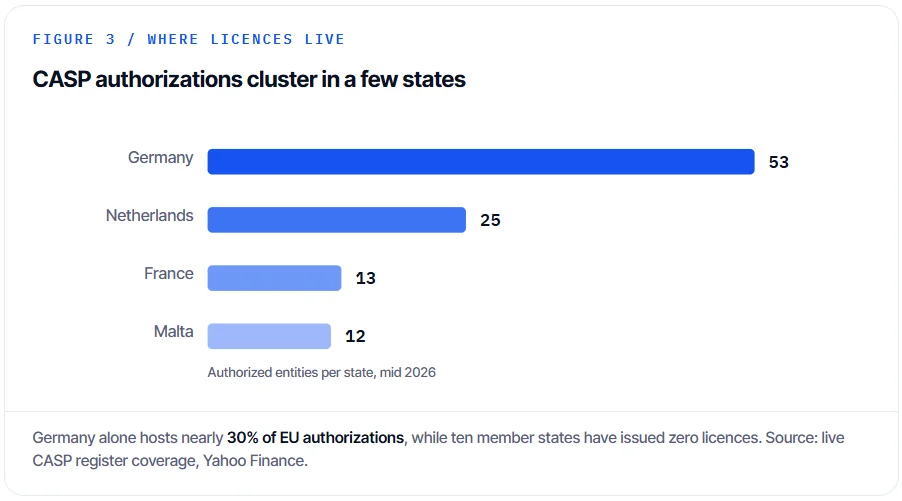
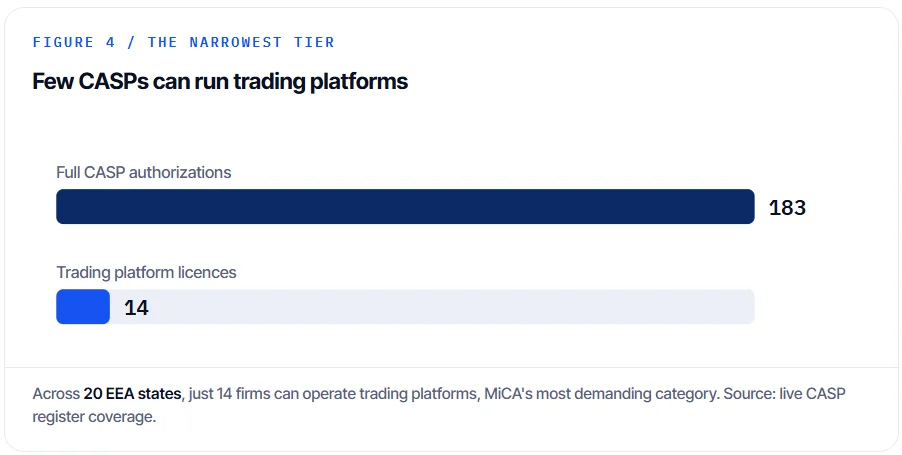
Full authorization does not guarantee every permission. The trading platform licence remains the hardest tier to win. Indeed, only 14 of 183 authorized entities hold it.
What comes next for Ripple
The road ahead looks clearer, though work remains. Ripple must close the final conditions on its Green Light Letter. After that step, full authorization can follow, much like the EMI process did.
For now, the market reaction stayed muted. XRP slipped about 3% on the news and traded near $1.10. Analysts stressed that the approval is a company licensing milestone, not a direct price catalyst.
Still, the strategic signal is strong. Ripple is building one regulated rail for Europe’s payment flows. Ultimately, that single integration could become its sharpest competitive advantage on the continent.




