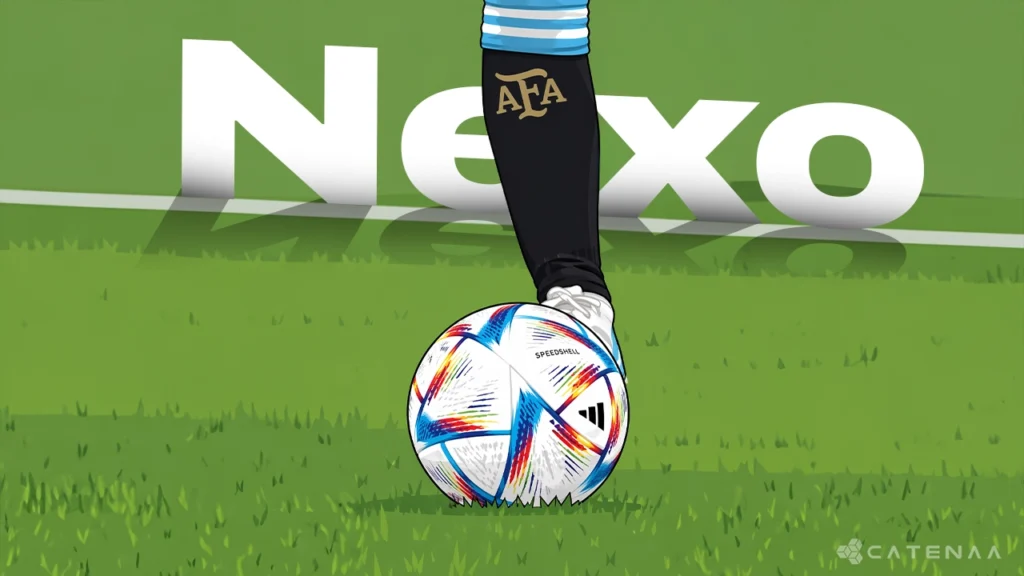


Catenaa, Thursday, April 23, 2026-Digital asset wealth platform Nexo has been named the Official Regional Digital Asset Partner of the Argentina Football Association, strengthening its presence in Latin America as global sports organizations increasingly integrate blockchain-related commercial partnerships ahead of the 2026 FIFA World Cup cycle.
The agreement links Nexo with the Argentina national football team through an official regional partnership focused on branding, digital engagement, and financial technology visibility. The announcement was made during a formal signing event in Buenos Aires attended by executives from both organizations.
The partnership expands Nexo’s footprint in South America, where the company has recently increased its operational presence through acquisitions and regional expansion efforts. These moves reflect a broader strategy among digital asset firms to align with high-visibility sports institutions as a way to strengthen mainstream recognition.
Argentina’s football team enters the upcoming World Cup cycle as defending champion, giving the partnership significant global exposure potential across international tournaments and promotional campaigns.
Sports and digital finance convergence accelerates
The collaboration highlights a growing trend in which sports organizations are forming structured partnerships with digital finance and blockchain-related companies. These agreements typically focus on marketing, fan engagement systems, and global brand positioning rather than direct financial services integration.
Football, in particular, has become a major platform for international digital brand expansion due to its global audience reach and commercial ecosystem. National teams and governing bodies are increasingly leveraging partnerships with technology-focused firms to expand revenue streams and digital engagement strategies.
In this case, the Argentina Football Association emphasized its broader international growth strategy, which includes partnerships with companies in innovation and technology sectors to strengthen global brand positioning.
Regional expansion shapes corporate strategy
For Nexo, the partnership represents a continuation of its expansion strategy in Latin America, a region that has seen increasing interest from digital asset companies due to strong retail adoption trends and growing fintech infrastructure.
The company has recently expanded its regional operations and established a stronger presence in Argentina, positioning the country as a key hub for South American growth. This aligns with broader industry patterns where firms are building localized operations to support regulatory engagement and market development.
Executives involved in the partnership described it as part of a long-term strategy to align with institutions that carry strong cultural and international influence, particularly in markets where sports play a central role in public engagement.
World Cup cycle drives commercial alignment
The 2026 FIFA World Cup cycle has become a focal point for global sponsorship activity, with brands across technology, finance, and digital services seeking association with national teams and tournament-related content.
As competition for global visibility increases, sports organizations are expanding partnerships with firms outside traditional sponsorship categories, including digital platforms and blockchain-related companies. These partnerships often focus on fan engagement tools, digital content distribution, and global marketing campaigns.
The Argentina partnership is part of this broader commercialization cycle leading into the tournament, where national teams are increasingly viewed as international brand platforms rather than purely sporting institutions.
Over the past several years, sports organizations have increasingly engaged with digital asset and blockchain-related companies for sponsorship and fan engagement initiatives. These partnerships have included digital collectibles, online engagement platforms, and new forms of fan interaction tied to major sporting events.
At the same time, global football governing bodies have explored digital infrastructure to expand audience participation and create new revenue models around media rights, collectibles, and digital experiences.
The integration of technology firms into sports sponsorship reflects a broader shift in how global sports properties are monetized, with emphasis on digital engagement and international reach. As the 2026 World Cup approaches, commercial partnerships between sports organizations and digital platforms are expected to expand further. National teams with strong global followings are likely to remain key targets for international brands seeking visibility across multiple markets.
The Argentina partnership demonstrates how sports institutions are positioning themselves within this evolving commercial landscape, where digital engagement and global branding are increasingly central to long-term strategy.




