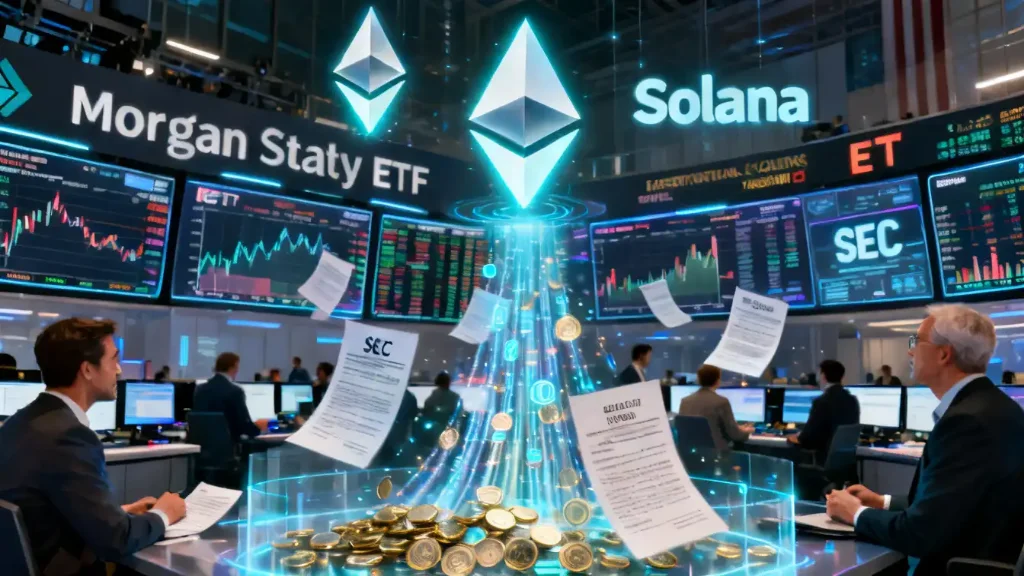


Catenaa, Sunday, June 28, 2026- Morgan Stanley has moved closer to launching spot Ethereum and Solana exchange-traded funds in the United States after submitting amended registration filings that reveal the lowest management fees currently proposed in either market.
The Wall Street giant filed updated S-1 registration statements with the U.S. Securities and Exchange Commission for its proposed Ethereum and Solana ETFs, marking the second round of amendments since the applications were first submitted in January.
The revised filings set sponsor fees at 0.14% for both funds, undercutting every existing Ethereum and Solana ETF competitor in the U.S. market and reinforcing Morgan Stanley’s aggressive strategy of competing on cost.
The proposed 0.14% fee would establish a new benchmark among crypto investment products.
In the Ethereum ETF sector, the current lowest fee is charged by Grayscale’s Mini Ethereum Trust at 0.15%. In the Solana ETF market, Franklin Templeton’s SOEZ fund currently holds the lowest fee position at 0.19%.
Morgan Stanley’s latest filings indicate the firm is seeking to replicate the pricing strategy that helped its Bitcoin ETF gain traction earlier this year.
The approach reflects intensifying competition among asset managers seeking market share in rapidly expanding cryptocurrency investment products.
The amended filings also provide new details regarding staking operations.
According to the registration documents, a portion of the Ethereum and Solana held by the funds will be staked to generate additional blockchain rewards.
The company has designated Figment Inc., Galaxy Blockchain Infrastructure LLC and Coinbase Canada Inc. as staking service providers.
Under the proposed structure, staking service providers and custodians will receive a 5% share of staking rewards generated by the funds.
The inclusion of staking functionality is particularly notable because it could enhance investor returns beyond simple asset appreciation while providing additional yield generated through blockchain network participation.
Industry observers often view repeated filing amendments as evidence of active discussions between applicants and regulators.
The latest submissions suggest Morgan Stanley continues to engage with SEC staff as part of the review process for both products.
The Ethereum ETF is expected to trade under the ticker symbol MSSE, while the Solana ETF would trade under the symbol MSOL if approved.
Although the SEC has not indicated when final decisions may occur, the updated disclosures are widely interpreted as a sign that the applications are advancing through the regulatory process.
Morgan Stanley’s latest ETF push follows the successful launch of its spot Bitcoin ETF earlier this year.
The Morgan Stanley Bitcoin Trust, trading under the ticker MSBT, debuted in April after being filed alongside the Ethereum and Solana products.
Like the proposed ETH and SOL funds, MSBT entered the market with a highly competitive 0.14% sponsor fee.
That pricing strategy appears to have delivered early results.
As of June 18, the Bitcoin ETF had accumulated approximately $300.7 million in net inflows, demonstrating investor willingness to consider lower-cost alternatives to more established products.
The crypto ETF market has evolved rapidly since the first spot Bitcoin funds launched in the United States.
Asset managers increasingly compete through lower fees, broader product offerings and additional features such as staking rewards.
Ethereum ETFs have already become a major battleground among issuers, while Solana ETFs are emerging as the next frontier for institutional crypto investment products.
The prospect of staking-enabled funds could further differentiate offerings as issuers seek to attract investors looking for exposure to blockchain-generated yields alongside digital asset price appreciation.
Spot cryptocurrency ETFs allow investors to gain direct exposure to digital assets through traditional stock market accounts without holding tokens themselves. Since the approval of spot Bitcoin ETFs in the United States, issuers have expanded efforts to launch similar products tied to Ethereum, Solana and other digital assets.
Staking is a process through which token holders help secure blockchain networks and validate transactions in exchange for rewards. Regulators have closely examined whether staking activities can be incorporated into exchange-traded products while maintaining investor protections and regulatory compliance.
Morgan Stanley’s latest amendments highlight growing confidence among major financial institutions that demand for diversified crypto investment vehicles will continue expanding as digital assets become more integrated into mainstream capital markets.