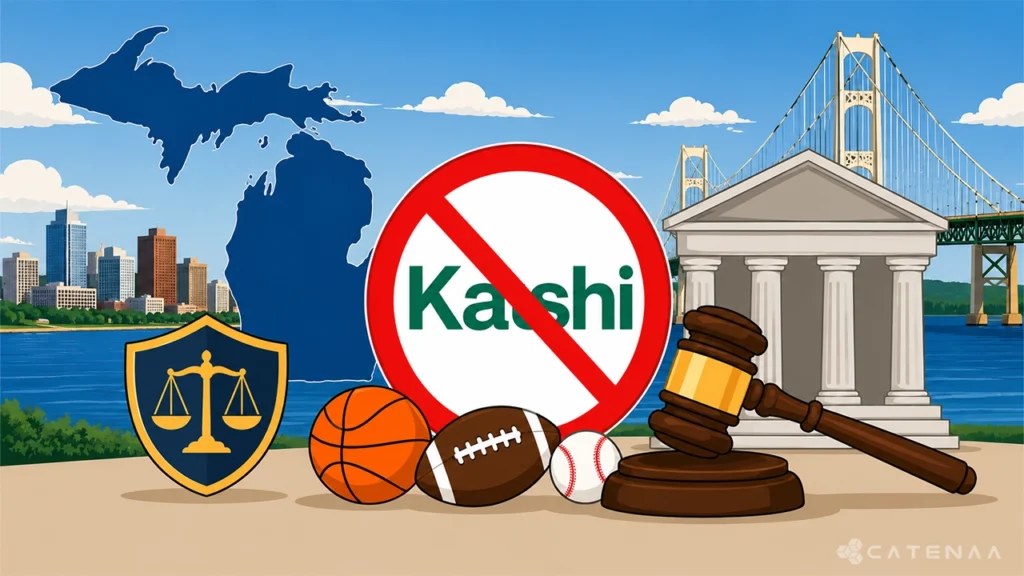


Catenaa, Wednesday, July 01, 2026- A Michigan judge has handed prediction market operator Kalshi a legal setback by ruling that a lawsuit challenging its sports event contracts should proceed in state court, escalating the growing conflict between federal commodities regulation and state gambling laws.
The decision allows Michigan Attorney General Dana Nessel’s lawsuit to continue in state court while preventing Kalshi from offering sports-related event contracts to Michigan residents during the legal proceedings.
The case is being closely watched across the digital asset and prediction market industries because it could influence how states regulate federally supervised event contracts.
Kalshi argued that, as a Commodity Futures Trading Commission (CFTC)-registered Designated Contract Market, its operations should fall exclusively under federal jurisdiction.
The court disagreed.
The lawsuit was originally filed in Michigan state court on March 3, alleging that Kalshi’s sports event contracts violate the state’s Lawful Sports Betting Act.
Kalshi sought to transfer the case to federal court, arguing that the Commodity Exchange Act preempts state gambling laws because the company operates under federal CFTC oversight.
However, Judge Paul L. Maloney ruled on June 26 that Kalshi failed to establish federal jurisdiction, sending the case back to Michigan’s state court system.
Importantly, the ruling does not determine whether Kalshi’s contracts are legal. Instead, it decides only that Michigan courts should hear the dispute.
The broader legal question over whether federal commodities regulation overrides state gambling statutes remains unresolved.
The Michigan decision adds to mounting legal pressure facing prediction market operators.
Earlier this month, Judge Maloney denied preliminary injunction requests filed by Polymarket and Robinhood involving similar sports-related event contracts.
In those rulings, the judge questioned whether certain sports prediction contracts qualify as regulated swaps under the Commodity Exchange Act.
Meanwhile, several states have intensified enforcement efforts.
Nevada previously obtained a temporary restraining order against Kalshi, while Massachusetts has also taken action against comparable prediction market platforms.
The cases illustrate the increasingly complex overlap between federal financial regulation and state gambling enforcement.
The outcome could have significant consequences for the emerging prediction market industry.
If courts ultimately determine that prediction platforms must obtain separate gambling licenses in every state where sports contracts are offered, operators would face substantial compliance costs and regulatory complexity.
Each state maintains its own licensing rules, fees and oversight standards, making nationwide expansion considerably more difficult.
The litigation is therefore being closely monitored by companies including Polymarket, Robinhood and other firms developing event-based financial products.
A ruling against Kalshi in Michigan state court could encourage additional state attorneys general to pursue similar legal actions.
At the center of the dispute is a fundamental regulatory question.
Kalshi maintains that its status as a federally regulated Designated Contract Market authorizes it to list event contracts under CFTC supervision.
Michigan argues that contracts tied to sporting events function as sports betting and therefore fall within state gambling laws regardless of federal registration.
Legal experts believe the eventual resolution could help define the boundaries between commodities regulation and state gaming authority as prediction markets continue expanding beyond traditional financial events.
The Michigan ruling narrows Kalshi’s legal options without ending the broader regulatory debate.
The company retains its federal registration and continues operating nationally, but uncertainty surrounding sports contracts may slow expansion until courts provide greater legal clarity.
As prediction markets gain popularity among retail traders and institutional investors, regulators at both state and federal levels are expected to play an increasingly active role in determining where financial innovation ends and gambling regulation begins.
Kalshi is a CFTC-regulated Designated Contract Market that allows users to trade event contracts based on the outcome of future events, including elections, economic indicators and sporting events. While the platform operates under federal commodities regulation, several US states argue that sports-related event contracts constitute sports betting subject to state gambling laws. The legal dispute reflects broader tensions between federal oversight of financial derivatives and state authority over gaming activities. The outcome could shape the regulatory framework governing prediction markets across the United States.




