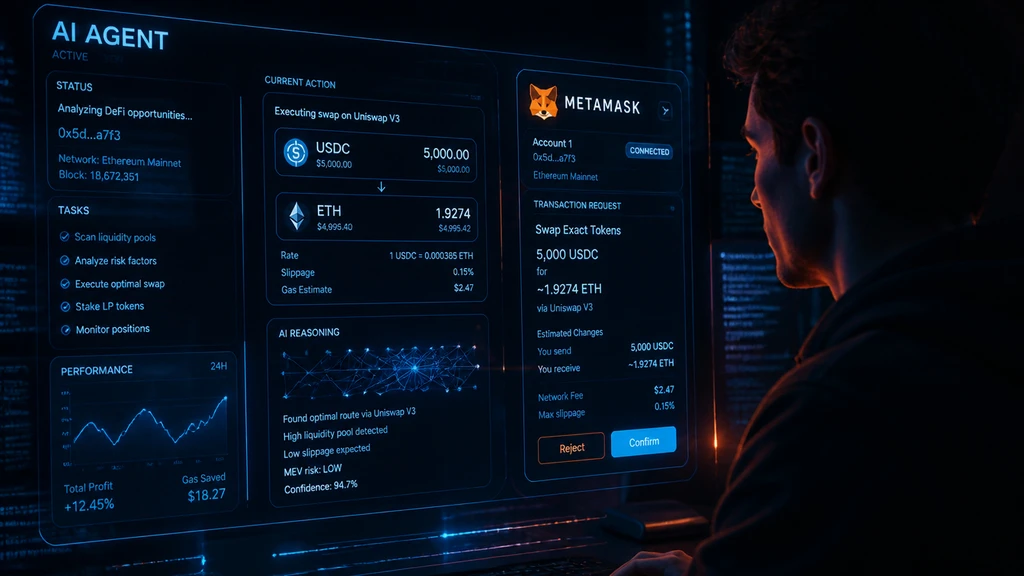


Catenaa, Monday, June 15, 2026- MetaMask has entered the emerging AI-driven finance sector with the launch of Agent Wallet, a self-custodial platform that allows autonomous software agents to execute decentralized finance transactions while keeping users in control of funds and approvals.
The new product positions Consensys-owned MetaMask at the intersection of artificial intelligence and decentralized finance, two sectors increasingly expected to converge as autonomous software systems take on more financial responsibilities.
The launch comes as industry forecasts project the global AI agent market could expand from $5.4 billion in 2024 to approximately $236 billion by 2034.
Agent Wallet is designed to allow AI-powered agents to interact directly with decentralized finance protocols, execute trades, provide liquidity, participate in prediction markets and manage on-chain financial activities without requiring constant user intervention.
Unlike traditional automated trading tools, the wallet is built specifically for autonomous AI systems capable of making decisions and carrying out transactions across multiple blockchain networks.
MetaMask currently supports Ethereum, Arbitrum, Optimism, Base, Polygon, Avalanche, BNB Smart Chain, Sei and Linea, alongside integration with Hyperliquid and other decentralized trading platforms.
The product also works with major AI frameworks including OpenAI Codex, Claude Code, Cursor, Openclaw and Nous Research Hermes Agent.
The launch reflects growing concerns about the risks associated with autonomous financial agents.
Industry analysts have warned that AI systems operating independently could become targets for malicious smart contracts, prompt injection attacks and fraudulent transactions.
MetaMask has attempted to address those concerns through mandatory security checks that cannot be bypassed.
Every transaction undergoes simulation testing, threat analysis powered by blockchain security firm Blockaid and maximum extractable value protection before execution.
The company is also offering protection of up to $10,000 for eligible transactions processed through its security framework.
Users can choose between Guard Mode and Beast Mode.
Guard Mode imposes spending limits, protocol restrictions and two-factor authentication requirements for activities outside predefined parameters.
Beast Mode offers greater autonomy for developers and active traders while still requiring approval for transactions identified as malicious.
The structure seeks to balance automation with user oversight, addressing one of the key challenges facing AI-driven financial systems.
MetaMask’s move highlights a broader shift occurring across the crypto industry as firms prepare for AI agents to become active economic participants.
While AI agents have traditionally focused on data analysis and workflow automation, blockchain infrastructure offers them the ability to hold assets, execute transactions and interact with financial markets around the clock.
That combination could create entirely new categories of autonomous financial activity.
The launch arrives as venture capital and technology companies increase investment in agentic AI, a sector focused on software capable of independently performing complex tasks.
For decentralized finance, AI agents could drive greater trading volumes, liquidity management and automated portfolio strategies.
However, the growth of AI-powered finance also raises regulatory, security and accountability questions that remain largely unresolved.
MetaMask’s Agent Wallet represents one of the industry’s earliest attempts to build a security framework around autonomous financial agents, potentially positioning the company as a key infrastructure provider if AI-driven DeFi adoption accelerates over the coming decade.
MetaMask is one of the world’s most widely used cryptocurrency wallets, serving millions of users across the Ethereum ecosystem. Its parent company, Consensys, was founded by Ethereum co-founder Joseph Lubin and has played a major role in developing blockchain infrastructure.
The launch of Agent Wallet reflects growing industry interest in combining artificial intelligence with decentralized finance. Market forecasts suggest AI agents could become increasingly important participants in digital economies as software systems gain the ability to transact, trade and manage assets independently. Security concerns remain a major challenge, with Gartner estimating that AI agent-related exploits could become a significant source of enterprise breaches by 2028.




