

Catenaa, Saturday, August 22, 2026- Kraken parent Payward reported $508 million in second-quarter adjusted revenue, up 17% from a year earlier, even as overall transaction volume fell and cryptocurrency spot trading weakened.
The results show the company becoming less dependent on the trading activity that historically drove crypto exchange earnings.
Payward reported $310 billion in total platform transaction volume for the quarter ended June 30, down 13% year over year.
At the same time, asset-based and other revenue increased to 60% of total revenue, compared with 55% a year earlier.
Traditional futures, equities and tokenized equities helped offset weaker crypto spot activity.
Payward also said Kraken gained spot-market share for a third consecutive quarter.
The changing revenue mix may be more important than the headline revenue growth.
Crypto exchanges traditionally earn heavily from transaction fees, leaving revenue exposed to sharp changes in market activity.
Payward is increasingly spreading that dependence across securities, derivatives, tokenized equities, custody, payments and infrastructure services.
Funded accounts increased 42% year over year to 6.6 million.
The company reported $40 billion in assets on its platforms at quarter-end.
Payward said customer balances grew for a fourth consecutive quarter when asset-price movements were held constant.
Its expansion in the European Economic Area also contributed to account growth following authorization under the European Union’s MiCA framework.
Revenue growth did not translate into stronger adjusted profitability.
Payward reported adjusted EBITDA of $23 million for the quarter.
Kraken reported $80 million in adjusted EBITDA for the second quarter of 2025, meaning the latest figure was about 71% lower year over year.
Adjusted revenue in that earlier quarter was $432 million.
The comparison shows Payward generating more revenue while retaining much less adjusted EBITDA.
Payward said in May that it aligned its cost structure with market conditions while protecting spending on its highest-priority growth businesses.
Both adjusted revenue and adjusted EBITDA are management-defined non-GAAP measures rather than standard accounting measures.
The narrowing profitability comes while Payward is spending heavily to build businesses beyond conventional crypto exchange activity.
The company has been assembling a broader trading and financial-services platform through product launches and acquisitions.
Payward completed its acquisition of derivatives venue Bitnomial on May 1.
The purchase gave the company a CFTC-regulated derivatives infrastructure stack in the United States.
It has since launched regulated spot-margin trading and perpetual futures products for eligible U.S. customers using Bitnomial infrastructure.
Payward also expanded into conventional equities and tokenized stocks.
Its xStocks business offers blockchain-based exposure to traditional securities for eligible customers outside certain restricted markets.
The company has also introduced tokenized pre-IPO exposure and expanded xStocks distribution across additional blockchain networks and wallet platforms.
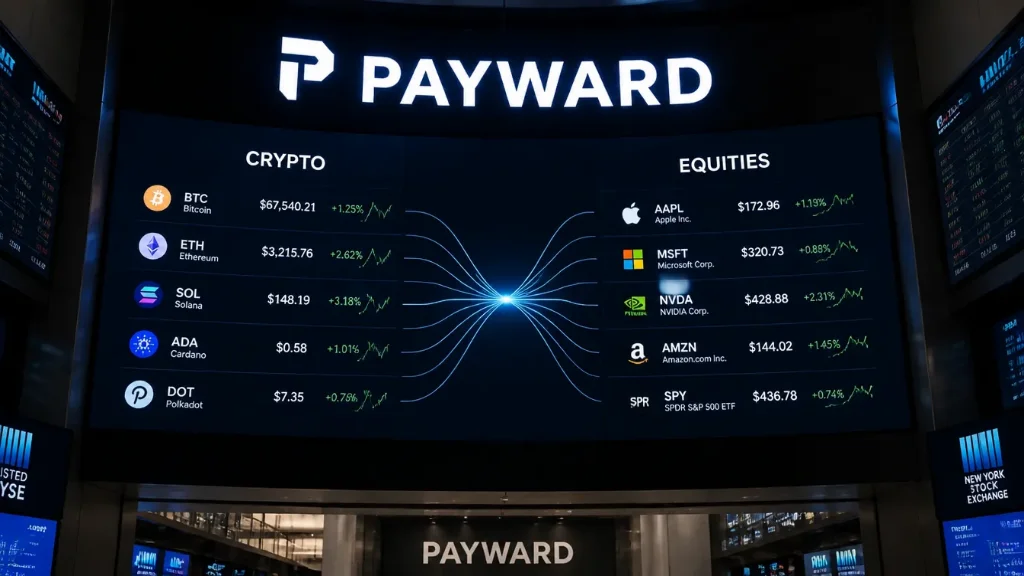
That strategy places Payward increasingly between conventional securities markets and crypto infrastructure rather than operating solely as a cryptocurrency exchange.
The expansion did not stop at the June quarter.
Payward completed its acquisition of Reap on July 1.
Reap focuses on stablecoin-native payments and card issuance, adding another payments layer to the group.
On July 27, Payward agreed to acquire Magic Labs’ wallet infrastructure business.
The planned acquisition would add embedded wallet technology to Payward’s business-to-business services.
Payward has also developed infrastructure that outside companies can use instead of building their own crypto systems.
The company said its first external partner went live on the Payward Services API during the quarter.
Its DeFi Earn Bitcoin Vault attracted about $400 million in deposits.
Payward also led a $20 million Series A investment in Onyx Odds, which is developing prediction markets using the company’s regulated U.S. derivatives infrastructure.
Co-CEO Arjun Sethi has framed the strategy around the convergence of asset classes, migration toward regulated venues and greater automation in financial markets.
Payward’s answer has been to place trading, risk management, settlement and compliance infrastructure beneath several consumer and institutional products.
The company now operates businesses including Kraken, NinjaTrader, xStocks, CF Benchmarks and other services.
That approach allows Payward to sell different financial products while relying on shared infrastructure underneath them.
The Q2 numbers offer early evidence that the strategy is changing the company’s economics.
Transaction activity fell, yet adjusted revenue rose.
Trading remains central to Payward, but revenue generated outside transaction-based businesses is taking a larger share.
The diversification also matters because Payward has been preparing for a possible public listing.
The company confidentially submitted a draft registration statement to the U.S. Securities and Exchange Commission in November 2025.
Its route to public markets has since been affected by market conditions, and Payward has not announced a firm listing date.
For prospective investors, the second-quarter results create two competing signals.
Revenue is growing even during weaker crypto trading, suggesting the company has developed businesses capable of cushioning a market downturn.
Adjusted EBITDA, however, has fallen sharply while Payward continues investing in acquisitions and new products.
That places attention on whether broader revenue can eventually translate into stronger margins.
Catenaa View
Payward’s second-quarter figures may mark an important stage in Kraken’s evolution from crypto exchange to multi-asset financial platform.
The company generated more adjusted revenue even as total platform transaction volume declined.
That is precisely what diversification is supposed to achieve.
But diversification carries costs.
Building derivatives infrastructure, equities trading, tokenization, payments, wallets and institutional services requires technology, regulatory licenses and capital.
The fall in adjusted EBITDA shows that revenue diversification should not be confused with improved profitability.
For Payward, the next test is whether the businesses now cushioning weaker crypto trading can also generate operating leverage as they scale.
The company is attempting something broader than surviving another crypto downturn.
It is positioning itself for a financial market where stocks, crypto assets, tokenized securities, stablecoins and derivatives increasingly trade through interconnected infrastructure.
If that model succeeds, Kraken’s future earnings may depend less on whether retail traders suddenly rush back into Bitcoin.
Kraken was founded in 2011 and is operated within Payward, which has expanded through acquisitions and product development across crypto, derivatives, equities, tokenized assets, payments and financial infrastructure. Payward reported $508 million in adjusted revenue for Q2 2026, compared with $432 million a year earlier. Funded accounts rose to 6.6 million, while total platform transaction volume declined to $310 billion. The group has recently acquired Bitnomial and Reap and agreed to acquire Magic Labs’ wallet infrastructure business. Payward has also been preparing for a potential initial public offering.




