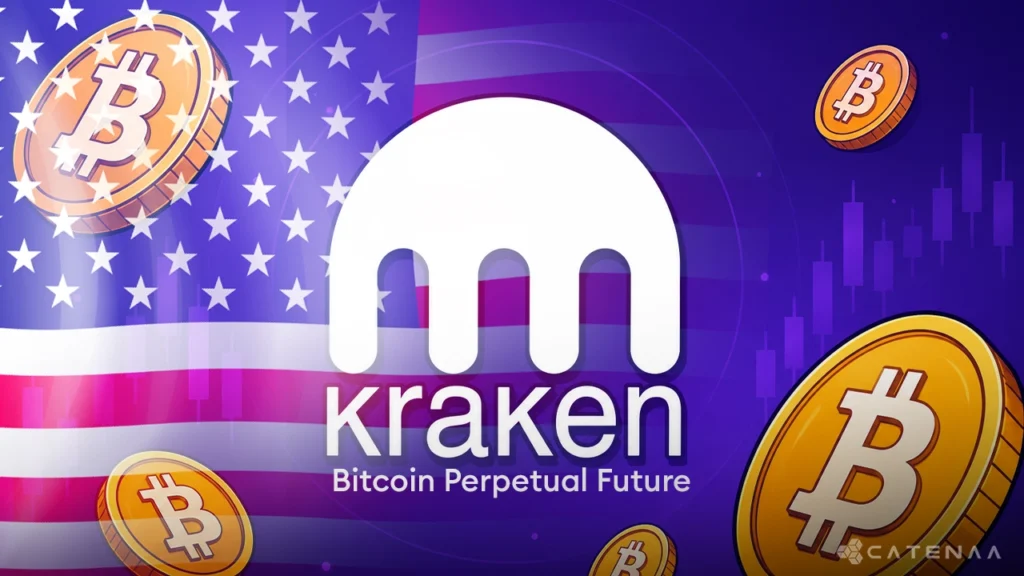


Catenaa, Saturday, June 20, 2026- Kraken has become the latest major cryptocurrency exchange to launch perpetual futures trading in the United States, signaling a dramatic shift in the country’s regulatory approach to digital asset derivatives and accelerating efforts to bring one of crypto’s most popular trading products onshore.
The launch follows Kraken’s acquisition of Bitnomial, a fully licensed Commodity Futures Trading Commission-regulated exchange, clearinghouse and brokerage, positioning the company to compete in what is rapidly becoming one of the most important segments of the digital asset industry.
The move comes just weeks after US regulators approved the first officially sanctioned Bitcoin perpetual futures products, ending years in which American traders largely relied on offshore exchanges for access to perpetual contracts.
Industry analysts view the development as another major step in the transformation of the United States into a regulated cryptocurrency trading hub.
Perpetual futures, commonly known as perps, are derivative contracts that allow traders to speculate on cryptocurrency prices without owning the underlying assets.
Unlike traditional futures contracts, perpetuals have no expiration date.
Instead, they use funding rate mechanisms to keep prices aligned with spot markets.
The structure has made perpetual futures the dominant trading instrument across global cryptocurrency markets.
On major international exchanges, perpetual contracts often generate significantly higher trading volumes than spot markets.
Their popularity stems from flexibility, leverage and continuous market exposure.
For years, US traders faced restrictions when attempting to access perpetual futures.
Many turned to offshore exchanges such as Binance and Bybit, creating regulatory concerns and exposing traders to additional operational risks.
American regulators generally resisted approving the products domestically.
That position began changing during 2026.
The CFTC has increasingly emphasized bringing crypto derivatives trading back into regulated US markets rather than allowing activity to remain concentrated offshore.
Kraken’s launch reflects that evolving policy direction.
A key factor enabling Kraken’s expansion was its acquisition of Bitnomial earlier this year.
Bitnomial holds the regulatory licenses required to operate futures and derivatives products within the United States.
The acquisition immediately strengthened Kraken’s ability to compete with traditional futures exchanges and emerging crypto derivatives platforms.
It also provided a regulatory foundation that many competitors currently lack.
Industry observers say the purchase could prove one of the most strategically important acquisitions in the company’s history.
Kraken is entering an increasingly competitive market.
Kalshi’s recently approved Bitcoin perpetual futures product generated more than $1 billion in trading volume shortly after launch.
Coinbase has also introduced long-dated futures products designed to replicate many characteristics of perpetual contracts.
Together, these developments are reshaping the US crypto derivatives landscape.
The emergence of multiple regulated providers gives traders alternatives to offshore venues while potentially attracting institutional participants that previously avoided unregulated platforms.
The rapid growth in trading activity suggests strong demand from both retail and institutional investors.
Perpetual futures are widely regarded as essential tools for risk management, hedging and capital-efficient trading.
Institutional investors have long used similar products in traditional financial markets.
The availability of regulated crypto perpetuals allows those strategies to be extended into digital assets under familiar compliance frameworks.
As more firms enter the market, analysts expect trading volumes to continue growing.
The launch also reflects a broader change in US cryptocurrency policy.
Rather than restricting innovation, regulators are increasingly attempting to integrate digital asset products into established financial systems.
Recent approvals involving perpetual futures, tokenized assets and cryptocurrency investment products suggest a more accommodating regulatory environment than existed in previous years.
The objective appears to be attracting trading activity, capital and innovation back into US markets.
That strategy could reshape global crypto competition.
The rise of regulated US alternatives may create challenges for offshore exchanges that have historically dominated perpetual futures trading.
Platforms such as Binance and Bybit built large global businesses around derivatives products unavailable in many jurisdictions.
As regulated competitors emerge, some of that trading volume could migrate back toward domestic markets.
The trend may also increase compliance expectations across the industry.
Kraken’s launch of perpetual futures trading in the United States marks another milestone in the mainstream adoption of cryptocurrency derivatives. Supported by its acquisition of Bitnomial and a more favorable regulatory environment, the exchange is entering a market that has traditionally been dominated by offshore platforms. As institutional participation grows and trading volumes expand, regulated perpetual futures may become one of the defining features of the next phase of cryptocurrency market development.
Perpetual futures originated within cryptocurrency markets and have become the most actively traded digital asset derivatives globally. Unlike traditional futures contracts, they do not expire and allow traders to maintain positions indefinitely through funding rate mechanisms. Regulatory concerns previously limited their availability in the United States, pushing many traders toward offshore exchanges. The CFTC’s recent approvals of regulated perpetual products represent a major policy shift designed to bring crypto derivatives activity into supervised markets. Kraken’s acquisition of Bitnomial and its earlier purchase of NinjaTrader reflect a broader industry trend toward building fully regulated digital asset trading ecosystems within the United States.