

May 09, 2026 – Coatue leads a landmark funding round. Kalshi’s valuation doubles in five months as institutional demand accelerates.
In Summary
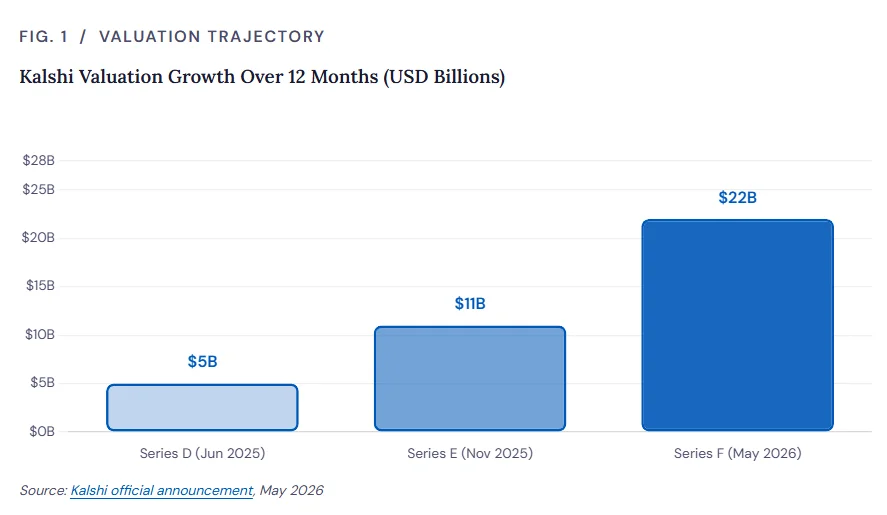
Kalshi closed a $1 billion Series F round led by Coatue at a $22 billion valuation.
The valuation doubled in five months, up from $11 billion in late 2025.
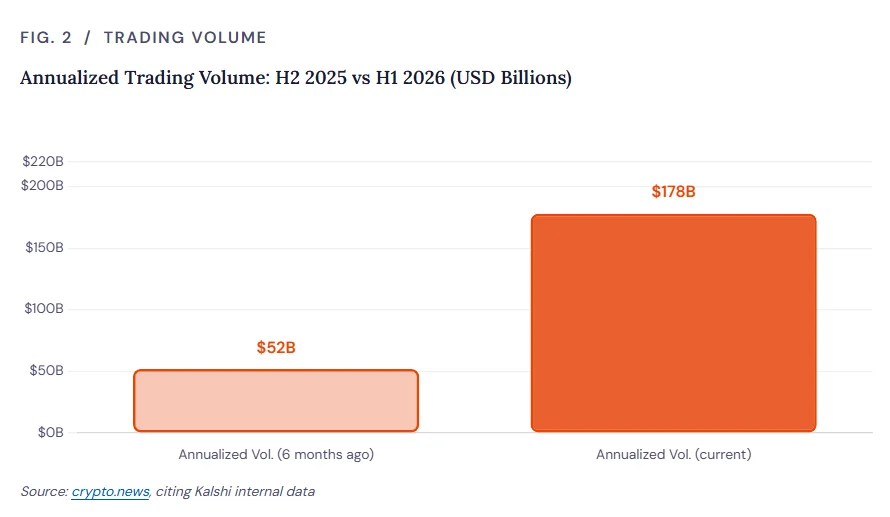
Annualized trading volume tripled from $52 billion to $178 billion in six months.
Institutional trading volume surged 800% over the same six-month period.
Kalshi controls more than 90% of all US prediction market activity.
Regulatory pressure remains, with cease-and-desist orders from multiple US states.

The Round at a Glance
Kalshi confirmed its $1 billion Series F on May 7, 2026. Coatue Management led the round. Sequoia Capital, Andreessen Horowitz (a16z), IVP, Paradigm, Morgan Stanley, and ARK Invest all joined.
The raise values the New York-based platform at $22 billion. That is double its $11 billion valuation from just five months ago. It is also roughly four times its $5 billion valuation from less than a year ago.
This is Kalshi’s third funding round in seven months. Each successive round has roughly doubled the company’s valuation. That pace is rare, even in today’s venture market.
“There are few categories in recent history that have scaled this quickly outside of AI. Event contracts could become a trillion-dollar market.
-“Tarek Mansour, CEO, Kalshi
Growth Metrics Back the Valuation
The fundraising narrative is supported by hard data. Kalshi’s annualized trading volume grew from $52 billion to $178 billion in six months. That represents a more than threefold increase.
Institutional volume grew even faster. It surged 800% over the same period. This reflects a structural shift, not just speculative retail activity.
Kalshi now reports $1.5 billion in annualized revenue. It serves two million monthly active users. The platform accounts for more than 90% of all US prediction market trading activity.
Who Is Investing
The investor roster spans traditional finance and crypto-native capital:

The mix of traditional and crypto-native investors signals broad confidence. Prediction markets are no longer a niche product. They are attracting mainstream institutional capital.
Where the Capital Goes
Kalshi plans to deepen adoption among hedge funds, asset managers, and proprietary trading firms. Insurance companies are also a target segment.
The company recently launched block trading capabilities. Its first bespoke institutional block trade was brokered by Greenlight, with Jump Trading providing liquidity on a carbon allowance contract. That deal marked a new chapter in the event-contract market structure.
Broker integrations are also expanding. Kalshi is building the infrastructure to support large-scale institutional order flow.
Regulatory Headwinds Persist
Regulatory Risk: Multiple US states have challenged Kalshi’s legal standing. The outcome of these disputes could affect platform operations and product scope.
Nevada, New Jersey, Illinois, and several other states have issued cease-and-desist orders or legal challenges against Kalshi. These states argue that some event contracts resemble unlicensed sports betting.
Kalshi disagrees. The company argues it operates under federal CFTC oversight. It says state-level challenges misread its jurisdictional structure. Litigation is ongoing.
The SEC added another layer of uncertainty this week. It delayed more than two dozen proposed prediction market ETFs. Regulators asked issuers for more information on product mechanics and investor disclosures.
Looking Ahead: Crypto Derivatives
Kalshi is reportedly exploring crypto perpetual futures as its next major product expansion. If it launches, the company would compete directly with Binance, Coinbase, and Kraken.
That move would transform Kalshi from a prediction market specialist into a broader derivatives venue. It remains in the early exploration phase, but the direction is clear.
The Bigger Picture
Prediction markets have arrived in the institutional mainstream. Kalshi’s $22 billion valuation is the clearest evidence yet. The platform has built liquidity, attracted elite capital, and established federal regulatory standing.
Regulatory uncertainty is the key risk. But the growth data suggest that institutional participants are pricing in a constructive outcome. The next twelve months will be decisive.