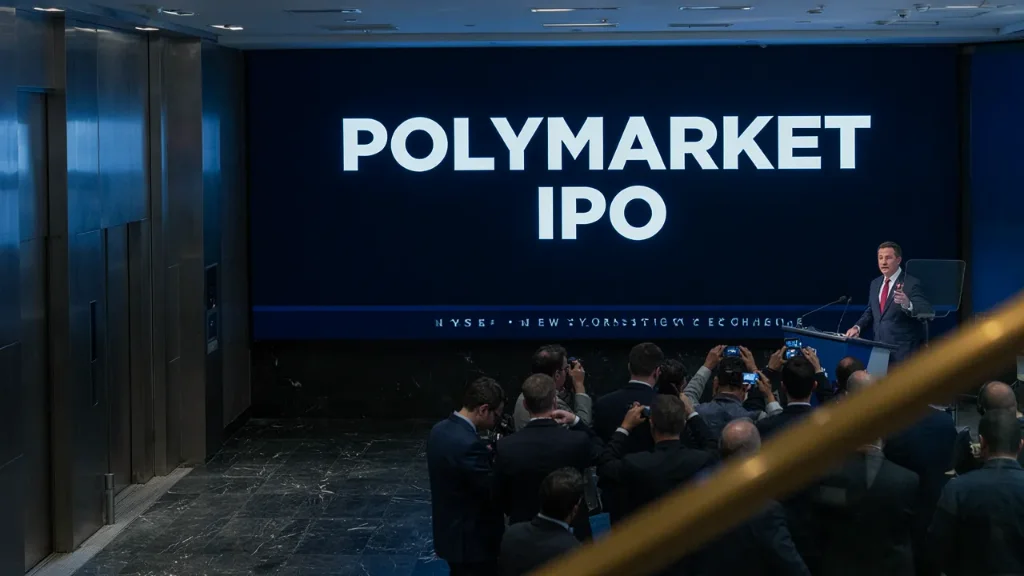


Catenaa, Thursday, August 20, 2026-JPMorgan Chase terminated Polymarket’s banking relationship over regulatory concerns but reportedly wants to compete for a role in any future initial public offering, exposing Wall Street’s complicated relationship with the booming prediction-market industry.
JPMorgan told Polymarket in October 2025 to find another banking provider, according to reports by the Financial Times and Reuters.
Polymarket subsequently moved the affected accounts to another lender.
Yet JPMorgan reportedly remains interested in becoming an underwriter if Polymarket eventually goes public.
The contrast is striking. JPMorgan was unwilling to retain part of Polymarket’s routine banking business because of regulatory concerns, but it has not closed the door on potentially lucrative investment-banking work.
The account closure did not end all business between the companies.
Polymarket says it continues to have operational relationships with JPMorgan across multiple entities, including arrangements involving customer fund flows.
CEO Shayne Coplan has also appeared at several JPMorgan events. He spoke at a private banking conference in Miami in February attended by wealthy clients.
The bank declined to comment publicly on the reports.
Neither the Financial Times nor Reuters reported that the account closure resulted from political pressure or a government directive.
Reuters said JPMorgan acted because of regulatory concerns.
The timing of the October 2025 decision is important.
Polymarket had previously agreed to stop serving U.S. customers after a 2022 Commodity Futures Trading Commission enforcement action.
The CFTC said Polymarket had operated an unregistered facility offering event-based binary options. The company paid a $1.4 million penalty and agreed to wind down markets that did not comply with U.S. derivatives rules.
Polymarket later found another route back into the American market.
It acquired QCX LLC and QC Clearing LLC in 2025. QCX had received CFTC designation as a contract market in July that year.
The business now operates as Polymarket US, giving the company a regulated platform for serving American traders.
The CFTC amended QCX’s designation in November 2025 to permit intermediated trading subject to regulatory requirements.
That means Polymarket today occupies a different regulatory position from the offshore platform JPMorgan was assessing when it closed the accounts.
The banking dispute comes as Polymarket’s valuation has risen rapidly.
The company is reportedly discussing another funding round that could raise about $1 billion at a valuation exceeding $20 billion.
Reuters reported earlier this month that the discussions remain at an early stage.
A valuation at that level would make any eventual Polymarket flotation one of the more closely watched financial-technology listings.
For major Wall Street banks, an IPO could generate underwriting fees and establish relationships around future capital raising, acquisitions and other financial services.
That helps explain why a bank can take a cautious position on deposit accounts yet remain interested in investment-banking work.
The two businesses carry different risk assessments and compliance requirements. The Polymarket case also enters Washington’s wider argument over crypto debanking.
Crypto executives have repeatedly accused U.S. banks of withdrawing services from digital-asset companies because of regulatory pressure.
President Donald Trump issued an executive order in August 2025 directing federal regulators to examine claims of politically or unlawfully motivated debanking.
JPMorgan has faced criticism after closing accounts connected with other cryptocurrency executives.
However, there is no reported evidence that its Polymarket decision was politically motivated.
Banks have argued that anti-money laundering rules, sanctions requirements and regulatory exposure can make some crypto relationships expensive to maintain.
Catenaa View
JPMorgan’s position illustrates an unusual feature of prediction markets’ move toward mainstream finance. A company can apparently be considered too difficult to bank in one part of a financial institution and attractive enough to court in another.
That distinction may become increasingly common as prediction-market companies grow.
Polymarket is no longer simply an offshore crypto platform operating through blockchain infrastructure. It now controls a CFTC-designated U.S. derivatives exchange and clearing operation and has attracted investment from major financial institutions.
Its regulatory exposure has not disappeared. Prediction markets continue to face disputes over sports contracts, state gambling laws, marketing practices and the boundary between federal derivatives regulation and state authority.
But those controversies have not prevented institutional money from pursuing the sector.
Intercontinental Exchange, the parent of the New York Stock Exchange, previously agreed to invest in Polymarket. The company’s valuation has since climbed further.
The JPMorgan episode therefore reveals more than a debanking dispute.
It shows how established finance may treat prediction markets simultaneously as a compliance problem, a competitor for trading activity and a potentially valuable investment-banking client.
Polymarket was founded in 2020 by Shayne Coplan and uses event contracts that allow traders to take positions on outcomes ranging from elections and economic events to sports and technology. The CFTC reached a $1.4 million settlement with the company in January 2022 over unregistered event-based binary options. Polymarket later acquired QCX and QC Clearing, creating a regulated route back into the U.S. market. QCX, now operating as Polymarket US, has been a CFTC-designated contract market since July 2025. Polymarket has since attracted institutional investment and is reportedly seeking fresh funding at a valuation above $20 billion.