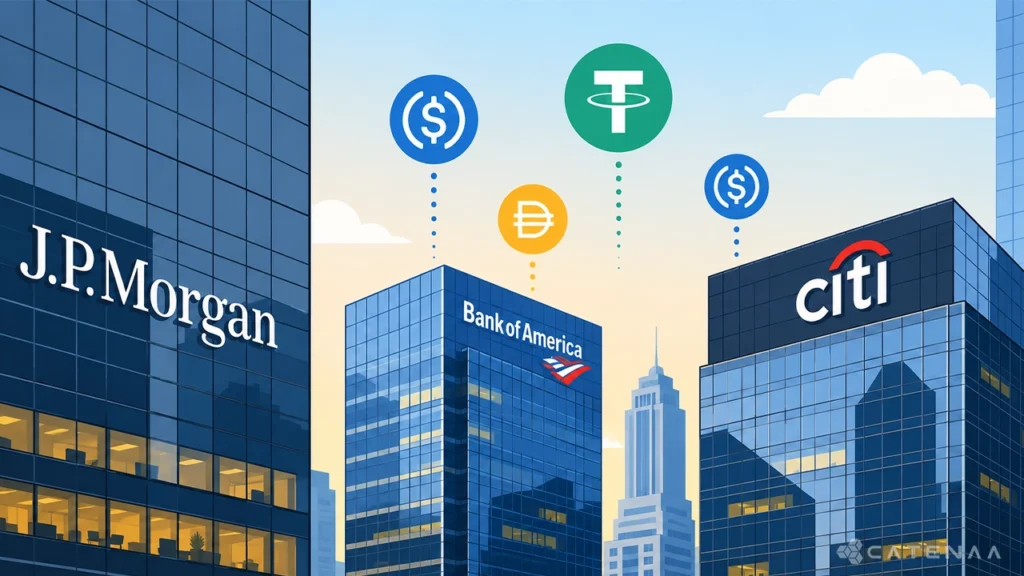


Catenaa, Saturday, June 13, 2026- Four of America’s largest banks are collaborating on a blockchain-based payment network that could reshape the future of digital money by offering tokenized bank deposits capable of settling transactions around the clock, potentially reducing the role of stablecoins in institutional finance.
JPMorgan, Citi, Bank of America and Wells Fargo are working through The Clearing House on what is known as a Tokenized Deposit Network (TDN), with a launch targeted for the first half of 2027.
The project seeks to modernize banking infrastructure by allowing regulated deposits to move across blockchain rails continuously, eliminating many of the timing restrictions associated with traditional payment systems.
Industry observers view the initiative as one of the banking sector’s most significant responses to the rapid growth of stablecoins and blockchain-based payments.
Unlike stablecoins, tokenized deposits are not separate digital assets.
Instead, they represent traditional bank deposits recorded on a shared blockchain ledger while remaining within the regulated banking system.
Customers would continue holding bank deposits, but settlement could occur instantly and continuously, including weekends and holidays.
Supporters argue the model combines blockchain efficiency with existing banking protections and regulatory oversight.
The approach allows banks to offer many of the advantages that have helped stablecoins gain traction among institutional users.
Stablecoins have become increasingly popular because they enable near-instant transactions regardless of banking hours.
Corporate treasury departments, multinational firms and digital asset businesses have increasingly relied on stablecoin networks for cross-border settlements and liquidity management.
The proposed Tokenized Deposit Network directly targets that use case.
By enabling 24-hour settlement within regulated banks, the system could reduce the need for businesses to move funds into stablecoins such as USDC or USDT.
Analysts say the initiative reflects growing concern among banks that stablecoins could gradually erode their role in payment infrastructure.
Several participating banks have already developed tokenized payment systems independently.
JPMorgan operates Kinexys and JPM Coin for institutional blockchain payments.
Citi has developed tokenized transfer services connecting major financial centers across multiple continents.
The new network would create interoperability between those previously isolated systems, allowing liquidity to move across institutions through a common framework.
The result could be one of the largest blockchain-based payment ecosystems operated by regulated financial institutions.
The project arrives as U.S. lawmakers continue debating digital asset legislation, including the Digital Asset Market Clarity Act.
Banks have generally supported regulated tokenized deposits while expressing concerns about stablecoins that offer interest-bearing features.
Industry experts note that a successful tokenized deposit network could strengthen arguments against a retail central bank digital currency by providing many of the same technological benefits through private-sector infrastructure.
That possibility may appeal to policymakers seeking payment modernization without introducing a government-issued digital dollar.
Beyond technology, the project highlights a broader battle over who controls the next generation of financial infrastructure.
Banks view tokenized deposits as a way to preserve their central role in payments, lending and liquidity management as blockchain technology becomes more widely adopted.
Stablecoin issuers, meanwhile, have spent years building networks that operate outside traditional banking rails.
The success or failure of the Tokenized Deposit Network could influence how trillions of dollars move through the global financial system over the coming decade.
The project remains in development, with launch plans targeting 2027.
If implemented successfully, the network could accelerate institutional blockchain adoption while intensifying competition between banks and stablecoin providers.
The initiative also underscores a growing trend: rather than resisting blockchain technology, major financial institutions are increasingly seeking to integrate it into existing financial infrastructure.




