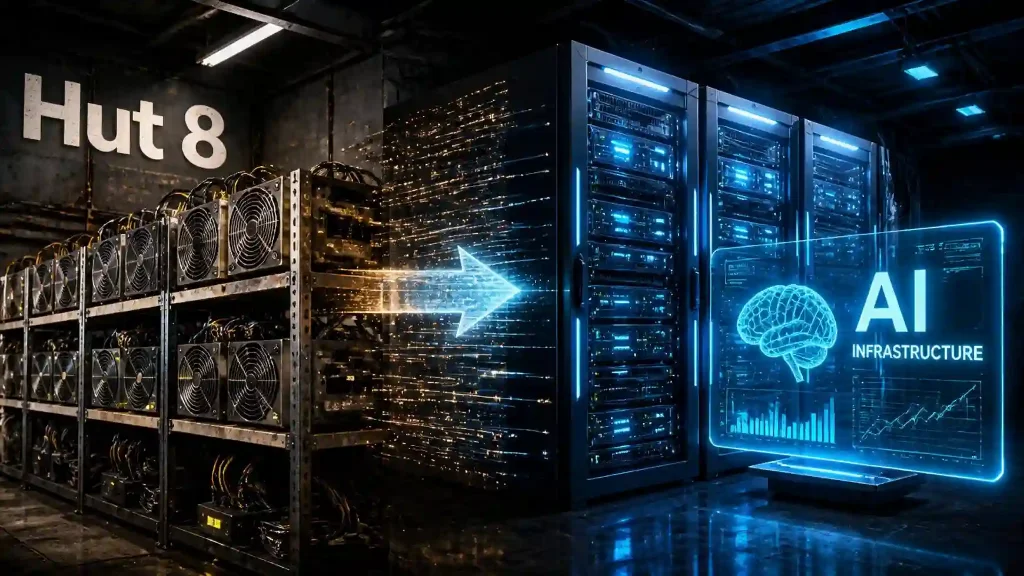


Catenaa, Monday, August 10, 2026– Hut 8 is accelerating its transformation from a Bitcoin mining company into an artificial intelligence infrastructure provider, expanding its AI data center development pipeline despite reporting second-quarter revenue that fell slightly short of Wall Street expectations.
The company reported $74.9 million in revenue for the second quarter, compared with $41.3 million during the same period last year. Although revenue nearly doubled year-on-year, it missed analysts’ expectations of approximately $80 million, sending Hut 8 shares down as much as 8% in early trading.
Hut 8 also recorded a net loss of $177.1 million, largely driven by $138.6 million in unrealized losses on its digital asset holdings rather than operating performance.
Despite the earnings disappointment, management emphasized continued expansion of its AI infrastructure business, which has become the company’s primary long-term growth strategy.
Chief Executive Officer Asher Genoot said Hut 8 has expanded its AI development pipeline to approximately 8.7 gigawatts, an increase of about 300 megawatts from the previous quarter.
The company is currently evaluating 11 exclusive development sites, each averaging more than 650 megawatts of potential capacity, while deliberately excluding additional acquisition opportunities and future expansion projects until they reach more advanced stages.
Hut 8 reiterated that it has fully commercialized its 1-gigawatt Beacon Point AI campus and now controls approximately 949 megawatts of contracted AI infrastructure capacity, representing an estimated $26.6 billion in future contract value.
Construction continues at both the Beacon Point and River Bend campuses, while financing arrangements for the second phase of Beacon Point are expected to be announced in the coming weeks.
Management also rejected suggestions that demand for AI computing infrastructure is weakening.
“Demand is robust. Everyone wants capacity,” Genoot said during the company’s earnings call, pointing to continued customer interest in large-scale AI data center projects.
The company also outlined a strategic shift in its Bitcoin business.
Rather than holding Bitcoin directly on Hut 8’s balance sheet, future cryptocurrency exposure will increasingly reside within American Bitcoin, Hut 8’s majority-owned subsidiary.
Genoot described Bitcoin as a treasury asset comparable to cash, indicating the parent company intends to focus more heavily on infrastructure development while housing its digital asset strategy within the subsidiary.
The results underscore Hut 8’s ongoing evolution from a traditional cryptocurrency miner into a diversified digital infrastructure company serving both blockchain and artificial intelligence markets.
Hut 8 was originally established as one of North America’s largest Bitcoin mining companies but has increasingly diversified into AI infrastructure as demand for high-performance computing accelerates. Many former cryptocurrency miners are repurposing existing power capacity and data center expertise to support artificial intelligence workloads, creating a new growth avenue less dependent on cryptocurrency price cycles.




