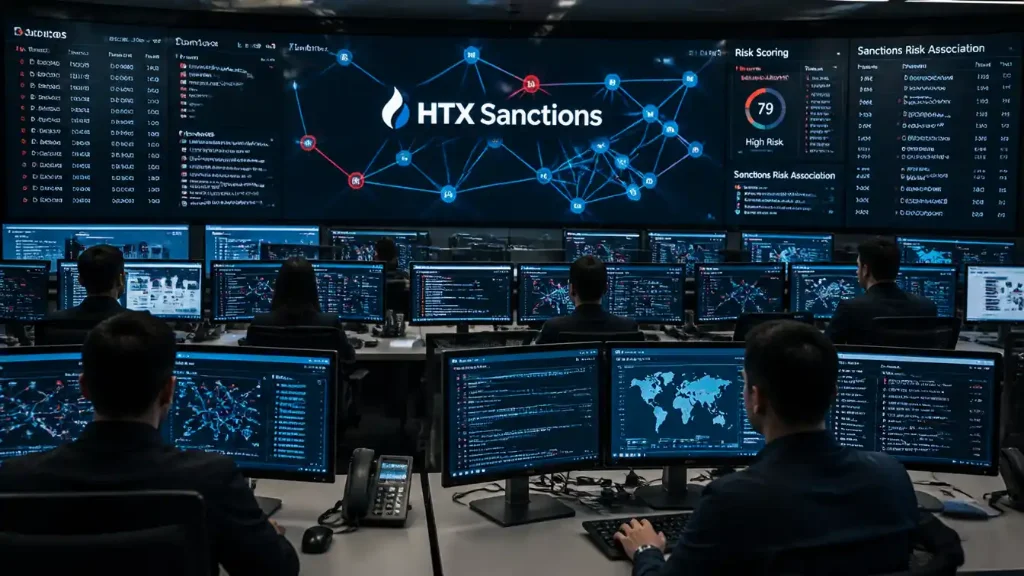


Catenaa, Friday, August 07, 2026- Cryptocurrency exchange HTX has significantly restructured its on-chain wallet infrastructure following sanctions imposed by the United Kingdom, prompting blockchain intelligence firm TRM Labs to warn that the changes are making sanctions compliance increasingly difficult for financial institutions and crypto service providers.
According to TRM Labs, HTX has rapidly rotated deposit and hot wallet addresses across multiple blockchain networks, including TRON, Ethereum, BNB Smart Chain and Solana, creating what the firm describes as a constantly shifting on-chain footprint.
The exchange, however, rejected suggestions that the activity was linked to sanctions evasion, stating that the wallet changes represent standard security procedures commonly used across the cryptocurrency industry.
Unlike traditional financial institutions that rely on static account identifiers, cryptocurrency exchanges can generate new blockchain addresses almost instantly.
TRM argues that this flexibility creates challenges for sanctions screening because address-based blocklists may become outdated within hours if exchanges continually rotate operational wallets.
The report suggests compliance systems increasingly need to identify behavioral patterns and infrastructure relationships rather than relying solely on previously sanctioned wallet addresses.
The restructuring follows sanctions imposed by the United Kingdom earlier this year against Huobi Global S.A., the legal entity associated with HTX.
British authorities alleged the exchange played a role in facilitating transactions linked to Russia’s financial sector following sanctions imposed over the war in Ukraine.
The UK measures represented one of the highest-profile sanctions actions targeting a major global cryptocurrency exchange.
However, comparable sanctions have not been imposed by U.S. or European Union authorities.
HTX maintains that the blockchain activity cited in the report reflects ordinary operational security.
Exchange representatives said rotating wallets is a common cybersecurity practice designed to improve asset protection, reduce operational risks and strengthen infrastructure resilience.
The company also reiterated previous statements that its global operations continue normally despite UK regulatory action.
The report illustrates how blockchain compliance is evolving beyond simple wallet screening.
As digital asset platforms adopt increasingly dynamic infrastructure, regulators, banks and compliance providers may require more sophisticated blockchain analytics capable of tracking transactional behavior rather than static wallet lists.
Industry analysts expect sanctions monitoring to become a growing competitive area for blockchain intelligence providers as institutional participation in digital assets expands.
Whether HTX’s wallet restructuring represents ordinary operational security or creates new sanctions compliance challenges remains a matter of interpretation.
What is clear is that blockchain compliance is becoming increasingly sophisticated, requiring regulators and financial institutions to monitor networks dynamically rather than relying on fixed wallet addresses alone.
HTX, formerly known as Huobi, ranks among the world’s largest cryptocurrency exchanges by trading volume and serves users across numerous jurisdictions. The platform supports multiple blockchain networks and offers spot trading, derivatives, staking and digital asset services. Growing regulatory scrutiny of global cryptocurrency exchanges has accelerated investment in blockchain intelligence, transaction monitoring and sanctions compliance technologies throughout the industry.