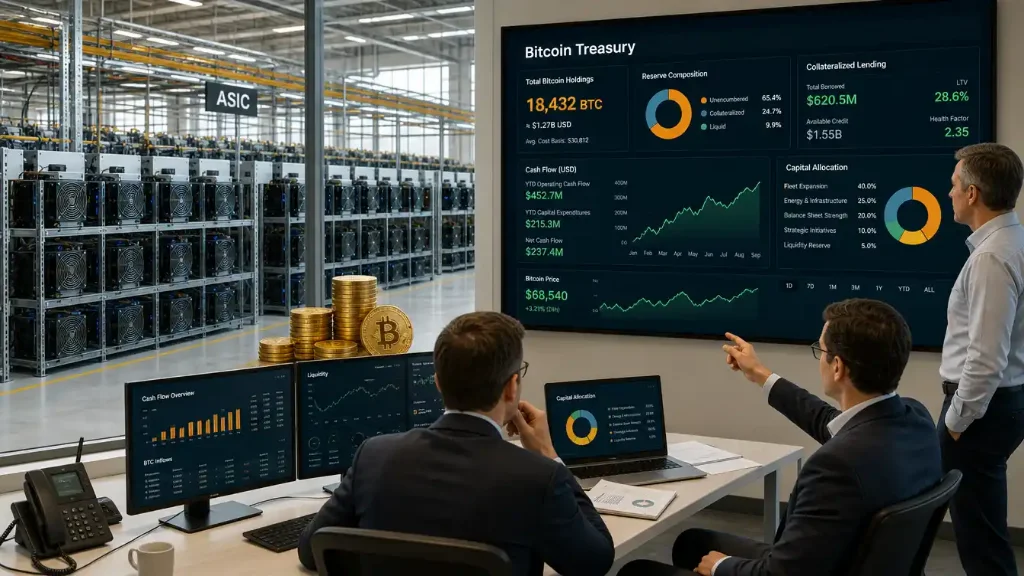


Catenaa, Tuesday, July 28, 2026- Bitcoin miners are increasingly being judged not only by how many coins they produce, but also by how effectively they manage the Bitcoin they hold, as post-halving economics reshape one of the cryptocurrency industry’s oldest businesses.
A new industry report by CoinRabbit and GoMining argues that shrinking block rewards, elevated mining difficulty and tighter operating margins are pushing miners to adopt treasury management strategies traditionally associated with public companies and institutional investors. Rather than maximizing production alone, successful operators are focusing on preserving liquidity, managing capital and avoiding unnecessary Bitcoin sales.
For much of Bitcoin’s history, mining success depended primarily on access to inexpensive electricity, efficient hardware and expanding hashrate.
Those factors remain fundamental, but they are no longer enough to guarantee profitability.
Following the 2024 Bitcoin halving, the block reward fell to 3.125 BTC, while network difficulty has remained near record levels, compressing margins across the industry and forcing operators to rethink how they deploy capital.
The report suggests the industry’s competitive advantage is shifting from operational efficiency alone toward financial discipline.
One of the report’s central arguments is that mined Bitcoin should no longer be viewed simply as inventory awaiting sale.
Instead, it is increasingly being treated as a treasury asset capable of supporting broader financing strategies.
Rather than selling newly mined Bitcoin to pay electricity bills, payroll and equipment costs, some miners are using their holdings as collateral to obtain liquidity while maintaining long-term exposure to the asset. That approach enables operators to preserve upside potential during market recoveries while reducing pressure to liquidate Bitcoin during weaker price cycles.
The strategy reflects a wider trend across the digital asset industry, where Bitcoin-backed lending is emerging as an alternative source of working capital.
The report identifies four characteristics that increasingly distinguish resilient mining businesses.
They include maintaining low operating costs, using collateral-based financing instead of forced asset sales, preserving liquidity through disciplined capital management and adopting a long-term investment approach that supports fleet upgrades and expansion during market downturns.
Collectively, those priorities resemble the financial management practices of mature corporations more than the operational focus that defined Bitcoin mining during its early years.
As institutional participation grows, miners are placing greater emphasis on balance-sheet strength and capital allocation alongside computing power.
The report argues that post-halving conditions reward operators capable of maintaining flexibility during periods of lower profitability.
Companies with stronger balance sheets can continue investing in newer, more efficient mining equipment while competitors facing cash shortages may be forced to reduce operations or sell Bitcoin at unfavorable prices.
That dynamic could accelerate consolidation across the mining industry, particularly as access to financing becomes an increasingly important competitive advantage.
The result is a business environment in which financial resilience matters as much as technological capability.
The changing role of treasury management mirrors developments elsewhere in the cryptocurrency sector.
Public companies holding Bitcoin, exchange-traded funds and institutional investors have all placed greater emphasis on long-term balance-sheet management over the past several years.
Mining companies now appear to be following a similar path by integrating treasury strategy into their core operating model rather than treating it as a secondary financial function.
Industry analysts increasingly view disciplined capital allocation as essential for navigating the cyclical nature of Bitcoin markets.
The evolution suggests Bitcoin mining is becoming a more sophisticated capital-intensive business.
Operational efficiency will remain essential because electricity costs, hardware performance and uptime continue to determine production economics.
However, the ability to manage liquidity, preserve Bitcoin holdings and deploy capital strategically may increasingly determine which companies outperform over multiple market cycles.
For investors, that means evaluating mining firms not only by hashrate growth and production volumes but also by treasury management, financing strategy and balance-sheet strength.
Bitcoin mining has evolved significantly since the network’s launch in 2009. What began as an activity performed by individual enthusiasts using personal computers has become a global industry dominated by specialized ASIC hardware, industrial-scale data centers and institutional operators. The 2024 halving reduced the block reward to 3.125 BTC, intensifying pressure on mining profitability by cutting newly issued Bitcoin while competition remained high. As margins narrowed, miners increasingly explored alternative financing methods, including Bitcoin-backed lending and long-term treasury management, to reduce reliance on asset sales and strengthen financial resilience.