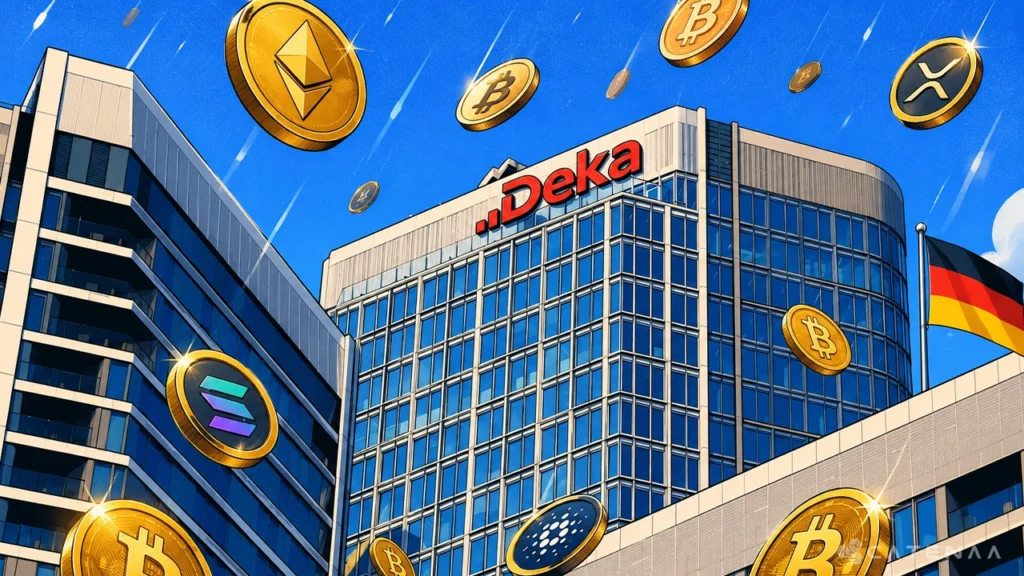


Catenaa, Wednesday, July 08, 2026- Germany’s largest savings and cooperative banking networks are preparing to offer cryptocurrency trading services to millions of retail customers, marking a dramatic shift in strategy after previously rejecting digital assets as too risky.
The move will enable customers of the country’s extensive banking sector to buy and sell cryptocurrencies directly through their existing banking applications, bringing regulated digital asset investing into one of Europe’s largest financial markets.
Germany’s Sparkassen savings banks collectively serve about 50 million customers, while the country’s cooperative banks maintain relationships with another 30 million clients. Together, the institutions represent one of the largest retail banking networks in Europe.
The rollout represents a notable reversal from 2021, when Germany’s savings banks abandoned plans to enter the cryptocurrency market because of concerns over volatility and investor protection.
The introduction of the European Union’s Markets in Crypto-Assets (MiCA) regulation has since created a comprehensive legal framework for digital asset services, encouraging traditional financial institutions to reconsider their approach.
Rather than directing customers to external cryptocurrency exchanges, both banking groups are developing regulated in-house trading platforms integrated into their existing mobile banking applications.
The cooperative banking sector has already taken a major step through DZ Bank’s meinKrypto platform, which operates within the VR Banking App.
The service allows customers to trade Bitcoin, Ethereum, Litecoin and Cardano through infrastructure licensed under MiCA by Germany’s financial regulator, BaFin.
Digital asset custody is handled by Boerse Stuttgart Digital, ensuring customer assets remain within Germany’s regulated financial system.
Meanwhile, DekaBank is developing a similar platform for the country’s network of approximately 340 Sparkassen institutions, with phased deployment expected later this year.
Participation remains voluntary, allowing each individual bank to decide whether to offer cryptocurrency services.
The initiative could substantially accelerate cryptocurrency adoption in Germany by allowing retail investors to access digital assets through familiar banking channels.
According to industry surveys, Germans place considerably greater trust in their primary banks than in standalone cryptocurrency exchanges, potentially lowering one of the main barriers to digital asset investment.
Although only around one-quarter of German consumers have invested in cryptocurrencies, banking executives expect regulated access through established institutions to encourage broader participation.
Despite embracing digital assets, banking organizations continue to warn customers about investment risks.
The German Savings Banks Association continues to classify cryptocurrencies as highly speculative investments that carry the possibility of complete capital loss.
Industry experts have also cautioned that customers who trust traditional banks may underestimate the volatility associated with digital assets simply because the services are offered through well-established financial institutions.
The rollout is therefore being positioned primarily for self-directed investors capable of assessing investment risks independently.
Germany’s banking expansion reflects a wider transformation occurring across Europe as MiCA provides regulatory certainty for cryptocurrency businesses.
Banks that previously remained cautious are increasingly integrating digital asset services into traditional financial products, including custody, trading and tokenized securities.
The trend is expected to intensify as more European financial institutions seek to compete with cryptocurrency-native platforms while maintaining regulatory compliance.
The European Union’s Markets in Crypto-Assets (MiCA) regulation established the world’s first comprehensive legal framework governing cryptocurrency issuers and digital asset service providers. Since taking full effect, MiCA has encouraged banks, asset managers and payment companies to expand into regulated cryptocurrency services. Germany has emerged as one of Europe’s most active digital asset markets, supported by a strong regulatory environment and established financial institutions. The integration of cryptocurrency trading into mainstream banking applications represents another milestone in the convergence of traditional finance and blockchain-based financial services, potentially expanding retail participation while placing digital assets under familiar regulatory oversight.