


August 16, 2026 – Stablecoin supply has shrunk for the first time since 2022. However, the monthly settlement volume just set a record. The GENIUS Act yield ban rewired how holders behave. Now the big banks are building rails of their own.
In Summary
Supply fell to roughly $300 billion by late July 2026. That is about $10 billion below the May peak, and June’s $7.7 billion drop was the largest since May 2022.
Volume moved the other way. Stablecoins settled a record $1.79 trillion in June, up 63% on the month and 125% on the year.
The GENIUS Act yield ban is the cause. Holders moved idle cash into tokenised Treasury funds paying close to 4%.
Rulemaking sped up sharply. The OCC proposed 12 CFR Part 15 on 25 February 2026. FDIC, FinCEN, OFAC and Treasury proposals soon followed.
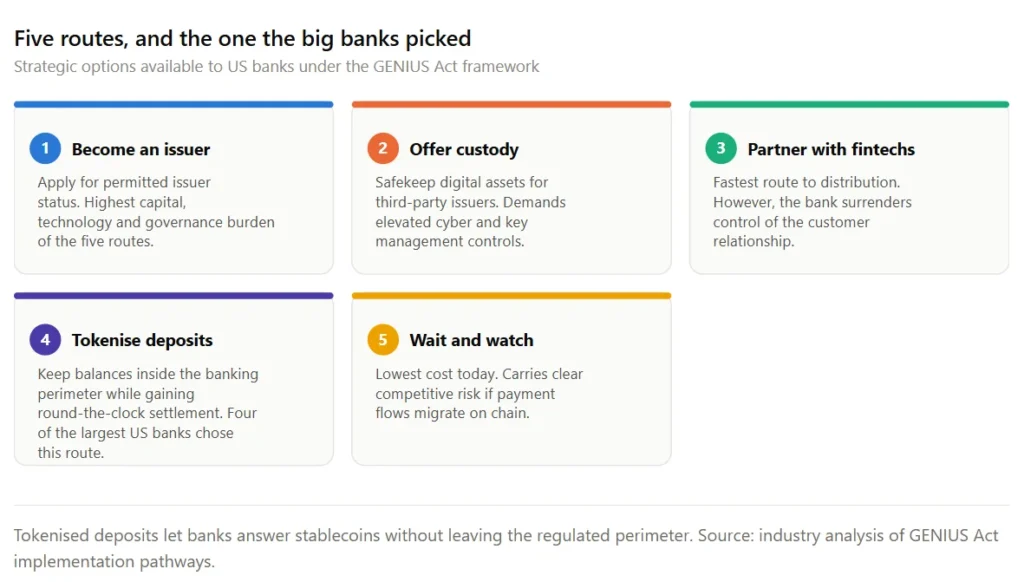
Four of the largest US banks are building a shared tokenised deposit network. The Clearing House will run it, with launch set for the first half of 2027.
For investors: total supply has stopped being a useful growth gauge. Volume and licensed issuer margins matter far more.
Stablecoin supply is shrinking. Trading volume, meanwhile, has never been higher. That split now defines the market. The GENIUS Act banned yield on payment stablecoins. Holders then acted just as you would expect. They moved idle cash into tokenised Treasury funds. Only working capital stayed on chain.
Supply fell for the first time in four years
Total stablecoin supply slipped to roughly $300 billion by late July 2026. That figure sits about $10 billion below the May peak. June alone brought a $7.7 billion drop. No monthly fall had been that large since the Terra collapse in May 2022.
Both big issuers felt it. Tether’s USDT fell from around $190 billion in May to roughly $184 billion. That is a drop of close to 3%. Circle’s USDC slid from a March peak near $80 billion to about $74 billion.
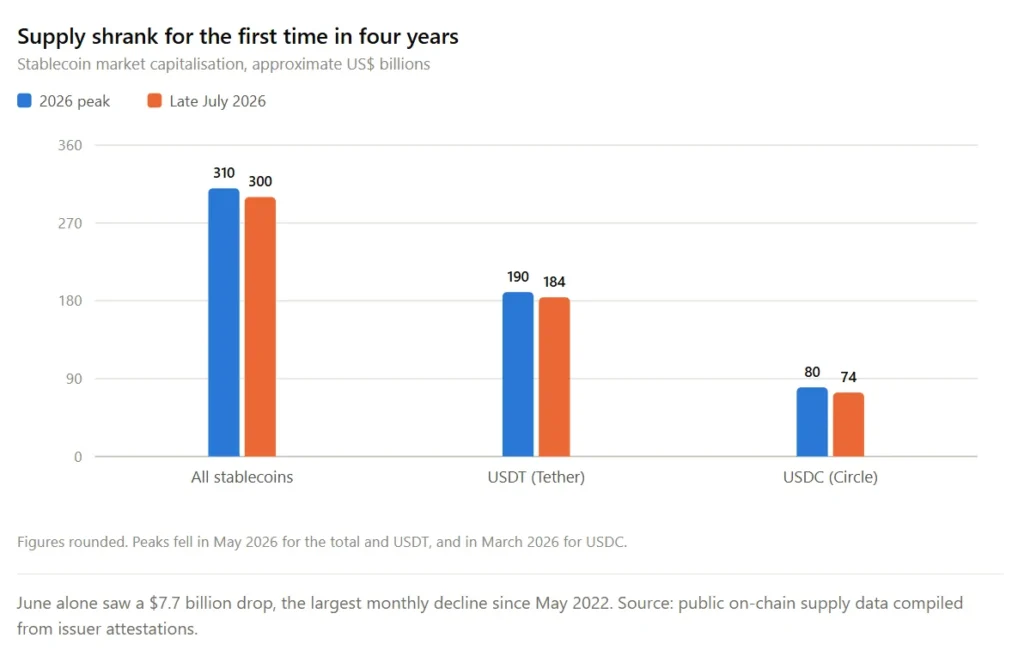
Headlines read the squeeze as a warning sign. The data underneath tells a different story.
Volume tells the opposite story
Stablecoins settled roughly $1.79 trillion in adjusted volume during June 2026. That total set an all-time record. It also marked a 63% jump in May. Against the same month a year earlier, the gain reached 125%.
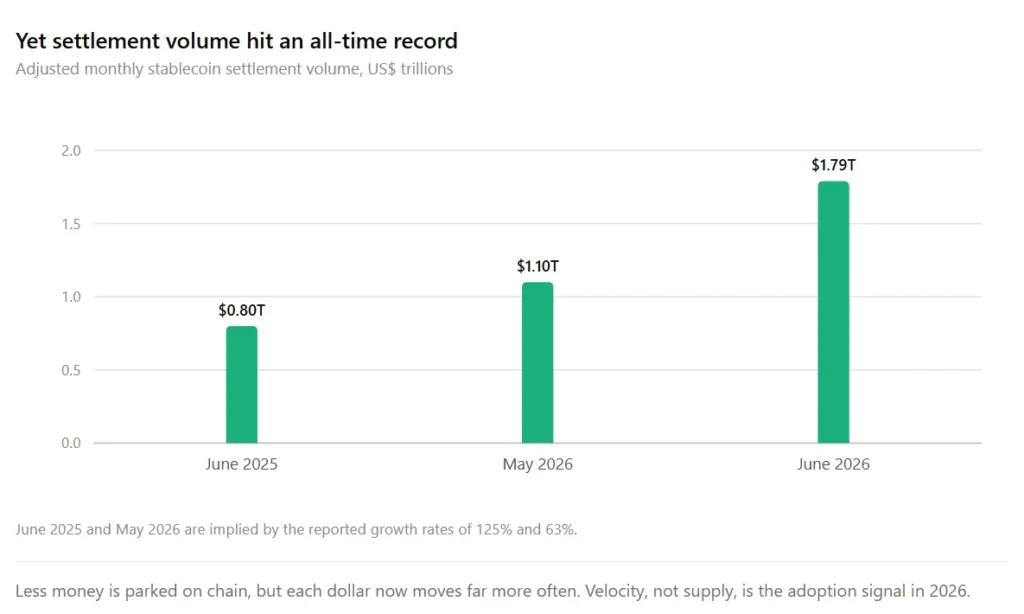
Money therefore moved faster while supply fell. Each stablecoin dollar now turns over far more often than it did. Circle’s USDC also pulled ahead of Tether on volume, even though it holds less than half the supply.

The yield ban explains the rotation
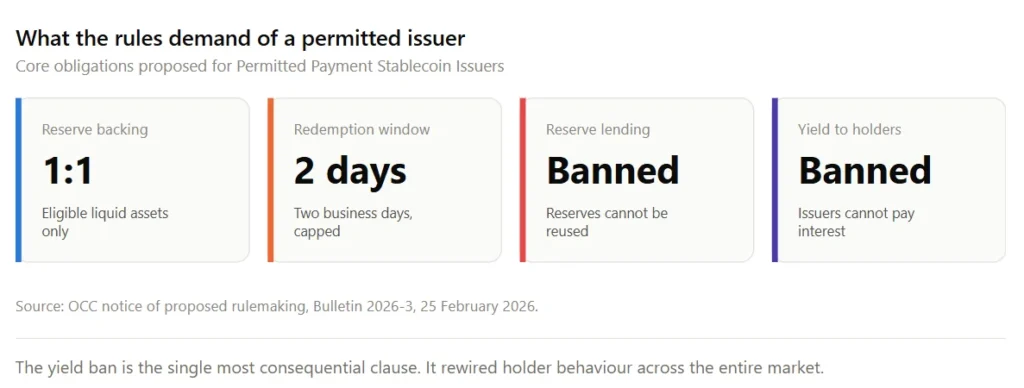
Congress passed the GENIUS Act on 18 July 2025. The law bars licensed issuers from paying interest to holders. Tokenised Treasury funds face no such limit. Many of them now yield close to 4%.
Company treasurers acted on that gap. They parked spare cash where it earns something. So the on-chain float now looks far more like a payments balance than a savings pot. That shift is a feature of the design, not a flaw in it.
Regulators moved unusually fast
The GENIUS Act gave agencies roughly one year to write the rules. They largely did so. On 25 February 2026, the Office of the Comptroller of the Currency put out a broad notice of proposed rulemaking. The plan creates a new 12 CFR Part 15. It covers reserves, payouts, custody, capital, and licence steps.
Other agencies moved fast, too. The FDIC opened proposals for state-chartered banks in December 2025 and April 2026. FinCEN and OFAC put out a joint money laundering and sanctions rule on 8 April 2026. The Treasury took up state sign-off standards that same month.
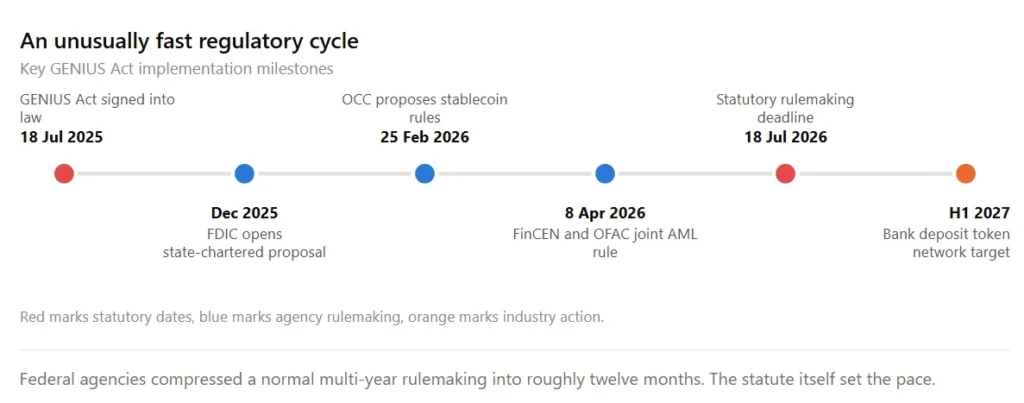
The duties that follow are heavy. Licensed issuers must hold one-to-one backing in safe, liquid assets. They must also meet cash-out requests within two business days. Lending or reusing reserves is banned outright.
Banks are building competing rails
Big banks did not sit still. JPMorgan, Citi, Bank of America, and Wells Fargo are building a shared tokenised deposit network. The Clearing House, which already runs CHIPS and the RTP network, will operate it. Pilots come first. A wider launch is set for the first half of 2027.
Tokenised deposits differ from stablecoins in one key way. They stay claims on insured bank deposits. They also keep the same credit, accounting, and legal treatment. Banks can therefore offer instant settlement without pushing money outside the safety net.
What investors should take from this
Judge adoption by volume, not by supply
Anyone valuing this sector on total supply is measuring the wrong thing. Volume, active wallets and merchant tie-ups now carry the signal. Supply just shows how much yield-free money people are willing to hold.
Issuer economics are tied to interest rates
Licensed issuers earn their income on reserve assets. Higher policy rates therefore lift margins, while cuts squeeze them. Given the current split at the Fed, that income line looks steadier than it did a year ago.
Compliance cost is becoming the moat
Round-the-clock security, blockchain analytics, and daily reserve checks all cost real money. Smaller issuers will struggle to carry that load. A market of a few licensed players therefore looks likely.
The risks worth watching
Three risks deserve attention. First, the 2027 bank network could pull large corporate flows away from public stablecoins. Second, rules abroad keep drifting apart, which makes cross-border payments harder. Third, the market stays top-heavy, since two issuers still hold most of the supply.
Even so, the direction of travel looks clear. The rules have not killed the stablecoin. Rather, they have turned a risky savings tool into a payments utility. For investors, that is a sturdier business. It is also a far less exciting one.




