

July 02, 2026 – Five former Ethereum Foundation researchers have launched a new nonprofit, arriving as the foundation cuts its budget and its ranks.
In Summary
EthLabs launched as an independent nonprofit led by five former Ethereum Foundation contributors.
Its debut landed one day before the foundation confirmed a 20% headcount cut.
Vitalik Buterin says the foundation will trim its budget by roughly 40% this year.
SharpLink, Bitmine and Joe Lubin are among the backers of the new lab.
EthLabs targets institutional adoption, scaling and interoperability work.
Ethereum’s governance is entering a new chapter. A group of five former Ethereum Foundation researchers has founded EthLabs, a nonprofit research organization. Moreover, its launch coincides with the biggest leadership transition the ecosystem has seen in years.
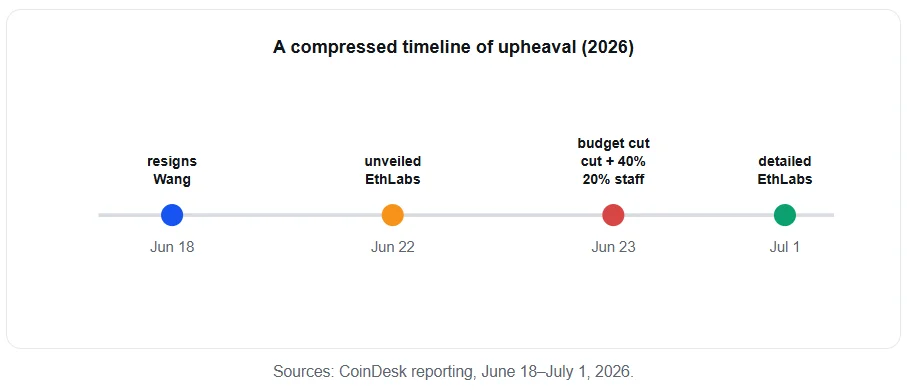
The timing draws attention. EthLabs unveiled itself on June 22, just one day before major layoffs hit the foundation. Consequently, many observers now question whether the two events are linked.
The founders reject that framing. Instead, they describe EthLabs as a response to a changing ecosystem. In their view, the foundation is narrowing its focus while adoption needs grow. Therefore, new organizations must step in.
A foundation in transition
The foundation is shrinking on purpose. On June 23, it confirmed a 20% reduction in headcount. In addition, co-founder Vitalik Buterin said annual spending would fall by roughly 40% this year.
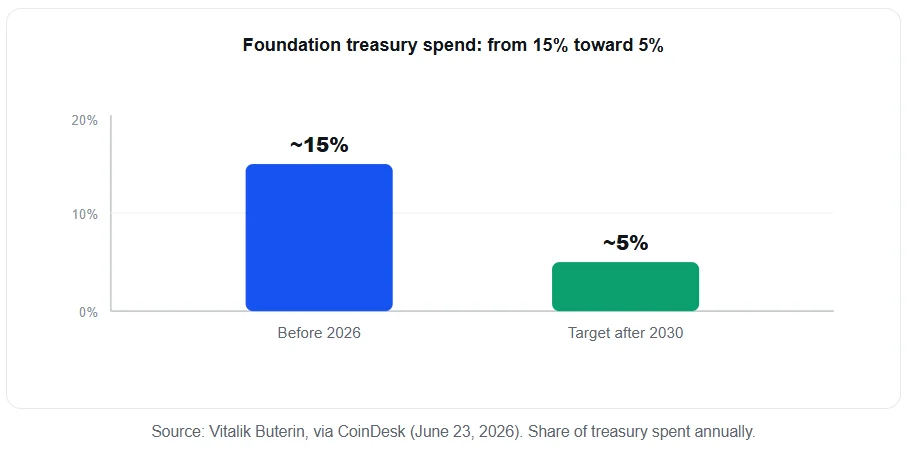
Buterin framed the reset as a move toward an endowment-style model. Specifically, the foundation aims to spend about 15% of its treasury before 2026, then near 5% a year after 2030. Therefore, the cuts reflect strategy rather than pure crisis.
Buterin also acknowledged real losses. He praised departing engineers who spent years on the protocol. Nevertheless, he defended the leaner path. He wants a “lean-and-done” future focused on security and high-impact upgrades.
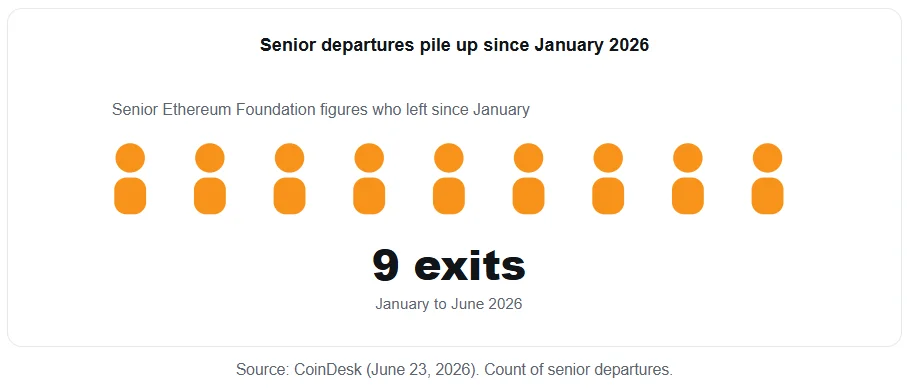
Leadership turnover has been steep. Since January, at least nine senior figures have departed the organization. Notably, co-executive director Hsiao-Wei Wang resigned on June 18, days before the EthLabs reveal.
Who is backing EthLabs
Big holders stand behind the new lab. Its funders include SharpLink Gaming and Bitmine Immersion Technologies, two of the largest corporate ether treasuries. Furthermore, Consensys CEO Joe Lubin, Anchorage Digital, Octant and SNZ joined the effort.
The founders are well known in protocol circles. They are Ansgar Dietrichs, Barnabé Monnot, Caspar Schwarz-Schilling, Josh Rudolf and Julian Ma. Previously, they worked on scaling, data availability, protocol economics and network finality.
Why the market matters
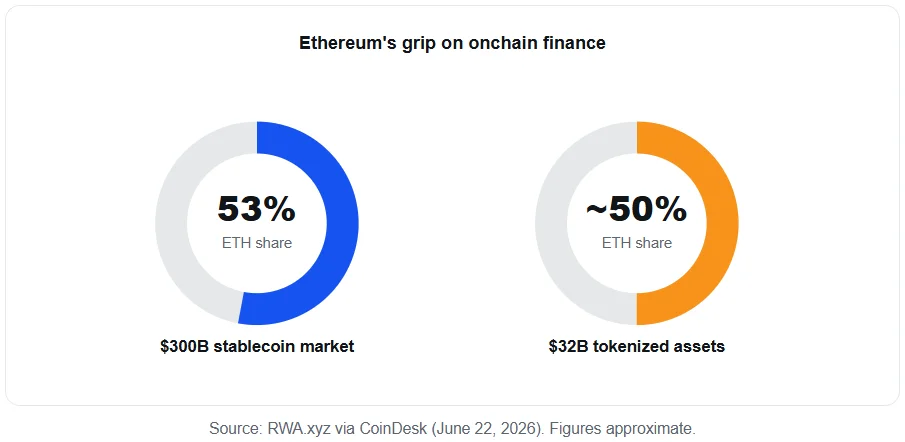
Ethereum’s institutional footprint gives the lab a clear target. The network dominates the $300 billion stablecoin market with a 53% share. Additionally, it hosts roughly half of the $32 billion tokenized asset market, RWA.xyz data shows.
Dietrichs argues that Ethereum’s build-out era is closing. “The decade of infrastructure build-out of Ethereum is coming to an end,” he told CoinDesk. Instead, he sees institutional adoption as the next frontier.
His reasoning rests on progress already made. Smart contracts, DeFi and layer-2 networks now exist at scale. As a result, the harder task becomes real-world use. In short, plumbing paves the way for adoption.
Complement, not replacement
EthLabs rejects the idea that it will supplant the foundation. Rather, Dietrichs says the lab will fill gaps the foundation now leaves open. “We’re not trying to create a competing vision for Ethereum,” he said.
Those gaps sit in practical, adoption-focused engineering. For example, the lab plans to work on layer-1 scaling, faster settlement and interoperability. Meanwhile, it will engage with financial institutions to explore blockchain infrastructure.
Independence is central to the pitch. Funders receive transparency reports, yet they hold no direct control over technical priorities. Ultimately, all research will be published openly, the organization said.
Still, the funding mix invites scrutiny. SharpLink and Bitmine hold large ether treasuries. Naturally, both benefit if the network thrives. However, EthLabs says an external grants process keeps its agenda at arm’s length.
What comes next
Success is far from guaranteed. As a young nonprofit, EthLabs must secure sustainable funding while demonstrating real impact. Still, its arrival signals a broader shift toward shared “steward” responsibility across Ethereum.
Competitive pressure sharpens the stakes. Rival chains court the same institutions and developers. Meanwhile, Ethereum must defend its lead in stablecoins and tokenized assets. For that reason, adoption-focused research now carries real urgency.
The foundation, in turn, is repositioning as a guardian of core values. These include credible neutrality, self-sovereignty and open infrastructure. Going forward, independent labs like EthLabs may carry much of the adoption workload.
Lubin frames this as a “multi-node” model. Under it, several steward organizations work together to protect and grow the network. Thus, responsibility spreads beyond a single institution. For Ethereum, that shift could prove defining.
The bigger picture
Dietrichs sees a missing narrative for Ethereum. “Ten years ago, everyone knew what Ethereum was trying to achieve,” he said. Today, he argues, the shared answer feels less clear.
He offers an ambitious vision to fill the gap. In his words, Ethereum could sit “at the very center” of an onchain financial system. Whether EthLabs helps deliver that future now remains an open question.




