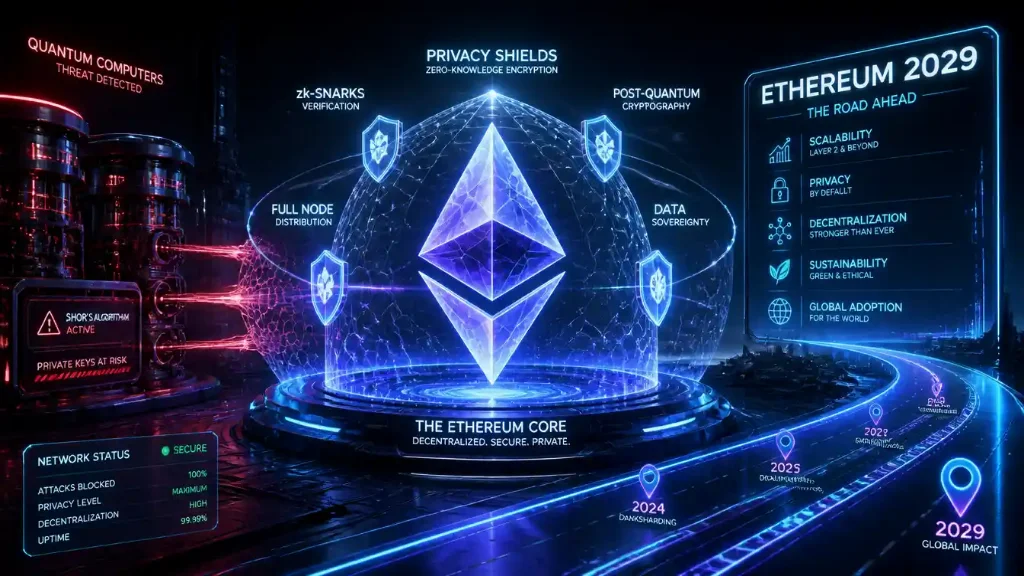


Catenaa, Tuesday, August 11, 2026-Ethereum is putting privacy and protection against future quantum computers at the center of its development plans, marking a shift from the network’s earlier focus on scaling and efficiency.
Ethereum co-founder Vitalik Buterin highlighted the change Monday while comparing Ethereum’s 2023 development roadmap with the Ethereum Foundation’s latest “Strawmap,” a working guide covering upgrades through 2029.
Several technologies now considered important were either absent or insufficiently developed when the earlier roadmap was created.
Privacy represents one of the biggest changes.
Public blockchains allow anyone to inspect transactions and, in many cases, trace balances and activity between addresses. That transparency can become a barrier when individuals, businesses and financial institutions require confidentiality.
Ethereum’s newer roadmap therefore treats stronger privacy protections as part of the network’s basic infrastructure rather than an optional feature.
Proposed technologies include privacy pools and systems designed to let users move assets without revealing their entire transaction history.
Censorship resistance is another part of that effort.
Ethereum plans to introduce Fork-Choice Enforced Inclusion Lists, or FOCIL, as a headline feature of the planned Hegota upgrade. The mechanism is intended to make it harder for individual block producers to exclude legitimate transactions.
Quantum computing has also moved higher on Ethereum’s agenda.
Today’s blockchain security depends heavily on cryptographic techniques that could eventually become vulnerable to sufficiently powerful quantum computers.
Although such machines do not currently pose an immediate threat to Ethereum, upgrading a blockchain after the threat becomes practical could be considerably more difficult than preparing beforehand.
Ethereum is therefore working toward becoming quantum-safe as part of a broader redesign Buterin has described as “Lean Ethereum.”
The project could eventually alter much of Ethereum’s underlying architecture.
Longer-term possibilities include replacing or heavily modifying the Ethereum Virtual Machine, the computing environment responsible for running Ethereum applications.
Alternative architectures such as RISC-V and leanISA are being considered.
Zero-knowledge technology has also advanced enough to assume a larger role than Ethereum developers expected in 2023.
SNARKs, which allow information to be mathematically verified without revealing all the underlying data, could support future scaling systems and native rollups.
Artificial intelligence is another new element.
Buterin expects modern AI systems to assist developers with formal verification, a process used to mathematically check whether software behaves as intended.
The roadmap also includes newer concepts such as blob and gas futures that were not part of Ethereum’s development discussion three years ago.
Not every earlier proposal has survived. Some planned improvements to the Ethereum Virtual Machine have been reduced or replaced as developers identified alternative approaches.
The changes indicate that Ethereum’s long-term challenge is expanding beyond transaction speed.
Developers are increasingly preparing the network for threats and requirements that could emerge as blockchain infrastructure becomes more widely used by institutions and individuals.
The Strawmap remains a working document rather than a fixed timetable, meaning priorities and implementation dates can change.
But the direction is becoming clearer.
Ethereum’s next phase is being designed around a network that can scale while also keeping transactions private, resisting censorship and surviving a future in which today’s cryptography may no longer be sufficient.




