

July 30, 2026 – Ethereum perpetual futures are moving toward faster networks. However, Ethereum may still anchor the market through settlement, liquidity, and collateral.
In Summary
Perpetual futures reward speed, low fees, deep liquidity, and reliable liquidation systems.
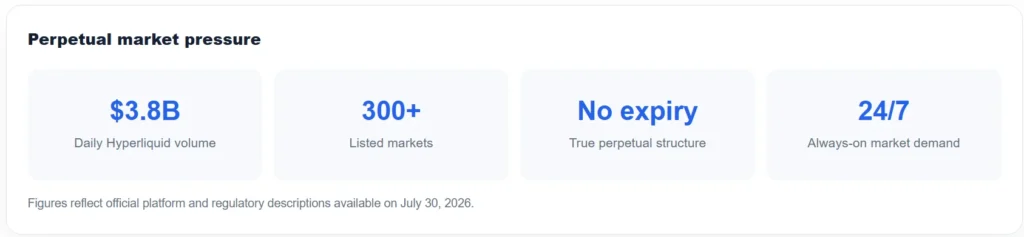
Hyperliquid’s official site recently displayed $3.8 billion in daily volume and more than 300 markets.
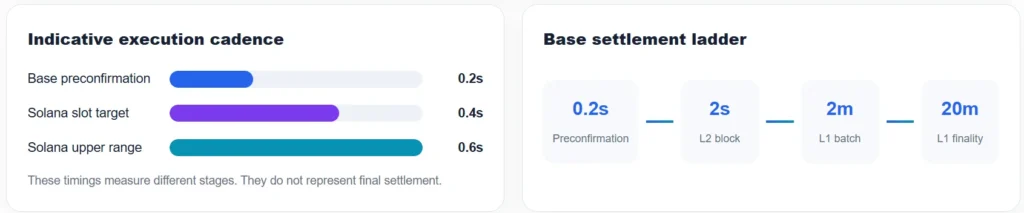
Base offers roughly 200 millisecond preconfirmations, while Solana targets slots lasting about 400 to 600 milliseconds.
Ethereum’s strongest opportunity now sits below trading screens, inside settlement, collateral, and liquidity infrastructure.
Perpetual futures reshape crypto trading
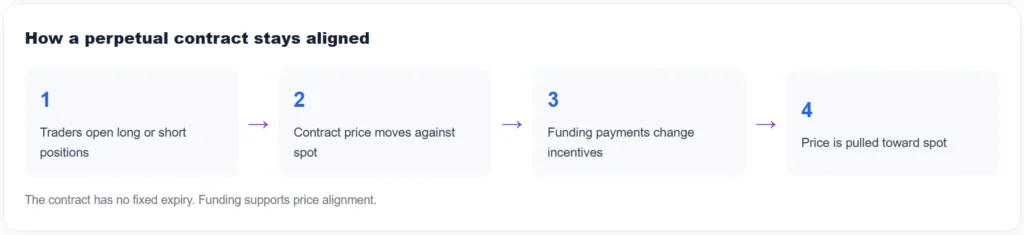
Perpetual futures have become one of crypto’s most important trading products. They let traders hold leveraged exposure without a fixed expiry date.
A funding mechanism keeps contract prices close to spot markets. In May, the U.S. derivatives regulator approved a true bitcoin perpetual contract. That decision confirmed that the product is moving beyond offshore crypto venues.
It also increased pressure on blockchains to support continuous, high-speed markets. This trend matters because perpetual exchanges process constant order updates, margin changes, and liquidations.
A delayed transaction can quickly become a loss during volatile trading. Therefore, execution quality now shapes where users, liquidity providers, and market makers choose to trade.
Speed is pulling trading away from Ethereum
Ethereum built the foundations of decentralized finance. However, its base layer was not designed for rapid order-book trading. Newer venues now optimize specifically for speed and low transaction costs.
Hyperliquid illustrates that shift clearly. Its official website recently showed $3.8 billion in daily volume across more than 300 markets.
Those figures reveal how quickly specialized infrastructure can attract active traders. Meanwhile, Base gives users preconfirmations in about 200 milliseconds.
Solana targets slots lasting roughly 400 to 600 milliseconds. These measures are not identical, yet both show the market’s direction.
Traders increasingly expect near-instant feedback, predictable fees, and continuous availability. Ethereum cannot win that race by forcing every trade onto its main chain.
Ethereum’s role is moving down the stack
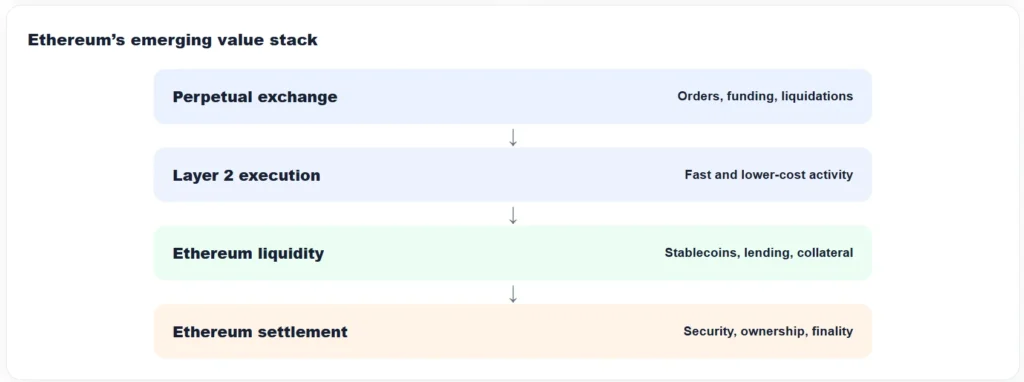
The more realistic strategy places Ethereum beneath the trading venue. Layer 2 networks can process orders, while Ethereum provides settlement and economic security.
The Ethereum Foundation now describes L1 and L2 networks as complementary systems. Its March strategy paper placed Ethereum at the center of settlement and liquidity.
That division of labor could support Ethereum perpetual futures without concentrating execution on mainnet. It also mirrors traditional finance.
Fast trading systems often sit above slower clearing and settlement infrastructure. The exchange handles speed, while the lower layer protects ownership and finality.
Ethereum could serve that lower function for onchain derivatives. Stablecoins, tokenized assets, and lending markets already create useful collateral around the network.
The opportunity still carries major risks
Ethereum’s new position is not guaranteed. Liquidity remains fragmented across different layer 2 networks. Users often bridge assets, switch wallets, and manage several transaction environments. That friction weakens the experience compared with a single integrated trading chain.
Moreover, settlement value does not always produce direct value for ETH holders. Layer 2 networks can reduce mainnet fees while keeping most activity elsewhere.
Therefore, Ethereum must improve interoperability and preserve strong demand for ETH-based settlement. Security also matters.
Perpetual markets use leverage, automated liquidations, and insurance systems. A technical failure can spread losses quickly during market stress. Institutional users will demand predictable execution, transparent risk controls, and reliable custody.
What investors should watch next
The next phase will test whether Ethereum can become essential without becoming the fastest venue.
Three indicators deserve close attention. First, track whether layer 2 perpetual exchanges gain deeper liquidity. Second, watch whether collateral moves easily across Ethereum networks. Third, examine whether more trading systems settle data or value on Ethereum.
Funding rates will offer another signal. Extreme rates can reveal crowded positioning and fragile leverage. Open interest growth should also be matched by stronger liquidation and insurance systems.
Regulation will also influence this market. The recent U.S. approval of a true bitcoin perpetual contract expands the addressable audience.
However, regulated platforms may favor stronger controls and lower leverage. Ethereum’s security-first design could become more valuable under that environment.
Ultimately, Ethereum perpetual futures may succeed through specialization, not domination. Execution can occur elsewhere, while Ethereum supports the underlying financial foundation.