


June 15, 2026 – The Strategy chairman points to surging Bitcoin dominance. The data backs part of his claim, yet the headline number needs context.
In Summary
Michael Saylor says investor confidence in Ethereum has collapsed.
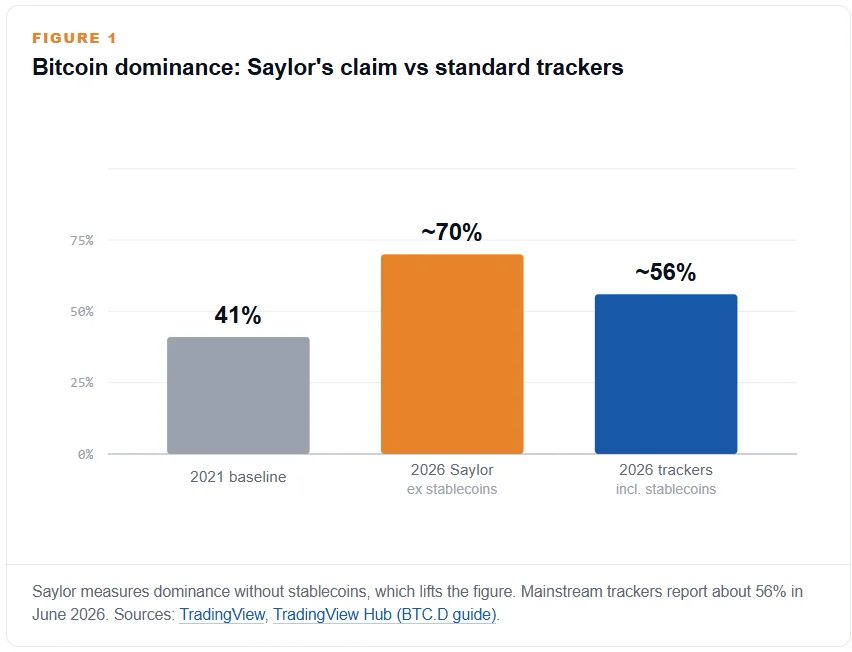
He cites Bitcoin dominance rising from 41% toward nearly 70%.
That figure excludes stablecoins, so standard trackers show about 56%.
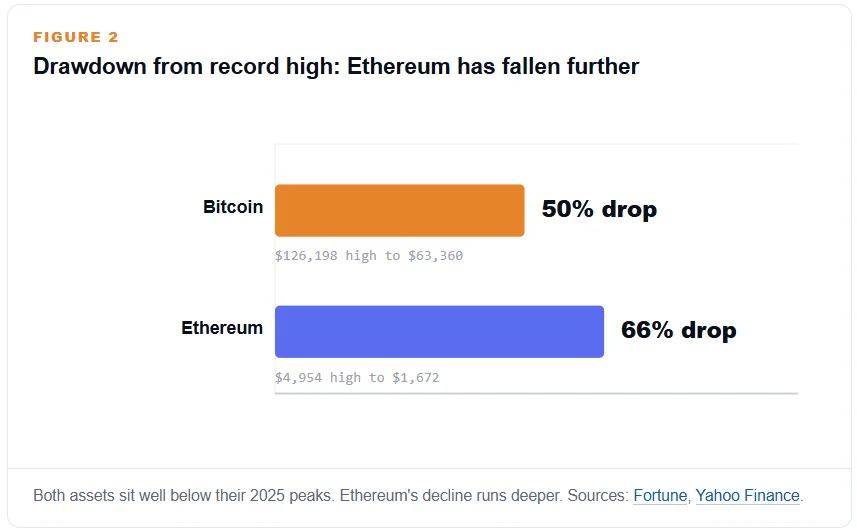
Ethereum has dropped roughly 66% from its 2025 record high.
Michael Saylor sparked fresh debate across crypto markets this week. The Strategy chairman spoke at the Bitcoin Corporate Day event on June 12. There, he declared that investor confidence in Ethereum has collapsed. His remarks quickly spread across trading desks and social feeds.
His argument rests on one striking number. Bitcoin now commands a far larger slice of crypto capital than before. Therefore, Saylor believes the case for altcoins as money is fading fast.
What Saylor actually said
Saylor framed his view in blunt terms. He said confidence in Ethereum had collapsed. That holds true, he added, “if you’re paying attention”. Moreover, he argued that monetary premiums across altcoins have now vanished.
“They’re going to live or die based on utility, and they’re all in a difficult competition.”
He pointed specifically to Bitcoin dominance, measured without stablecoins. According to Saylor’s comments reported by TradingView, that metric climbed from about 41% in 2021 toward nearly 70% today. As a result, he says capital continues to consolidate into Bitcoin alone.
Furthermore, Saylor claims that most tokens must now survive on utility alone. He believes scarcity and narrative no longer support their prices. In his view, only Bitcoin still holds a true monetary premium.
The dominance figure needs context
Saylor’s headline number deserves a closer look. Standard trackers report Bitcoin dominance near 56% in June 2026, as shown in this Bitcoin dominance guide. However, those readings include stablecoins inside the total market cap.
Stablecoins now exceed $300 billion in combined value. Consequently, stripping them out lifts Bitcoin’s share by several points. Even so, an ex-stablecoin reading lands closer to the low 60s. Therefore, the “nearly 70%” claim sits at the aggressive end of the range.
Still, the broader trend is genuine and well documented. Bitcoin has steadily gained market share for several years. Meanwhile, most altcoins have lost ground against it since 2021.
Context matters when one metric drives such a bold claim. Different trackers also calculate the total market in different ways. Hence, small method changes can move dominance by several points. In other words, the exact percentage depends on what you count.
Ethereum has fallen harder than Bitcoin
Recent price action supports part of Saylor’s case. Bitcoin traded near $63,360 on June 12, per Fortune’s daily price report. Ethereum, by contrast, hovered around $1,672 the same day, according to Yahoo Finance.
The gap widens sharply when measured from each peak. Bitcoin hit a record $126,198 in October 2025. Ethereum peaked earlier at $4,954 in August 2025. As a result, Ethereum has shed about 66% from its high. Bitcoin, meanwhile, sits down roughly 50%.
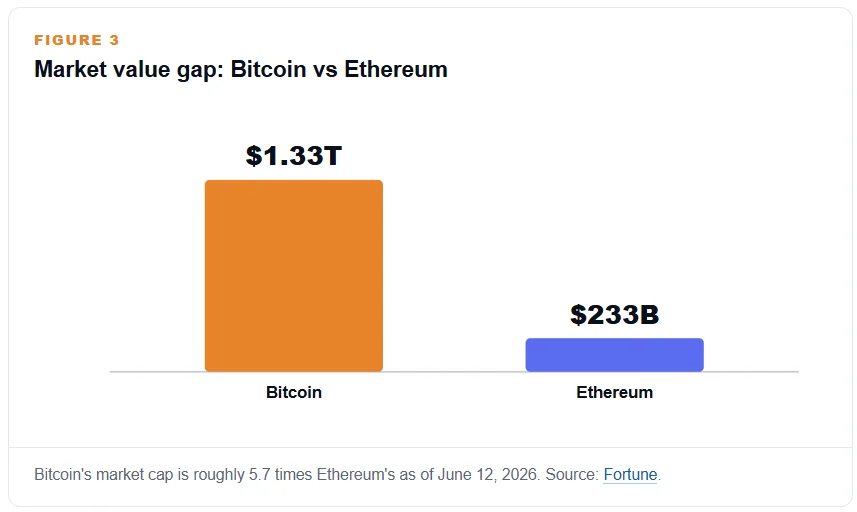
The market-cap divide tells a similar story. Bitcoin’s market value sits near $1.33 trillion today. Ethereum trails far behind at about $233 billion. In short, one asset now dwarfs the other.
The competition Saylor named
Saylor did not single out Ethereum on its own. Instead, he named several rivals reshaping the landscape. These include Solana, BNB Chain, Sui, and Hyperliquid. He also flagged Ethereum’s own Layer-2 networks.
Arbitrum and Base settle to Ethereum, yet they capture much of the value. Consequently, activity that once lived on Ethereum mainnet now spreads across many chains. This creates a real paradox for the network.

Each rival competes on a different strength. Solana targets fast consumer apps. Hyperliquid focuses on on-chain derivatives. Meanwhile, BNB Chain leans on Binance’s deep retail base.
Ethereum’s identity paradox
Ethereum now faces a problem partly of its own making. Its Layer-2 networks improve speed and cut fees for users. Yet those same rollups pull activity away from the mainnet. Consequently, the base layer can look quieter than before. Indeed, much value now settles on chains that Ethereum secures. Critics call this fragmentation a quiet tax on Ethereum’s economics.
Why critics push back
Not everyone accepts the “collapse” framing, though. Analysts at U.Today called the claim dubious. After all, institutions continue to build on Ethereum despite the recent sell-off.
Ethereum still hosts the deepest DeFi liquidity by a wide margin. In addition, it leads major chains in developer activity. Spot Ethereum ETFs also drew billions of dollars after launch.
Saylor’s own record invites some healthy skepticism too. Back in 2024, he doubted that spot Ethereum ETFs would arrive. Those products later launched and pulled strong inflows. Therefore, readers should carefully weigh his clear Bitcoin bias.
What it means for investors
The data points toward consolidation, not a total wipeout. Capital has clearly concentrated around Bitcoin since 2021. However, Ethereum remains the largest smart-contract platform by far.
Saylor’s core message still carries weight for allocators. Many now treat Bitcoin as their core crypto holding. By contrast, they treat altcoins as higher-risk venture bets.
Investors should therefore separate narrative from measurable trends. The shift in dominance is structural and easy to verify. The word “collapsed”, however, remains a matter of interpretation.
History also offers a useful reminder here. Bitcoin dominance has swung widely across past market cycles. It once towered above 90% in Bitcoin’s early years. Later, it slid under 45% during the 2021 altcoin boom. Therefore, today’s reading reflects a long cycle, not a final verdict. Patient investors will watch the next few quarters closely.




