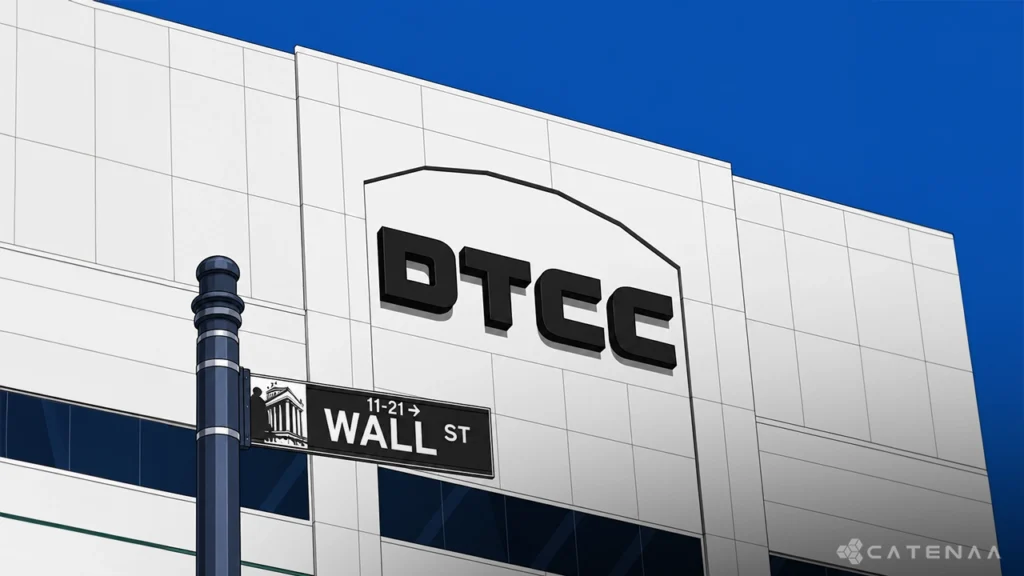


Catenaa, Saturday, May 09, 2026-The Depository Trust & Clearing Corporation will begin limited production trades of tokenized securities in July 2026 across selected real-world assets in the United States, before expanding into a full service rollout scheduled for October 2026.
The roll out will be done with backing from more than 50 financial firms spanning traditional markets and crypto platforms including BlackRock, Goldman Sachs, Bank of America, Citadel Securities, Circle, Coinbase, and Kraken, as the institution prepares to integrate blockchain settlement into infrastructure that currently supports more than 114 trillion dollars in custody across U.S. markets.
Limited July Launch
The DTCC will introduce its tokenization service through its Depository Trust Company division, starting with a restricted set of highly liquid assets that include Russell 1000 equities, major exchange-traded funds, and U.S. Treasury securities.
The initial phase will test blockchain-based recording and settlement processes under controlled conditions before broader market access begins later in the year. Industry participants involved in the program include more than 50 firms covering asset managers, banks, trading firms, and digital asset companies working within a joint development group.
Shift Building
The initiative reflects a steady shift inside traditional finance toward blockchain-based settlement models. DTCC already processes the majority of U.S. equity and fixed income transactions, making its move into tokenization one of the largest structural changes in post-trade infrastructure. The company has tested blockchain recording systems in pilot programs approved by regulators, creating pathways for securities to be tracked on distributed ledger systems while remaining under existing regulatory frameworks.
Industry Alignment Broadens
Large Wall Street firms participating in the working group view tokenization as a potential method for improving settlement speed and reducing operational delays across asset transfers. Crypto firms such as Circle, Coinbase, and Kraken are involved alongside established financial institutions, signaling convergence between regulated digital dollar systems and traditional capital markets. The presence of both groups indicates shared interest in creating interoperable systems rather than separate parallel markets.
Implications Markets
Market participants expect tokenization to change how securities are issued, settled, and transferred, particularly in areas involving Treasury instruments and exchange-traded funds. Faster settlement cycles could reduce counterparty exposure and operational friction. Institutional investors may gain access to continuous trading windows if blockchain settlement systems scale across multiple asset classes. At the same time, integration challenges remain, particularly around custody standards, compliance reporting, and cross-platform interoperability between legacy systems and blockchain networks.
Industry analysts tracking post-trade infrastructure shifts note that DTCC’s entry into tokenization signals stronger institutional acceptance of blockchain settlement layers.
Some market infrastructure specialists view the rollout as an incremental upgrade rather than a replacement of existing systems, with hybrid models expected to operate for an extended period. Others point to participation from major asset managers as a sign that tokenized securities may gradually become standard components of capital markets infrastructure rather than experimental products.
The rollout timeline places DTCC at the center of ongoing efforts to integrate distributed ledger systems into regulated financial markets. The phased approach suggests a cautious transition designed to maintain stability while testing operational performance under real trading conditions. Broader adoption will depend on regulatory clarity, market demand, and the ability of financial institutions to align internal systems with blockchain-based settlement rails.
The Depository Trust & Clearing Corporation serves as the primary custodian and settlement backbone for U.S. securities markets, processing the vast majority of equities and fixed income transactions.
Its Depository Trust Company division holds custody of more than 114 trillion dollars in assets, making it one of the largest financial infrastructure operators globally. Over the past several years, the organization has explored blockchain integration through pilot programs and regulatory approvals that allow selected securities to be recorded on distributed ledger systems.
These efforts align with broader industry trends in tokenization, where financial institutions and fintech companies are working to represent traditional assets such as bonds, equities, and funds on blockchain networks. Recent collaborations between asset managers, exchanges, and crypto firms have accelerated development of tokenized financial products, setting the stage for larger institutional participation in blockchain-based settlement systems.