


July 06, 2026 – More than $124 trillion in US household wealth will change hands by 2048, and the heirs receiving it own crypto at far higher rates than their parents.

In Summary
Cerulli sees $124 trillion in US wealth moving to heirs and charity by 2048.
Younger heirs own crypto several times more often than the generations giving it.
A 2% shift of older wealth could add $2.2 trillion in fresh crypto demand.
Big banks are racing to add crypto access before the money changes hands.
Concentration, spousal transfers, and slow diversification all temper the bull case.
A quiet force could reshape crypto demand for years. The crypto wealth transfer moves trillions from older Americans to young heirs. For a decade, analysts tracked adoption through ETFs, halvings, and rate cuts. Yet the deeper driver now appears to be demographic. Moreover, it has already begun.
The shift starts in estate offices, not on trading floors. Because of that, markets find it easy to ignore. Still, the pool’s size makes it hard to dismiss.
A $124 trillion handover to younger heirs
Cerulli Associates sees a $124 trillion move in US wealth by 2048. Furthermore, about $105 trillion flows straight to heirs. Another $18 trillion goes to charity. Baby Boomers and older cohorts supply nearly $100 trillion of that sum. Indeed, they account for 81% of all transfers.
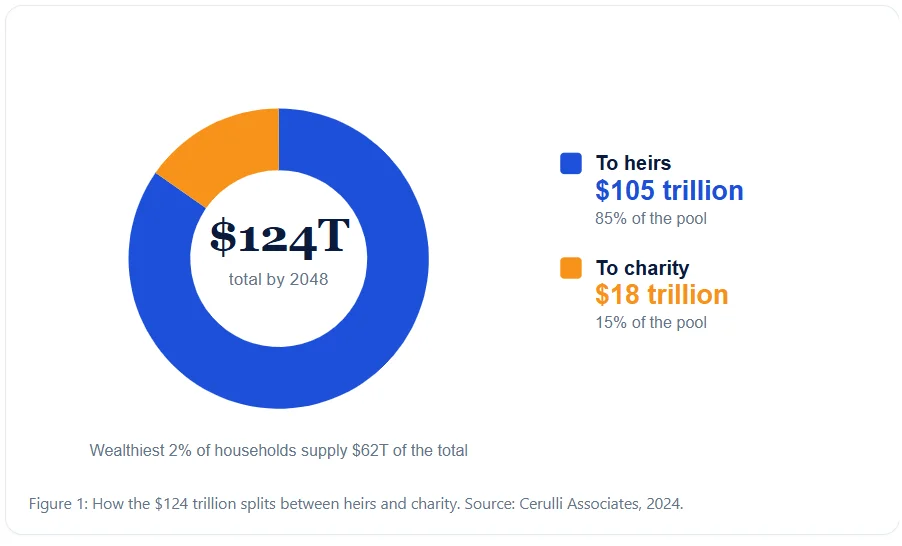
The pool keeps growing, too. In 2020, the same estimate stood at $84 trillion. Since then, gains in stocks and homes have lifted it sharply. Meanwhile, heirs now inherit roughly $2.5 trillion each year. Cerulli expects that yearly figure to top $4 trillion by 2036.
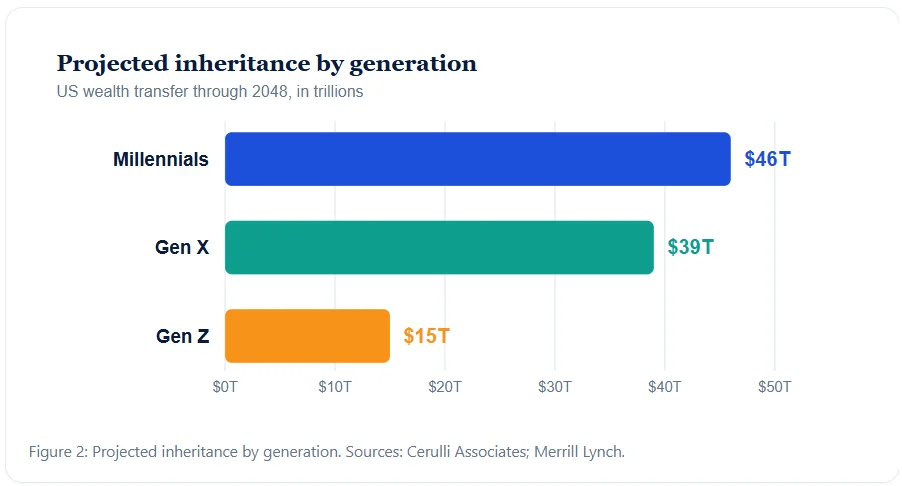
Millennials stand to gain the largest slice, about $46 trillion. Gen X should collect close to $39 trillion. Younger Gen Z heirs trail with roughly $15 trillion. In addition, more than half the total starts with the richest 2% of homes.
Why the crypto wealth transfer matters
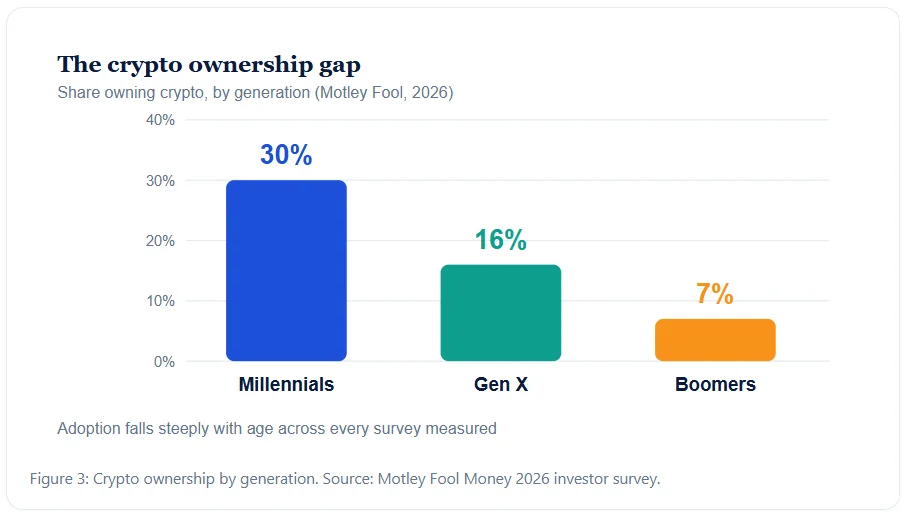
The young invest in very different ways from their parents. For example, a Motley Fool survey reported that 30% of millennials owned crypto. By contrast, only 16% of Gen X and 7% of Boomers held it. A Gemini survey found even higher youth uptake. Specifically, 51% of Gen Z and 49% of millennials owned crypto.
The gap shows up among wealthy families as well. A Coinbase survey asked 4,350 US adults with investment accounts. Young investors kept 25% of their holdings in non-traditional assets, including crypto. That share was roughly triple the 8% seen among older groups.
Bank of America research found a similar split among rich clients. The young put about 14% of their holdings into crypto. Older clients put in just 1%. On top of that, most young investors doubt that stocks and bonds alone can beat the market. As a result, the same dollars may carry a heavier crypto weight once heirs take charge.
Sizing the potential flows
Researchers have started to price this shift. Grayscale head of research Zach Pandl notes that Americans aged 60 and over hold nearly $110 trillion. He argues a 2% move into digital assets would add $2.2 trillion in fresh demand. However, that result depends on real choices, not an automatic shift.
Galaxy Research reached a smaller figure from a 2023 base. It saw an immediate transfer pushing $160 billion to $225 billion into crypto. Back then, the whole asset class was worth about $1.5 trillion. Since that report, the market and its on-ramps have grown much wider.
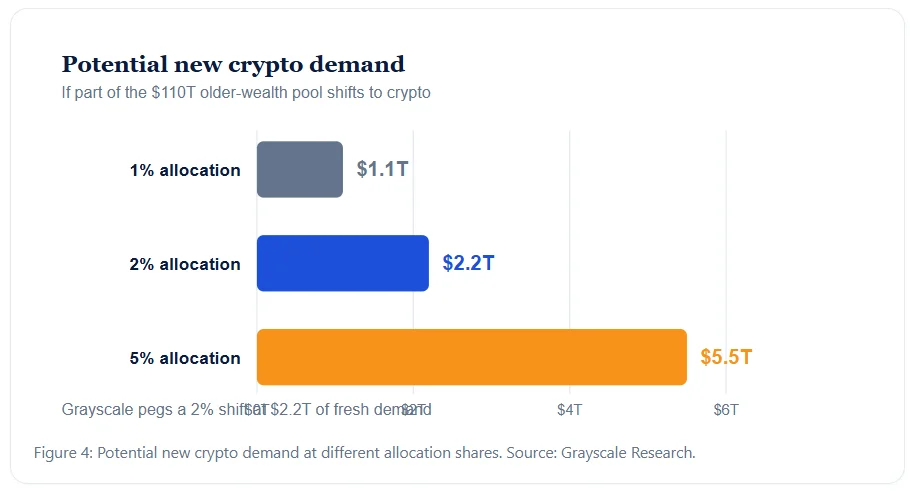
Scale is the real story here. One percent of the $110 trillion pool equals $1.1 trillion. Two percent lifts that to $2.2 trillion. Five percent would top $5 trillion. Even modest moves, therefore, dwarf a single ETF launch.
Wall Street is already repositioning
Big banks are moving with unusual speed. Morgan Stanley began piloting spot crypto trading on E-Trade in May 2026. It set a fee of 50 basis points to undercut rivals. Similarly, Charles Schwab launched its own spot service at 75 basis points. Vanguard, once a loud skeptic, now lets clients trade crypto funds.
JPMorgan also named the transfer as a driver of future Bitcoin demand. Its early-2026 client notes also pointed to strong ETF inflows. By that point, US spot Bitcoin ETFs had pulled in $62 billion.
Morgan Stanley framed its move as a defense. The firm’s wealth chief called direct access a way to keep app-native clients. He noted that future customers grew up on phones, not brokers. Consequently, the product roadmap now argues the crypto case on its own.
The urgency runs deep across the trade. A Natixis survey found 41% of advisors see the transfer as a threat. Moreover, many young investors have already fired advisors who lack access to crypto. Cerulli says $85 trillion will reach the hands of Gen X and millennials. Therefore, firms are racing to court the next generation early.
Crypto’s most durable case may rest on outliving the skeptics rather than converting them.
Where the thesis meets friction
Nevertheless, several facts soften the bull case. Because $62 trillion starts with the richest 2%, the average heir gets far less. In addition, rising health and retirement costs eat into the pool over time. Galaxy warned that longer lives and medical bills would trim the sums that reach young hands.
Timing adds another delay. About $54 trillion first moves between spouses. Nearly $40 trillion of that reaches widowed women in older cohorts. Thus, a large share of wealth remains within the same age group for years.
Heirs also tend to shift slowly rather than rush into new bets. In fact, survey data point to caution and respect for a parent’s wishes. Meanwhile, older investors keep closing the gap on their own. Some counts now put Gen X and Boomers at 37% of US crypto owners.
Still, the math favors patience. Every passing year hands control to cohorts with a far higher crypto appetite. Their baseline weighting runs three to fourteen times that of their parents. So the strongest case for crypto may rest on time itself. In the end, the trend could outlast the skeptics rather than convert them.




