

July 12, 2026 – XRP, Shiba Inu and Bitcoin have all clawed back ground this month. However, fund flows and exchange data suggest the move reflects vanishing supply rather than returning buyers.

In Summary
XRP, Shiba Inu and Bitcoin have all bounced, but sentiment remains stuck in extreme fear at 23.
US spot XRP ETFs have stalled, posting a $7.29 million outflow on July 8 and a net July outflow of $2.61 million.
Traders drained a net 95.35 billion SHIB from exchanges in one day, shrinking the tradable float.
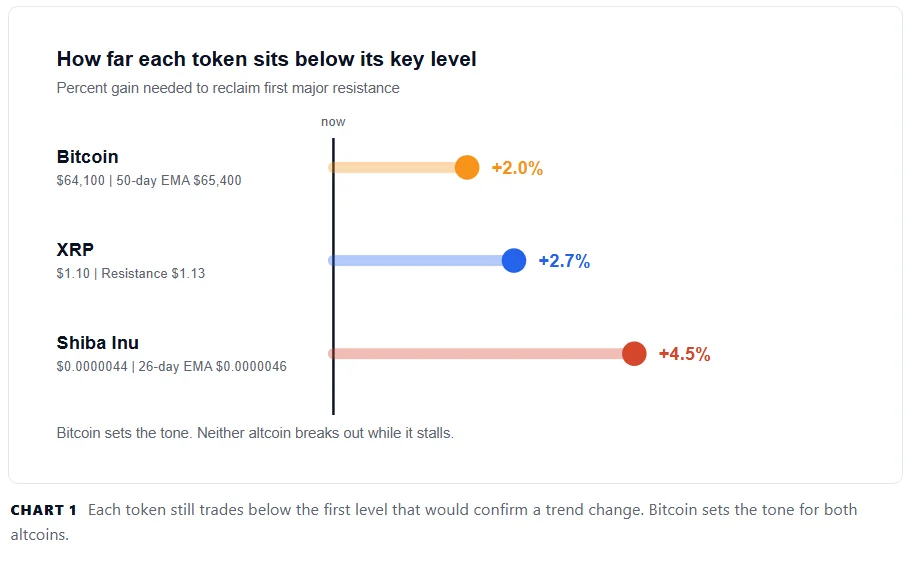
Bitcoin must reclaim its 50-day EMA near $65,400, or the whole recovery will likely stall again.
The crypto market rebound now underway rests on shrinking supply, not on fresh money. XRP has climbed back toward $1.10. Shiba Inu holds near $0.0000044. Bitcoin changes hands around $64,100 after a brutal June.
Yet the flow data tells a colder story. Buyers are not arriving in size. Instead, sellers have simply run low on tokens to sell.
That distinction matters enormously. Rallies built on absent sellers fade quickly. By contrast, those built on new capital tend to last.
Why This Crypto Market Rebound Looks Thin
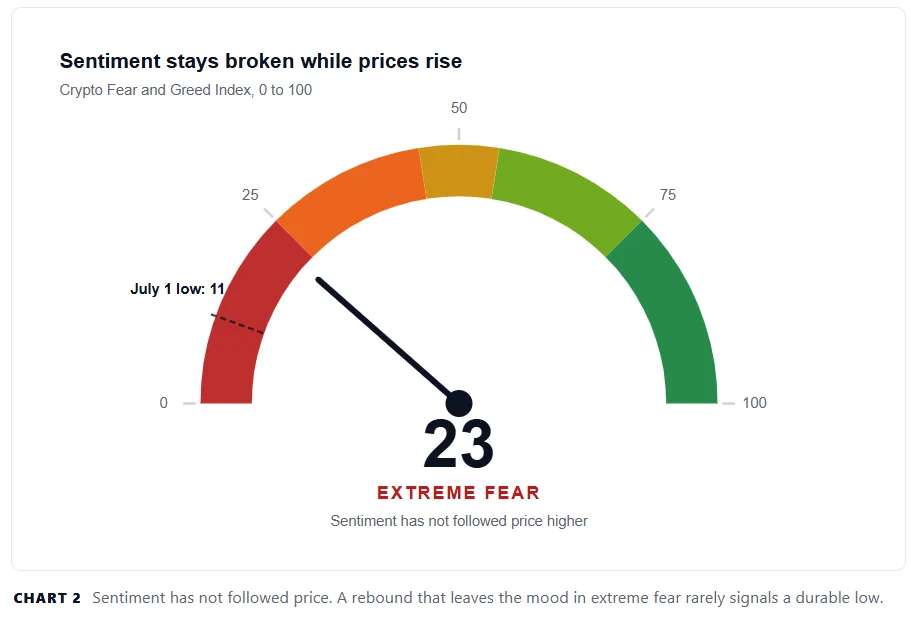
Start with sentiment. The Fear and Greed Index sits at roughly 23, deep in extreme fear. Moreover, the gauge bottomed at just 11 on July 1. Prices have since risen, but the mood has barely moved.
Normally, a real recovery drags sentiment up with it. Here, it has not. Therefore, traders should treat the bounce as mechanical rather than emotional.
The macro backdrop explains much of the damage. Rate anxiety pulled money out of risk assets through June. Consequently, almost every major token fell together, which points to a market problem rather than a coin problem.
Bitcoin itself trades near $64,100. Furthermore, that price sits roughly 50% below its cycle peak. Traders are not buying strength. They are buying wreckage.
One event on June 29 explains the mechanics neatly. A single wave of forced selling wiped out about $326 million in leveraged positions. That flush cleared the market of stretched longs.
Afterward, the natural sellers largely vanished. Prices then floated higher on very little volume. Such moves look like strength, yet they carry no real conviction.
XRP Bounces, But the ETF Bid Fades
XRP tells the clearest version of this story. The token dropped to $1.009 on June 26, its weakest print since November 2024. It also closed June down 22.1%.
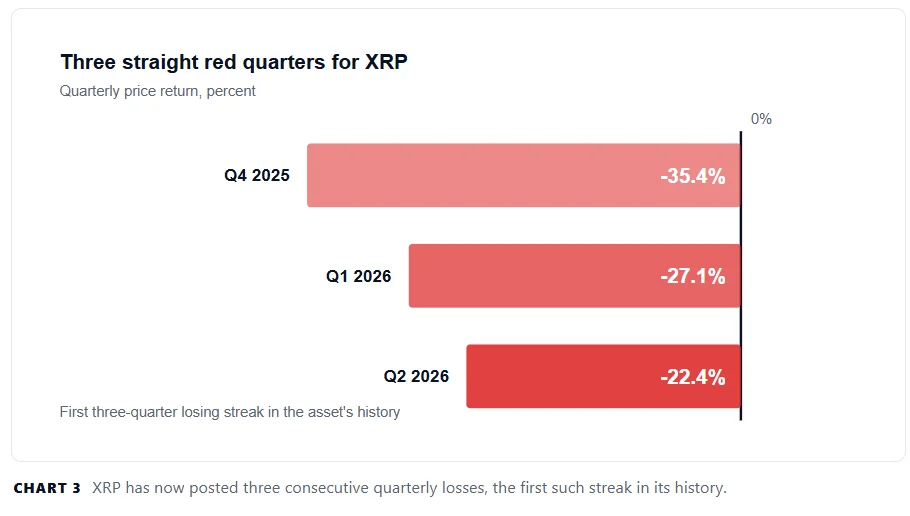
That capped a grim run. XRP fell 35.4% in the fourth quarter of 2025. Then it lost 27.1% in the first quarter of 2026. Finally, it shed a further 22.4% in the second quarter.
Three straight losing quarters is a first for the asset. Nevertheless, the bounce off $1.00 held, and buyers repeatedly defended the level.
Now look at the money. The seven US spot XRP funds have absorbed about $1.40 billion since launch. Notably, they kept buying while the price collapsed.
However, that bid has now stalled. The funds bled $7.29 million on July 8, their largest daily outflow since March. Two sessions before that recorded exactly zero net flow. As a result, July stands at a small net outflow of $2.61 million.
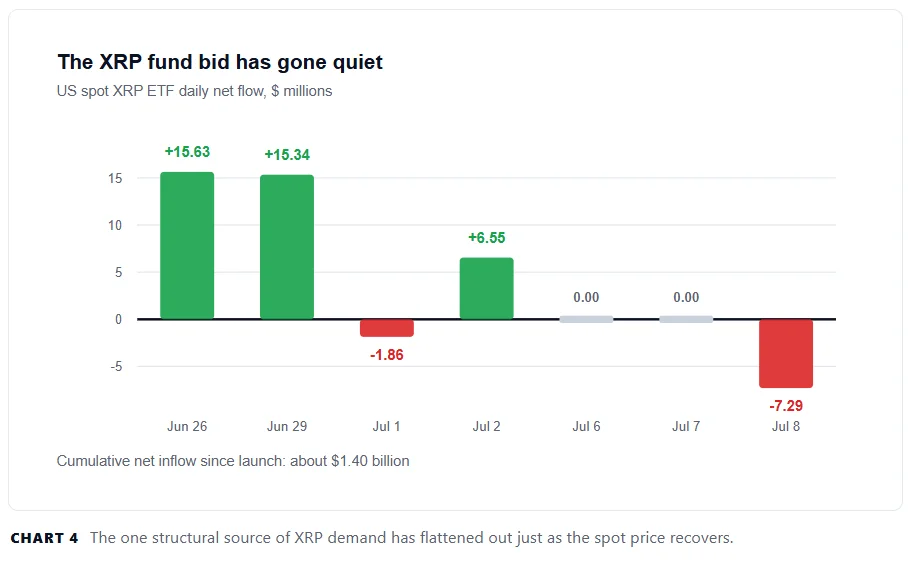
Those funds now hold roughly 964 million XRP. Their combined assets sit near $1 billion.
So the one genuine source of structural demand has gone quiet. Meanwhile, the price rises anyway. That gap should worry anyone calling a bottom.
Ripple news flow has stayed broadly positive all year. Even so, the token kept sliding. Clearly, macro conditions now outrank project fundamentals.
Shiba Inu Drains Its Exchange Float
Shiba Inu shows the supply squeeze most vividly. The token trades near $0.0000044, giving it a market value close to $2.5 billion. Its circulating supply runs to roughly 589 trillion tokens.
June punished holders hard, and the meme coin lost about 24%. Since July began, though, it has added roughly 4%.
The interesting action sits on-chain. Traders pulled 226.3 billion tokens off exchanges in a single day. They deposited only about 131 billion back. Therefore, order books lost a net 95.35 billion SHIB in 24 hours.
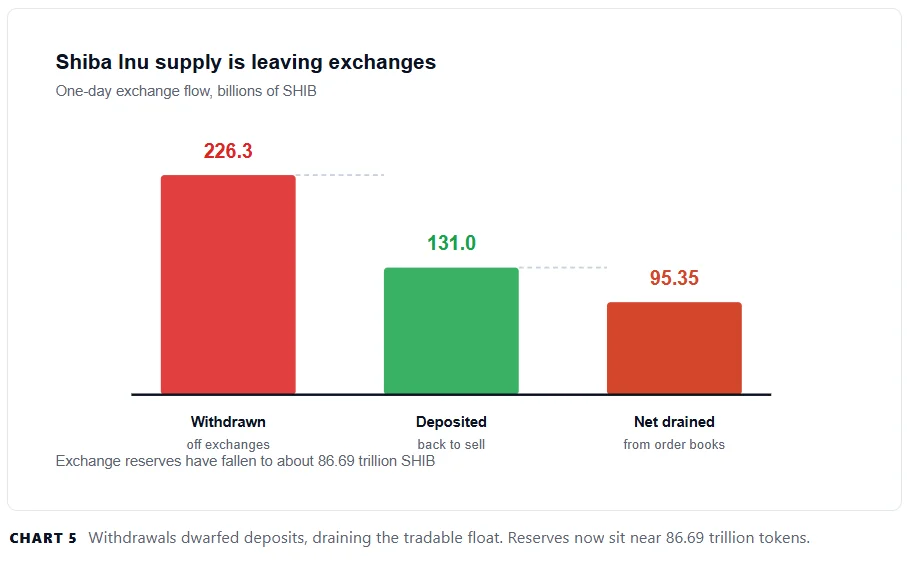
Exchange reserves have now fallen to about 86.69 trillion tokens. A separate session saw a further 124 billion tokens withdrawn.
A smaller float means sharper moves. Still, withdrawals alone prove very little. Some transfers reflect custody reshuffles rather than conviction buying.
Prices can drift higher on an empty order book for a while. Eventually, though, someone has to actually buy.
Crucially, deposit and withdrawal counts both collapsed week over week. In other words, the whole market got quieter, not hungrier. Thin books lift prices cheaply, but they also drop them cheaply.
One caution belongs here. Some coverage has framed the outflow as a 263-billion-token surge. That figure does not match the underlying on-chain record.
Bitcoin Still Sits Below the Line That Matters
Bitcoin frames everything else. The asset defended the $58,000 to $60,000 zone and bounced hard. Momentum has improved, and volume has held steady during the climb.
Yet one level still caps the move. The 50-day exponential average sits near $65,400. Bitcoin has failed there repeatedly during this downtrend.
Above that line, the path opens quickly. The 100-day average waits near $69,000. Beyond that, the 200-day average sits around $75,000, the true bull-and-bear divide.
Below the line, the story stays stuck. Another rejection is likely to send Bitcoin back toward $60,000.
Because altcoins take direction from Bitcoin, that single level also governs XRP and Shiba Inu. Neither token breaks out while Bitcoin stalls.
What Traders Should Watch Next
Three signals will settle this debate quickly.
First, watch fund flows. XRP products must resume steady inflows, or the demand thesis collapses entirely.
Second, watch exchange balances. Shiba Inu needs continued outflows plus rising spot volume, not just falling activity.
Third, watch $65,400. Bitcoin must reclaim that level on strong volume to confirm anything.
Until those boxes tick, this remains a relief bounce with a supply tailwind. Prices can drift higher on an empty order book for a while. Eventually, though, someone has to actually buy.
Traders should size positions accordingly.