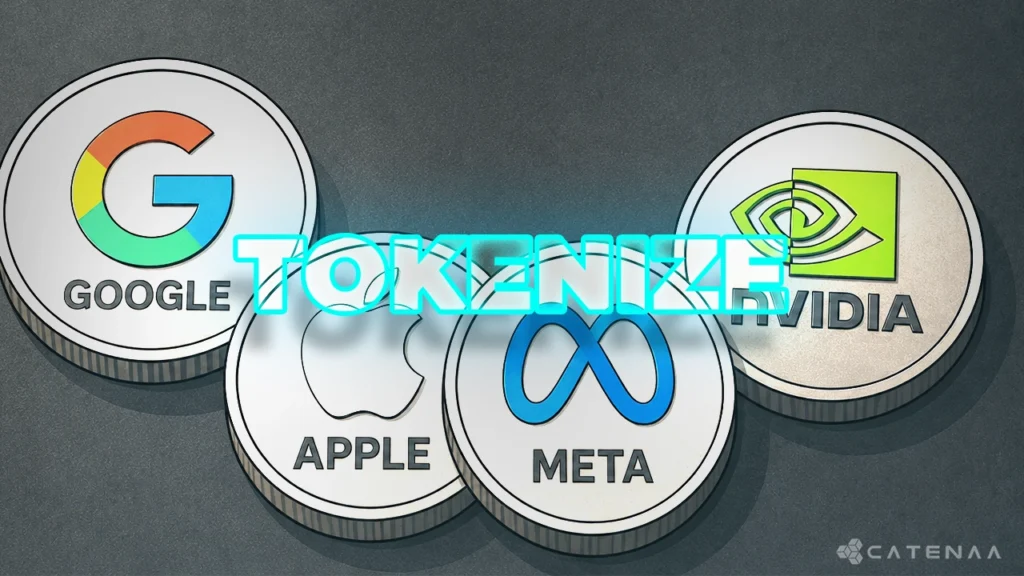


Catenaa, Saturday, July 11, 2026- Cryptocurrency exchanges are accelerating efforts to bring private technology companies onto blockchain-based trading platforms, marking a new phase in the convergence of digital assets and traditional capital markets as firms compete to become gateways for tokenized investing.
Recent developments across the industry suggest the competition has moved well beyond cryptocurrency trading. Exchanges are increasingly introducing products linked to private companies, tokenized equities and real-world assets as they seek new sources of growth in an increasingly competitive market.
The latest example comes from cryptocurrency exchange MEXC, which reported strong demand for investment products linked to SpaceX, highlighting growing retail appetite for exposure to private companies that have historically remained inaccessible to ordinary investors.
Industry observers say the announcement reflects a broader transformation taking place across digital finance rather than an isolated product launch.
For much of the past decade, cryptocurrency exchanges focused primarily on spot trading and digital tokens.
Today, many are repositioning themselves as multi-asset investment platforms combining cryptocurrencies with tokenized stocks, exchange-traded funds, commodities and private equity.
The objective is to create unified investment ecosystems where digital assets and conventional financial instruments coexist on blockchain infrastructure.
Analysts believe this evolution is being driven by slowing growth in traditional cryptocurrency trading, intensifying competition and rising institutional interest in tokenized real-world assets.
Among the most notable developments is growing interest in pre-IPO investment products.
Companies such as SpaceX, OpenAI and Stripe have become some of the world’s most valuable private businesses, yet ordinary investors generally have little opportunity to participate before public listings.
Blockchain technology offers exchanges a potential solution through tokenized investment products that provide economic exposure to private market valuations while expanding global market access.
Supporters argue such products could eventually democratize investment opportunities that have traditionally been available only to venture capital firms, private equity funds and institutional investors.
MEXC’s latest figures illustrate that investor demand for these products is increasing.
The company said subscriptions for its SpaceX-linked investment products exceeded $173 million, attracting more than 74,000 participants, while trading volumes for related perpetual futures surpassed $7.1 billion within weeks of launch.
Although these figures originate from the company itself, they reflect growing market interest in tokenized exposure to globally recognized technology brands.
The trend extends well beyond a single exchange.
Several major trading platforms have recently introduced tokenized equities, blockchain-based brokerage services and infrastructure designed to support real-world asset trading.
The expansion reflects a broader strategic repositioning across the cryptocurrency industry. Rather than competing solely on trading fees or token listings, exchanges are increasingly investing in infrastructure capable of connecting blockchain markets with conventional financial assets.
Tokenization allows assets to trade around the clock, supports fractional ownership and enables settlement through blockchain networks, features that many industry participants believe will define the next generation of financial markets.
For exchanges, integrating traditional investment products may also reduce dependence on volatile cryptocurrency trading cycles.
Despite growing enthusiasm, tokenized private equity remains an evolving market subject to significant regulatory uncertainty.
Questions surrounding investor protection, ownership rights, disclosure requirements and cross-border securities regulation remain unresolved across many jurisdictions.
Regulators in the US, Europe and Asia are continuing to examine how tokenized financial products should fit within existing securities frameworks while balancing innovation with market integrity.
Future regulatory decisions are likely to determine how quickly tokenized private markets can expand beyond early adopters. The race unfolding among cryptocurrency exchanges is no longer simply about digital currencies.
It is increasingly about who will build the infrastructure connecting blockchain technology with the world’s financial markets.
Whether through tokenized stocks, pre-IPO investments, decentralized trading or on-chain settlement, exchanges are positioning themselves to become comprehensive digital investment platforms rather than cryptocurrency marketplaces alone.
If current trends continue, the distinction between crypto exchanges and traditional brokerages may become progressively less meaningful as both industries converge around tokenized finance.
Tokenization has emerged as one of the fastest-growing segments of digital finance, allowing conventional financial assets to be represented and traded on blockchain networks. Financial institutions, asset managers and cryptocurrency exchanges are investing heavily in infrastructure supporting tokenized stocks, bonds, funds, commodities and private equity. The movement is driven by expectations that blockchain technology can improve market accessibility, enable fractional ownership, shorten settlement times and expand global liquidity. As regulatory frameworks mature, competition is increasingly shifting from cryptocurrency trading toward building integrated platforms capable of serving both digital assets and traditional financial markets through a unified blockchain-based infrastructure.a