

June 24, 2026 – US crypto ETFs split sharply in June 2026. Bitcoin and Ethereum funds bled billions of dollars. Yet XRP and Hyperliquid products quietly continued to draw buyers.
In Summary
Bitcoin and Ethereum ETFs lost about $2.5 billion through June 18.
Hyperliquid and XRP funds together added under $75 million.
The flow gap signals de-risking, not a clean rotation into altcoins.
A hawkish Federal Reserve kept rates high, raising crypto’s opportunity cost.
A widening split in crypto ETF demand
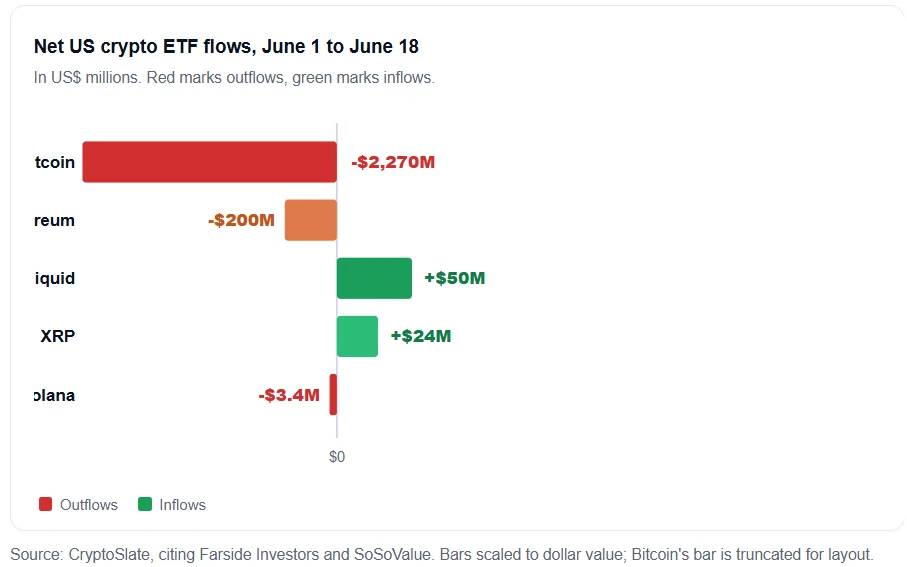
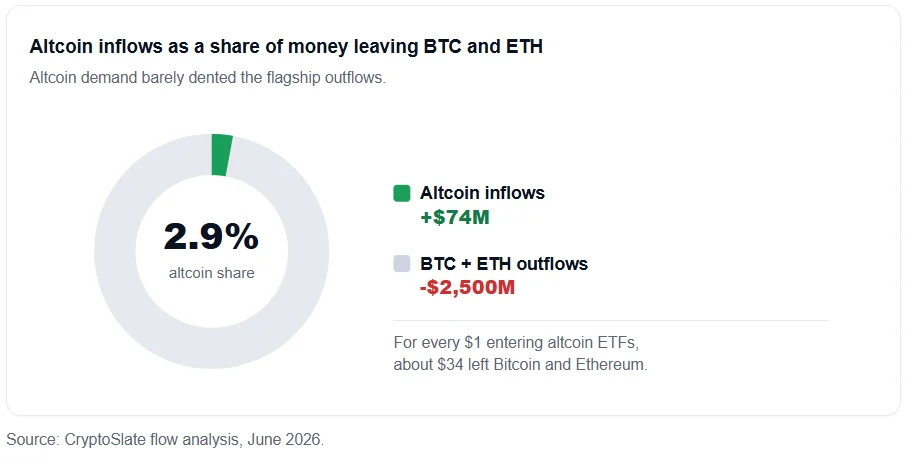
US-listed spot Bitcoin ETFs shed nearly $2.3 billion through June 18. Ethereum funds lost roughly $200 million across the same window. Together, the two flagship categories surrendered about $2.5 billion, according to CryptoSlate.
Smaller altcoin products, however, told a very different story. Hyperliquid ETFs pulled in close to $50 million. XRP funds added around $24 million. Solana, by contrast, closed with $3.4 million in net outflows.
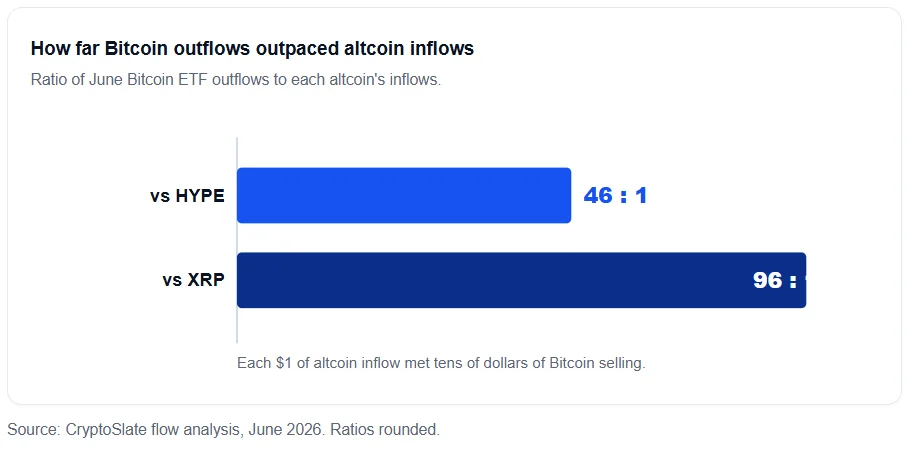
In total, altcoin inflows reached only $74 million. That sum equals less than 3% of the money that left Bitcoin and Ethereum. The imbalance is hard to ignore. Bitcoin outflows outpaced Hyperliquid inflows by roughly 46 to 1. Measured against XRP, the ratio stretched to about 96 to 1. Clearly, no meaningful swap of capital occurred.
Why the numbers point to de-risking
Analysts often frame altcoin inflows as a “rotation” trade. This data, though, resists that tidy story. A true rotation would shift comparable sums between assets. Instead, the dollars leaving Bitcoin dwarf the trickle entering smaller funds. Consequently, the pattern reads as broad de-risking. Investors appear to be trimming risk rather than chasing fresh bets.
ETF flows carry weight because they capture demand from regulated brokerage accounts. These dollars travel through custody and settlement infrastructure. As a result, they tend to shape price across weekly timeframes. Citi has estimated that spot Bitcoin ETF flows drive about 45% of weekly moves in the BTC price. That specific figure stays hard to verify in the bank’s primary materials. Still, its direction matches June’s persistent weakness.
What the Bitcoin outflow data shows
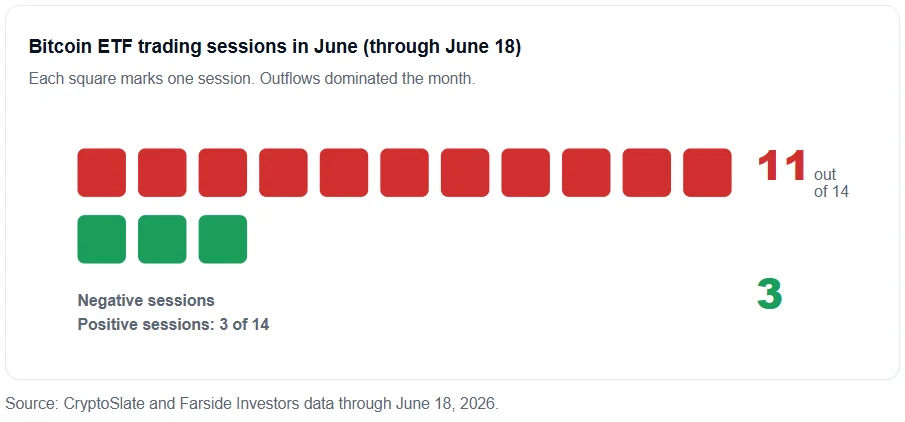
Bitcoin ETFs recorded negative flows in 11 of the first 14 trading sessions in June. The June 18 session alone saw $90.7 million leave the category, per Farside Investors. BlackRock’s IBIT drove much of the bleed. Earlier in the month, the complex also suffered a record 13-day outflow streak. That run erased roughly $4.4 billion before it finally paused.
The takeaway is structural, not just bearish. ETF wrappers now act as a fast lane in both directions. When sentiment sours, the same product becomes the quickest exit. Therefore, daily flow prints increasingly move the short-term narrative.
Hyperliquid’s persistent bid
Hyperliquid’s HYPE products remain strikingly new. Bitwise launched its spot fund on May 14. The category has logged fewer than 25 trading sessions so far. Even so, cumulative HYPE inflows reached about $189 million through June 18. The June contribution added close to $50 million of that total.
The bull case is simple. Persistence through a weak tape suggests a distinct buyer base. These allocators seem to back on-chain derivatives infrastructure directly. They held positions while Bitcoin and Ethereum funds shed assets. The bear case is equally clear, however. The category is barely six weeks old. Assets under management stay thin. Moreover, one heavy redemption week could wipe out the entire cumulative figure.
XRP’s recurring demand
XRP offers a steadier, if smaller, signal. Spot XRP ETFs added $10.6 million during the June 14 to 18 week. Cumulative inflows now sit near $1.5 billion, based on SoSoValue data. Total net assets across the category reach roughly $995 million. Notably, XRP funds logged only two negative weeks since mid-March.
That stretch included sessions when Bitcoin and Ethereum products bled heavily. Such consistency points to recurring appetite for regulated XRP access. Many existing holders simply want a compliant wrapper for exposure they already own. Yet the scale stays modest. Weekly additions of $10 million to $25 million look small. They fall far short of offsetting a single Bitcoin redemption day.
The macro backdrop tightening the screws
Policy is now working against crypto risk appetite. The Federal Reserve held its target range at 3.50% to 3.75% on June 17. New Chair Kevin Warsh struck a notably hawkish tone, CNBC reported. The Fed also stripped prior language hinting at future cuts. Officials lifted their 2026 inflation projection to 3.6%.
Higher-for-longer rates raise the opportunity cost of volatile assets. Therefore, allocators face weaker incentives to add crypto exposure. The updated dot plot now signals a possible hike by October. Against that backdrop, cautious ETF behavior makes obvious sense.
The broader market context
These flows landed in an already nervous market. The total crypto market cap sat near $2.14 trillion in late June. Bitcoin dominance held around 58%, underscoring its grip on sentiment. Daily volume across all coins reached about $74 billion. Against those totals, $74 million in altcoin inflows barely registers.
Context also matters for the timing. Energy prices stayed elevated after Middle East tensions. As a result, inflation pressure lingered into the summer. Markets quickly repriced the path for rates higher. Risk assets, including crypto, felt that shift almost at once. The ETF tape simply made the caution visible.
What to watch next
July flows will likely settle the debate. Suppose Bitcoin and Ethereum return to positive weekly flows. In that case, the altcoin bid appears to be early positioning. Alternatively, the bleed may simply continue. Then HYPE and XRP would mark the floor of crypto ETF demand.
For now, the scraps tell the clearest story. Big money is stepping back, not switching sides. Investors should therefore watch the flagship funds first. Their direction still sets the tone for the whole market.