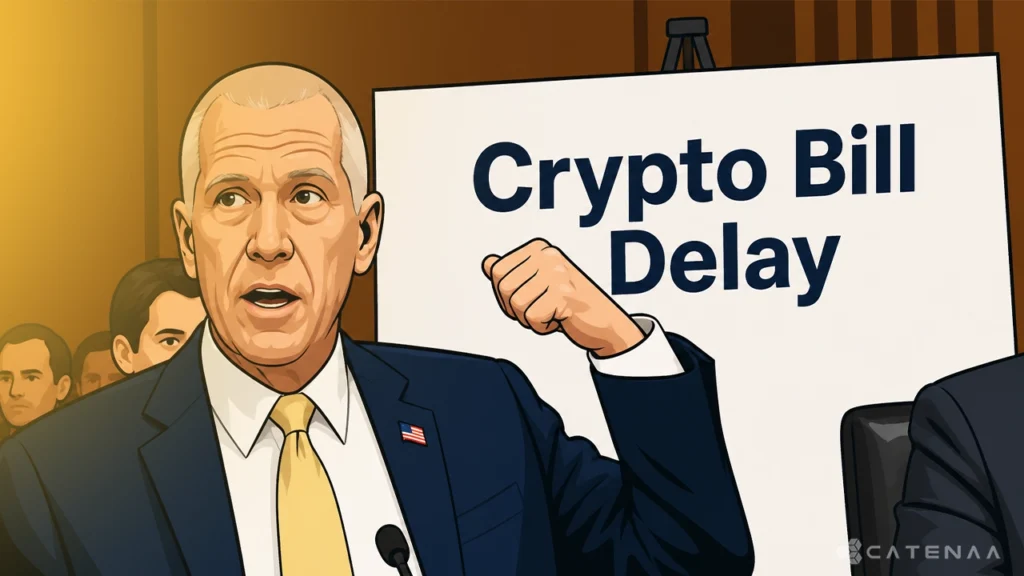


Catenaa, Saturday May 02, 2026 US crypto legislation faces renewed uncertainty after Sen. Thom Tillis signaled he would oppose the Clarity Act unless ethics provisions are included, creating a fresh hurdle for lawmakers working to pass the bill.
Tillis, a member of the Senate Banking Committee and a central negotiator on the proposal, said he would withdraw support if conflictofinterest safeguards are not added before the bill reaches a vote. The development comes as Congress attempts to finalize a regulatory framework for digital assets amid growing political and industry pressure.
Legislative Context Deepens
The Clarity Act is designed to establish regulatory definitions and oversight for cryptocurrencies, including stablecoins and trading platforms. It has been under negotiation for months, with lawmakers seeking bipartisan support to move it through the Senate.
Tillis has played an active role in shaping discussions, particularly on stablecoin yield provisions. His latest stance introduces a new layer of complexity, as ethics rules could affect how public officials and their families interact with the crypto sector.
The bill had already faced delays, with Tillis previously requesting that committee consideration be postponed until May. His position now adds uncertainty to the legislative timeline.
Implications for Passage
The introduction of ethics requirements may complicate efforts to secure enough votes for passage.
Lawmakers must balance calls for stricter oversight with political sensitivities tied to existing business interests connected to digital assets.
Analysts say the issue could slow negotiations or force compromises that reshape the bill’s scope. Without agreement on ethics provisions, the legislation risks stalling in committee or failing to reach the Senate floor.
The uncertainty also affects market expectations, as many industry participants have anticipated clearer regulatory guidelines from Congress this year.
Expert Analysis Emerges
Policy analysts view Tillis’ position as a critical factor in determining the bill’s outcome. His influence within the Senate and willingness to oppose the measure may force broader negotiations on governance standards.
Some experts argue that ethics rules are necessary to address concerns about conflicts of interest in a rapidly growing sector. Others warn that overly strict provisions could deter participation or complicate implementation.
Analysts also note that Tillis is not seeking reelection, which may allow him greater independence in shaping his stance on the legislation.
Negotiations Continue Ahead
Lawmakers are expected to continue discussions in the coming weeks, focusing on resolving disagreements over ethics language and other outstanding issues. The bill must secure bipartisan support to meet the Senate’s voting threshold.
Observers say progress may depend on direct involvement from senior political leaders and a willingness to compromise on contentious provisions. The timeline for passage remains uncertain, with some analysts suggesting delays could extend beyond the current legislative session.
The outcome will shape how the US approaches crypto regulation and its position in the global digital asset market.
Background on Crypto Policy
The US has been working to establish a clear regulatory framework for cryptocurrencies as the market expands. Existing rules are fragmented across agencies, creating uncertainty for businesses and investors.
Efforts to pass comprehensive legislation have gained momentum alongside increased political attention and industry lobbying. The Clarity Act represents one of the most advanced attempts to define regulatory authority and standards.
Challenges remain, including questions around market oversight, investor protection, and the role of federal agencies. Ethical considerations have also emerged as digital assets intersect with political and financial interests.
The debate reflects broader tensions between innovation and regulation, with lawmakers seeking to balance growth with accountability.
The Clarity Act emerged as a bipartisan effort in the US Congress to define regulatory jurisdiction over digital assets. Lawmakers introduced it to address ongoing overlap between the Securities and Exchange Commission and the Commodity Futures Trading Commission, which had created uncertainty for crypto firms operating in the United States.
Early drafts focused on separating securities from commodities classifications for tokens, while also setting disclosure and compliance standards for issuers and exchanges. Over time, the bill expanded to include stablecoin provisions, market structure rules, and consumer protection measures. As of 2026, it remains under negotiation in the Senate, facing delays tied to ethics provisions, regulatory scope disputes, and broader political divisions over crypto oversight and federal authority.




