

August 09, 2026 – A Coldcard seed-generation flaw has turned a hardware-wallet failure into a warning for institutional crypto custody. The episode shows why offline storage alone cannot replace layered controls, independent approvals, and tested recovery procedures.
In Summary
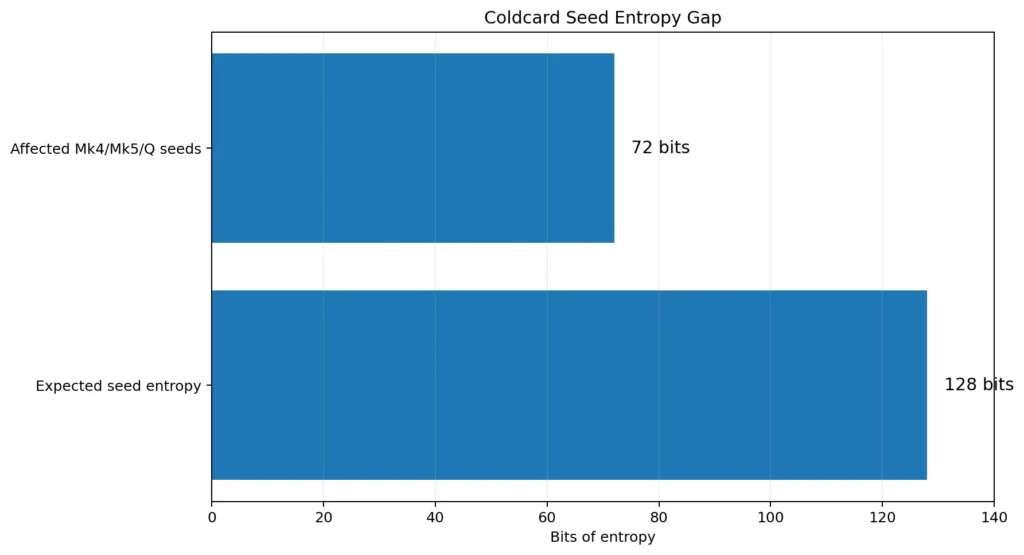
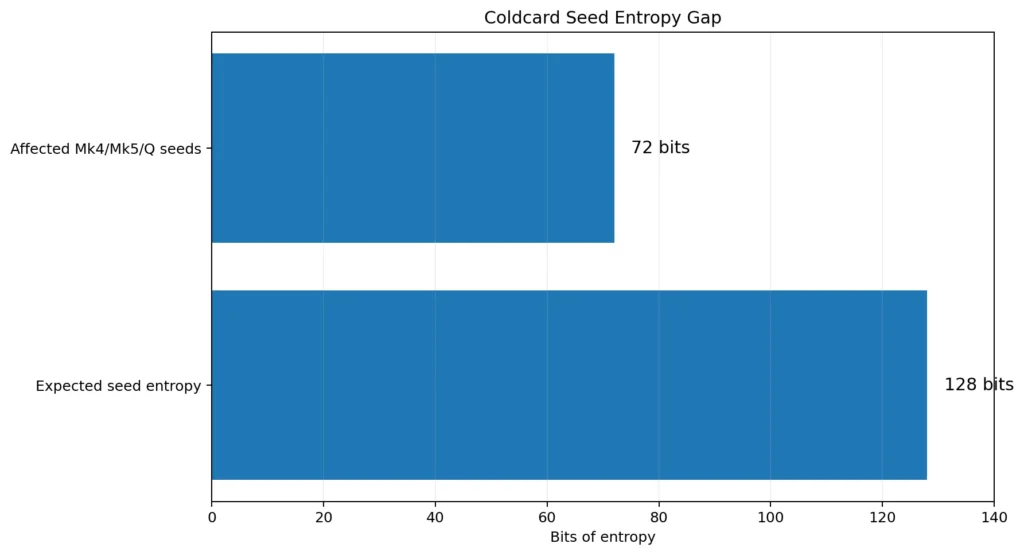
Some affected Coldcard seeds had about 72 bits of entropy instead of the expected 128 bits.
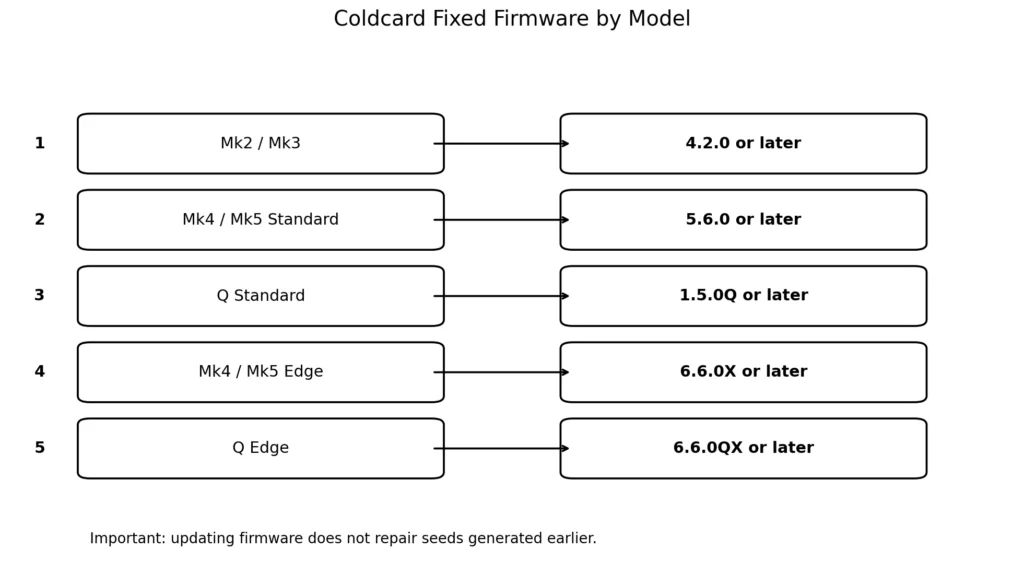
Fixed firmware does not repair an already vulnerable seed, so affected users must migrate funds.
U.S. regulators permit bank crypto custody, while requiring safe operations and strong third-party risk management.
Institutional custody increasingly competes on approval controls, auditability, recovery design, and transaction governance.
Regulated investment products may appeal to investors who want bitcoin exposure without managing private keys.
What failed inside the wallet
Coldcard’s maker published a security advisory on July 30 and updated it on August 1. The advisory says affected firmware weakened randomness during seed generation.
Seeds created on Mk4, Mk5, and Q devices before fixed releases carried about 72 bits of entropy. The expected level was 128 bits.
Older Mk2 and Mk3 devices faced a more severe issue across firmware versions 4.0.1 through 4.1.9. Independent dice input could protect affected seeds when enough private rolls were added.
At least 50 independent rolls contributed 128 bits of entropy, according to the advisory. Ninety-nine rolls contributed about 256 bits.
Critically, an update does not repair an existing seed. Affected users must generate a new seed and move funds.
That changes the risk discussion. A wallet can remain offline and still fail when the cryptographic identity is created.
The official advisory does not publish a confirmed aggregate theft figure. Institutions should separate confirmed technical facts from evolving loss estimates.
Why institutions should care
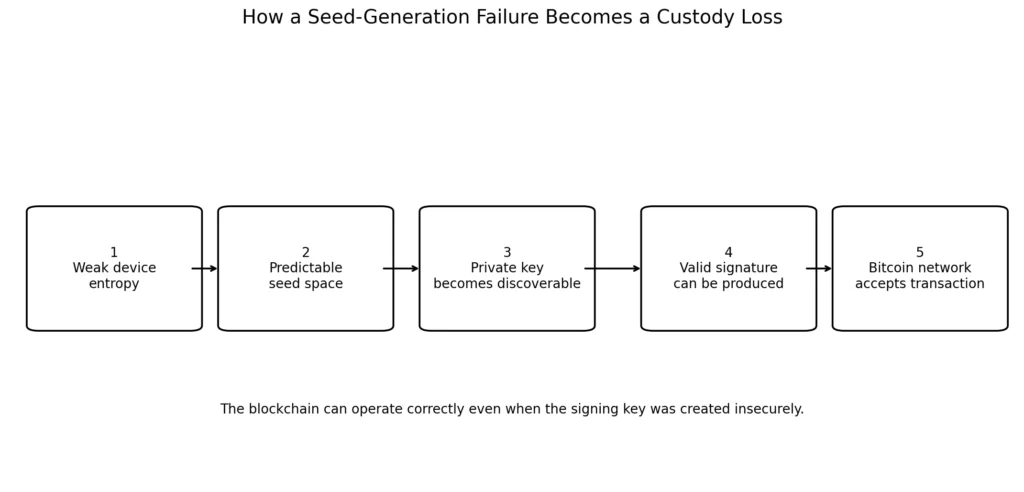
The incident does not show a weakness in Bitcoin’s consensus rules. Instead, it highlights risk in the infrastructure that creates signing authority.
For treasuries, funds, and banks, that distinction matters. Blockchain finality cannot verify whether a private key was generated securely.
Once a valid key signs a transaction, the network treats that signature as legitimate. Governance must therefore sit before the signature.
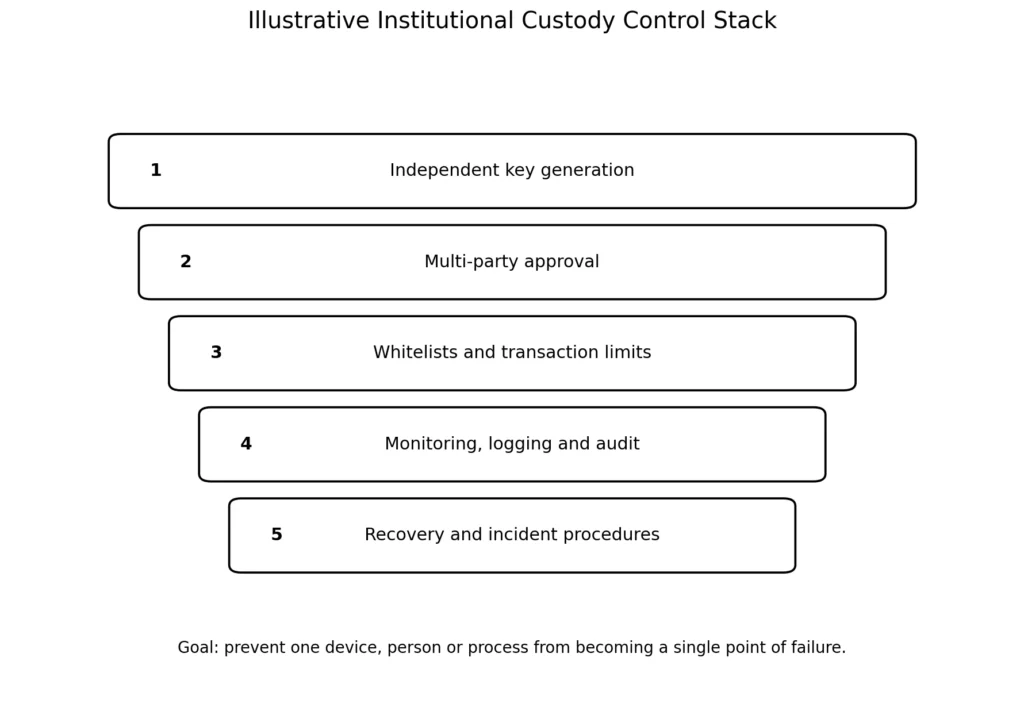
Institutional custody must prevent one device, person, or software process from moving assets alone. That requires independent controls around key creation and withdrawals.
Regulators already focus on custody controls
U.S. banking agencies already treat crypto safekeeping as a risk-management activity. Their joint statement says banks must operate safely and follow applicable laws.
The guidance creates no new supervisory expectations. However, it reinforces that crypto custody should fit established governance and control frameworks.
The Office of the Comptroller of the Currency also permits national banks to outsource crypto custody services. Those arrangements remain subject to appropriate third-party risk management.
After a hardware failure, that requirement becomes more important. Outsourcing custody does not outsource accountability for vendor selection, monitoring, and recovery.
Governance becomes the real custody product
Institutional providers now sell more than offline key storage. They sell approval rules, role separation, address controls, and recovery processes.
One qualified custodian reports $104 billion in assets under custody. It also lists whitelisting, transaction limits, user roles, and security checks.
Those controls show the direction of travel. Strong custody combines technical isolation with operational friction at critical moments.
A robust model can use independently generated keys, multi-party approvals, transaction limits, and verified destination addresses. It also needs tested recovery plans.
No single control removes all risk. The goal is to stop one failure from becoming a total loss.
That design also improves audit trails, clarifies accountability, and gives risk teams measurable checkpoints during incidents.
ETFs gain another custody argument
The episode may strengthen interest in regulated bitcoin investment products. They offer price exposure without requiring investors to manage private keys.
BlackRock’s iShares Bitcoin Trust reported $47.4 billion in net assets on July 24. The product highlights reduced operational and custody complexity.
That structure has trade-offs. Investors gain easier access, but they lose direct control over on-chain bitcoin.
For many institutions, that compromise may be acceptable. Their priority is often governed exposure, auditability, and operational resilience.
What changes next
The Coldcard episode shows that cold storage is only one layer of security. Institutions must also examine entropy, approvals, monitoring, and recovery.
Boards should ask how keys are generated, separated, approved, and replaced. They should also test what happens when one vendor fails.
The emerging standard is layered custody with independent failure boundaries. Controlled friction may become a security feature for institutional capital.