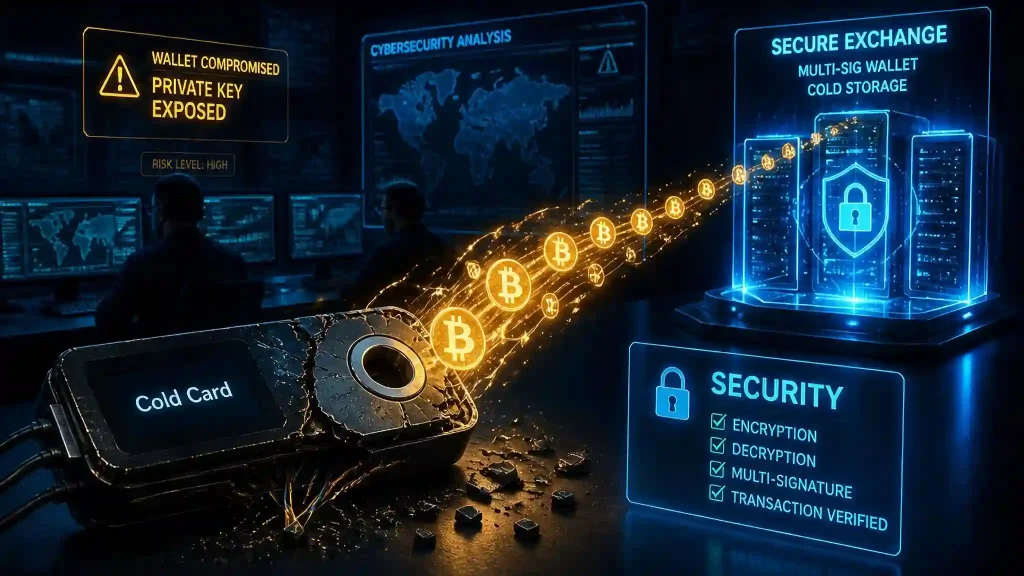


Catenaa, Thursday, August 06, 2026- One of the largest known security breaches involving Bitcoin hardware wallets is driving a sharp shift in investor behaviour, with cryptocurrency holders increasingly moving assets from self-custody wallets back to centralized exchanges in search of stronger security protections.
OKX Chief Compliance Officer Jonathan Brockmeier said the exchange is experiencing record inflows following the Coldcard exploit, suggesting the incident has shaken confidence in self-managed digital asset storage.
The Coldcard vulnerability, disclosed last week, has been linked by Galaxy Research to the theft of more than 1,300 Bitcoin, valued at over $80 million, across multiple waves of attacks. Galaxy has warned total losses could rise further as investigations continue.
Brockmeier said the trend marks a reversal of the market reaction following the collapse of FTX in late 2022, when investors rushed to withdraw funds from exchanges in favour of self-custody.
“We’re seeing record levels of inflows now to centralized exchanges post-Coldcard,” Brockmeier said, describing the movement as the opposite of the post-FTX migration.
The shift highlights the continuing debate within the digital asset industry over the trade-off between user control and institutional-grade security.
While self-custody removes dependence on third parties, it also places full responsibility for safeguarding private keys and recovery phrases on individual users.
Brockmeier argued that centralized exchanges can offer additional protection through dedicated cybersecurity teams and artificial intelligence systems that monitor suspicious activity before transactions are completed.
According to OKX, the exchange prevented $26.3 million in scam-related losses during the first half of 2026 by blocking suspicious transfers.
The company also said it safeguarded more than $1.1 billion in customer assets belonging to over 500,000 users during the same period.
Beyond transaction monitoring, OKX said it uses AI-driven analytics to identify broader fraud indicators, including compromised devices, phishing attempts and social engineering attacks before customer funds are moved.
The exchange’s investigative team includes former law enforcement officials, including former U.S. Drug Enforcement Administration personnel and investigators involved in dismantling the Silk Road darknet marketplace.
The Coldcard incident comes amid a broader rise in digital asset security breaches.
Earlier this year, cybersecurity firm Blockaid reported that crypto projects lost more than $1 billion to hacks during the first half of 2026, while the number of verified exploits reached a record high.
Meanwhile, OKX continues expanding internationally after securing authorization under the European Union’s Markets in Crypto-Assets (MiCA) framework and growing its U.S. operations following its American launch last year.
The exchange said it plans to offer users different levels of account security, allowing customers holding larger balances to activate stricter authentication and withdrawal protections.
The collapse of FTX in 2022 triggered one of the largest migrations toward self-custody in cryptocurrency history as investors sought greater control over their digital assets. Hardware wallets subsequently became widely regarded as the safest storage option. However, the recent Coldcard vulnerability has reignited debate over whether professional custodians and regulated exchanges can sometimes offer stronger protection through dedicated cybersecurity infrastructure, continuous monitoring and institutional risk management.




