

June 02, 2026 – Coinbase has reopened a serious India play. The exchange now supports direct Indian rupee deposits and withdrawals through IMPS. This removes a major friction point for Indian crypto users. It also signals a sharper compliance-led push into one of crypto’s most active markets.
In Summary
Coinbase has launched direct INR deposits and withdrawals in India.
Indian users can now fund Coinbase accounts through IMPS.
The move reduces reliance on peer-to-peer crypto funding routes.
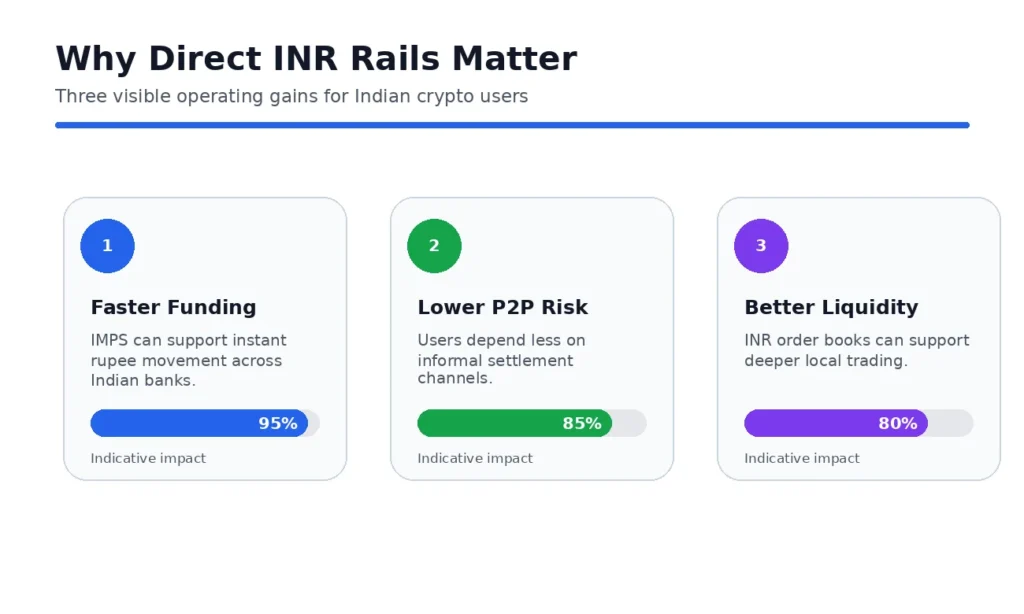
Direct rupee rails can improve liquidity in INR crypto order books.
India remains one of the world’s strongest crypto adoption markets.
Coinbase gains a stronger compliance-led entry point into India.
Tax and regulatory uncertainty may still limit trading momentum.
What Happened
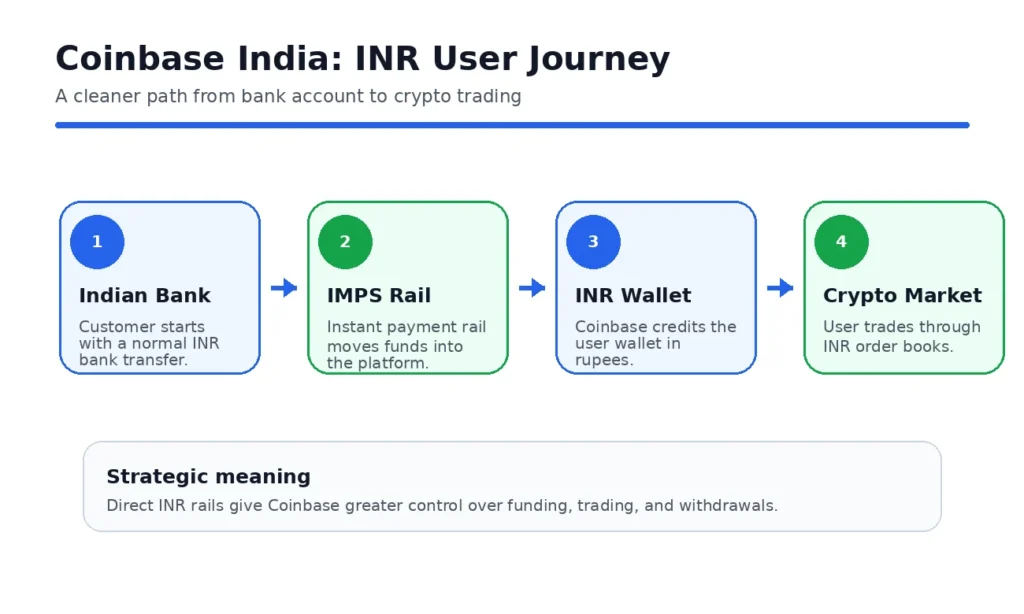
Coinbase has launched direct Indian rupee deposit and withdrawal rails for customers in India. The service uses IMPS, India’s instant interbank payment system. Users can now fund accounts without peer-to-peer rails or third-party intermediaries. Coinbase also says Indian customers can access spot trading, INR order books, and perpetual futures on major crypto assets.
This is more than a product update. It is a strategic re-entry into a difficult but valuable crypto market. Coinbase had earlier paused parts of its India service. It later registered with India’s Financial Intelligence Unit. That registration enabled the exchange to offer crypto services under local anti-money laundering rules.
Why INR Rails Matter
Fiat rails are the front door of any crypto exchange. Without them, users face delays, higher costs, and operational risk. In India, many users have relied on P2P transfers. That model can work, but it adds counterparty risk.
Direct INR rails simplify the user journey. A customer can deposit rupees, buy crypto, trade, and withdraw funds. The process now looks closer to a standard financial app.
IMPS gives Coinbase a strong payment backbone. The network supports real-time, 24/7 interbank transfers across India. That makes it suitable for fast-moving crypto markets.
The Bigger Market Signal
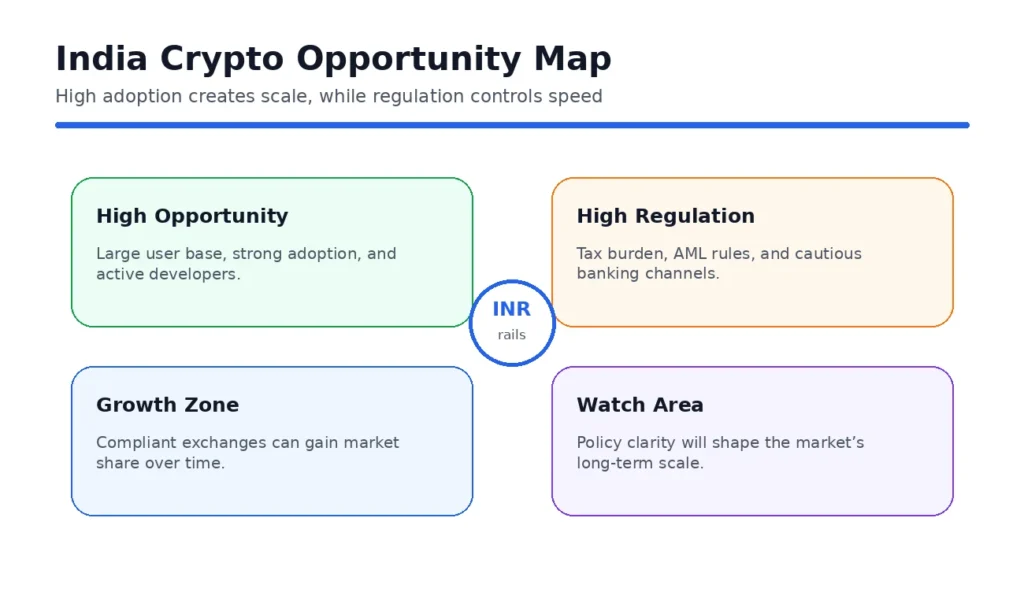
India is not an easy crypto market. However, it is too large to ignore. India ranked first in the 2025 Global Crypto Adoption Index. That ranking reflects strong grassroots activity across centralized exchanges, DeFi, and on-chain services.
This creates a clear opportunity. Coinbase can target serious traders, developers, and institutions. It can also position itself as a regulated alternative to informal access routes.
Still, taxes remain a major challenge. India applies a 30% tax on crypto gains. It also maintains strict anti-money-laundering requirements for crypto platforms. These rules can reduce short-term trading appetite. Yet they also push exchanges toward stronger compliance.
Why Coinbase Wants India Now
Coinbase is trying to diversify growth beyond the United States. That matters because competition in crypto trading remains intense. The company reported an 8.6% market share of crypto trading volume in Q1 2026. It also said derivatives trading volume grew 169% year over year on a trailing 12-month basis.
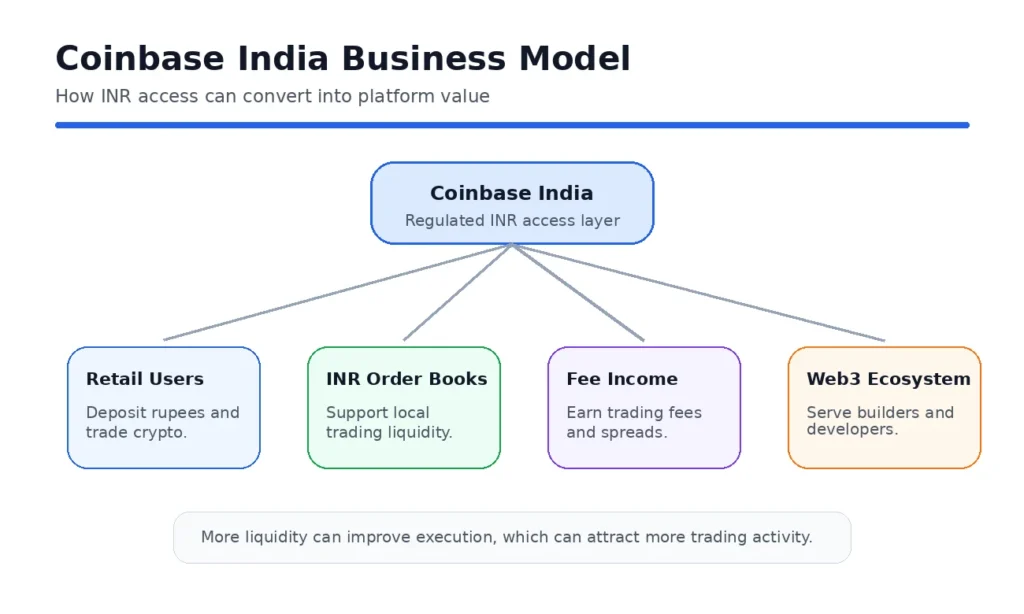
India gives Coinbase three growth levers. First, it can capture retail trading flow. Second, it can build local liquidity in INR order books. Third, it can serve India’s Web3 developer base.
That last point matters. India is not only a trading market. It is also a major source of blockchain engineering talent. Therefore, INR rails could support both user acquisition and ecosystem building.
What Could Go Wrong
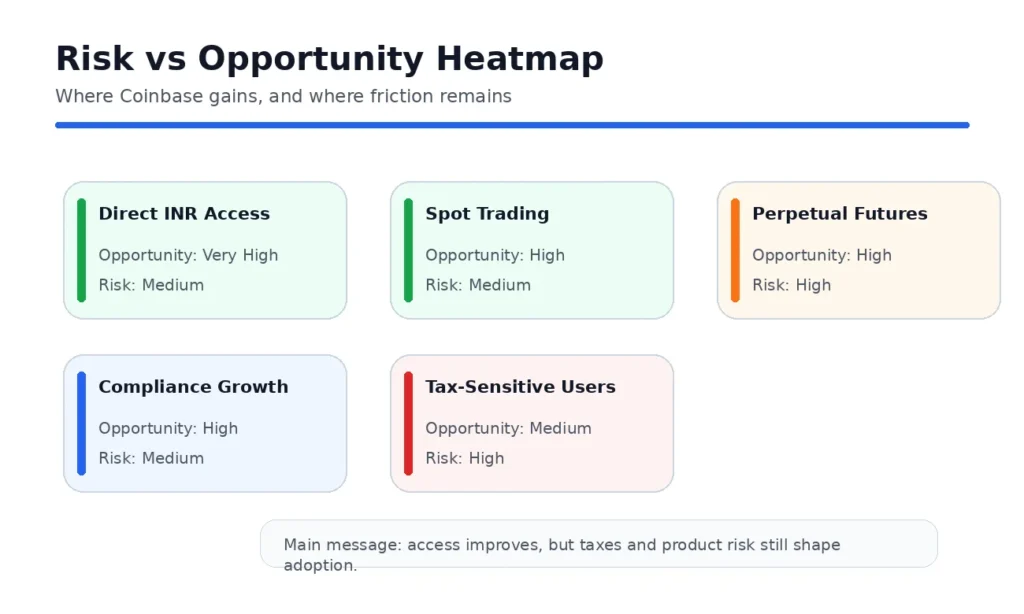
The biggest risk is regulation. India has built a tax and compliance framework but has not enacted a comprehensive crypto law. That gap may keep banks cautious. It may also limit aggressive product expansion.
The second risk is trading economics. A 30% tax on gains can reduce active trading. It may push users toward longer holding periods. It may also reduce high-frequency retail behavior.
The third risk is competition. Local exchanges already understand Indian payment behavior. Global rivals also want access to India’s trading base. Therefore, Coinbase must compete on trust, liquidity, and execution quality.
Analytical View
Coinbase’s India launch is not just about deposits. It is about control over the full trading journey. Direct INR rails improve onboarding, settlement, and liquidity. They also reduce dependence on informal funding channels.
This gives Coinbase a stronger foundation in India. However, the market will not reward access alone. Users will compare fees, execution quality, asset coverage, and withdrawal reliability.
The bigger story is regulatory maturity. India’s crypto market is moving from workaround-based access to access via registered platforms. That shift favors exchanges capable of compliance. It also raises the bar for entry for smaller platforms.
For Coinbase, India is a long-term option. The near-term revenue impact may stay modest. Tax rules still limit trading intensity. Yet the strategic value is clear. India offers scale, developer depth, and persistent crypto demand.