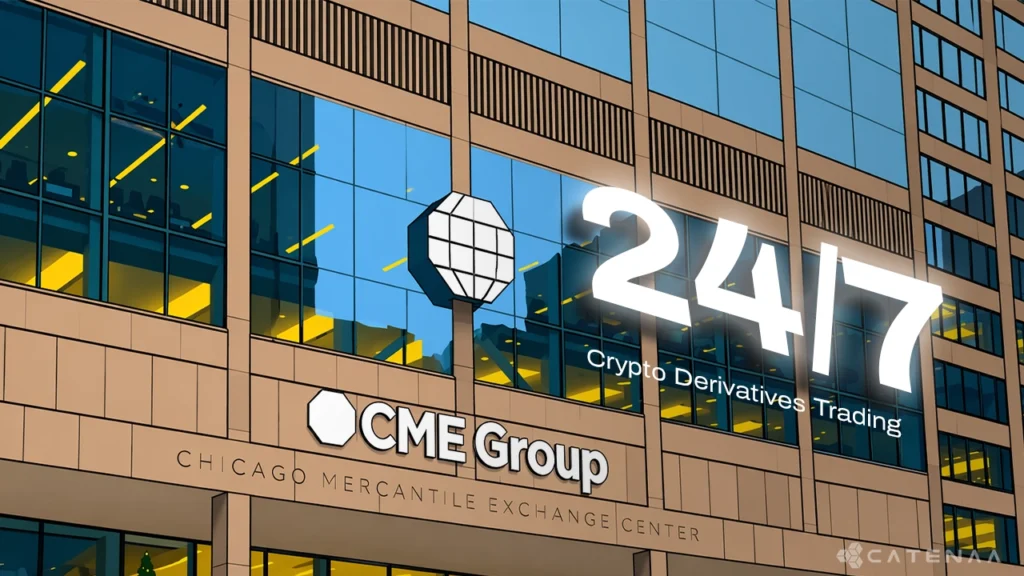


Catenaa, Wednesday, April 15, 2026- CME Group will begin offering round-the-clock trading for its cryptocurrency futures and options on May 29, expanding access to regulated 24/7 crypto markets and adding Avalanche (AVAX) and Sui (SUI) contracts. The move aligns the major U.S. derivatives exchange with the continuous nature of crypto markets.
CME’s decision allows traders to engage in futures and options for Bitcoin, Ethereum, and other crypto assets at any time, matching the non-stop operations of crypto-native platforms such as Binance Futures, Coinbase Derivatives, and Kraken. The expansion will include both standard and micro contracts for Avalanche and Sui, enabling flexible trade sizes of 5,000 AVAX or 500 AVAX and 50,000 SUI or 5,000 SUI.
The exchange currently offers a wide suite of crypto futures covering over 75% of total market capitalization, including BTC, ETH, SOL, XRP, ADA, LINK, and XLM. Average daily open interest across CME’s cryptocurrency products reached nearly $25 billion in 2025. The addition of AVAX and SUI contracts aims to enhance capital efficiency and provide clients with broader choices in regulated trading.
CME first launched bitcoin futures in 2017 and ether futures in 2021. The move toward 24/7 trading reflects growing institutional demand for continuous crypto exposure, as highlighted by BlackRock CEO Larry Fink’s statements on asset tokenization. The U.S. Commodity Futures Trading Commission recently approved the use of certain cryptocurrencies as collateral in derivatives markets, paving the way for expanded offerings.
Offering 24/7 trading positions CME to compete with decentralized and global crypto-native exchanges while maintaining regulatory oversight. Market participants can respond immediately to volatility and global developments without time constraints, potentially attracting increased institutional participation.
The initiative also signals broader acceptance of crypto derivatives in mainstream finance, bridging traditional markets with digital asset infrastructure and liquidity demands.




