

July 29, 2026 – Wall Street’s biggest financial groups are backing the CLARITY Act as Washington nears a decisive crypto policy window. Their support signals that digital assets are moving from specialist markets into mainstream financial infrastructure.
In Summary
Five major financial firms have publicly supported the CLARITY Act.
The House approved the bill with 294 votes, including 78 Democrats.
The Senate Banking Committee advanced it by a 15-to-9 vote.
Stablecoin rewards remain the bill’s hardest unresolved commercial issue.
Passage could accelerate regulated custody, trading, tokenization, and institutional product development.
Institutional support changes the debate
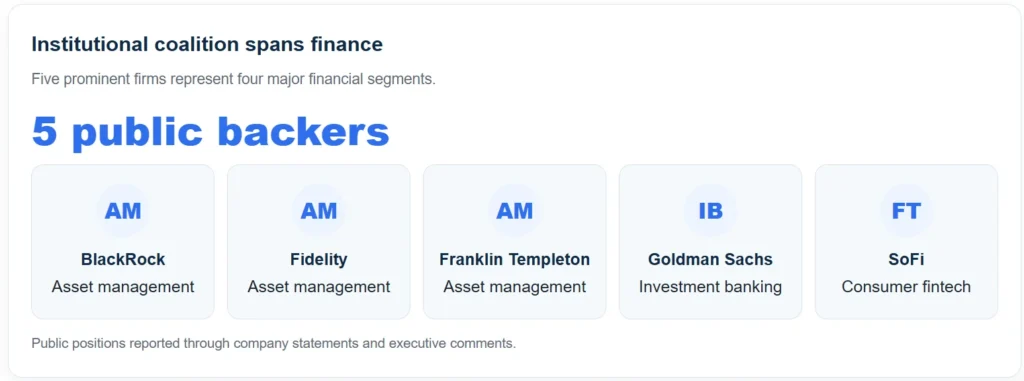
BlackRock, Fidelity, Franklin Templeton, Goldman Sachs, and SoFi have publicly backed the CLARITY Act. That coalition spans asset management, banking, brokerage, and consumer finance.
This matters because these firms already operate under demanding financial rules. Their endorsement reframes crypto legislation as market infrastructure, not industry relief.
Fidelity said statutory clarity could benefit American investors and preserve United States leadership. The Senate Banking Committee also recorded support from technology, investor, and digital asset groups.
However, institutional support does not mean every firm accepts every provision. Instead, large players appear to prefer an imperfect framework over prolonged legal uncertainty.
That preference reflects economics. Regulatory ambiguity raises compliance costs, delays product launches, and restricts partnerships between banks and blockchain companies.
Clearer rules could lower those barriers. They could also increase competition among custodians, exchanges, brokerages, and asset managers.
The bill has real bipartisan momentum
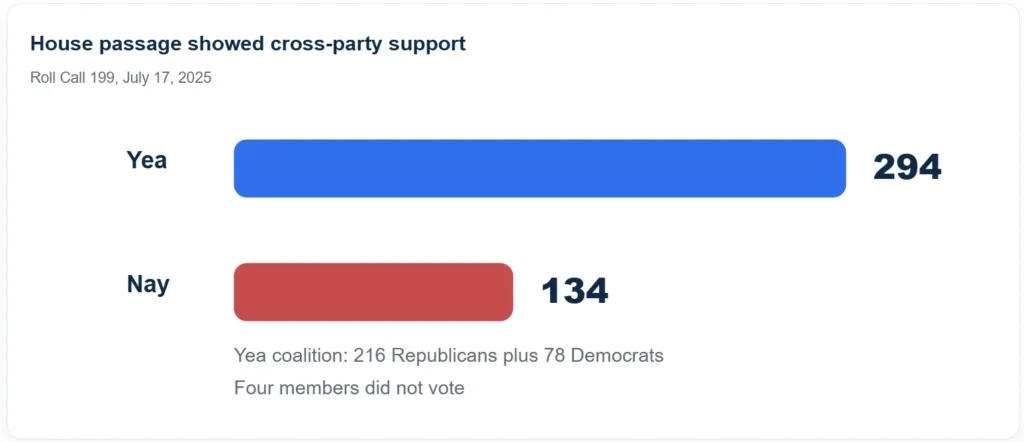
The House passed the measure with 294 votes in July 2025. Support included 216 Republicans and 78 Democrats.
That result gave the proposal a strong bipartisan foundation. Moreover, it reduced the risk that crypto market structure remained a partisan project.
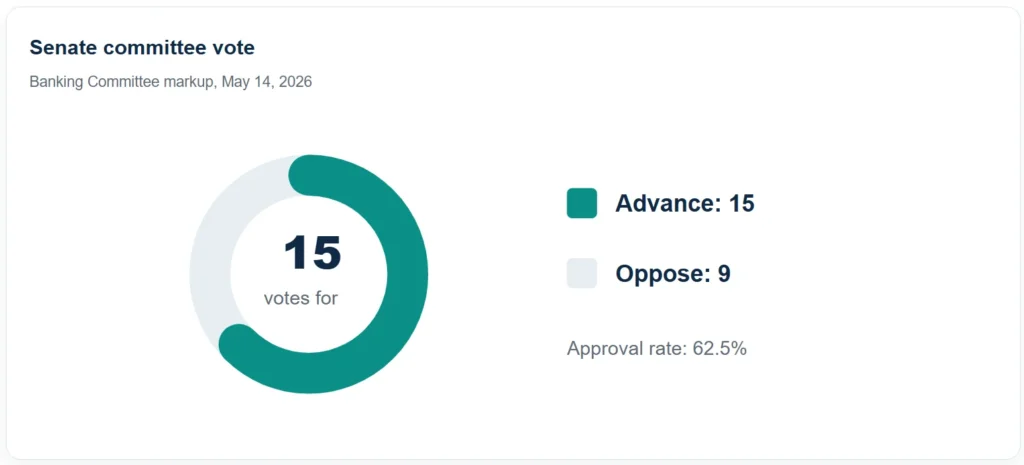
In May 2026, the Senate Banking Committee advanced the bill by 15 votes to 9. The measure now awaits Senate floor action.
Still, committee approval does not guarantee final passage. Senators must resolve policy disputes and manage limited floor time before the August break.
Any Senate amendments would also require House agreement. Therefore, the present momentum remains meaningful but incomplete.
What the CLARITY Act would change
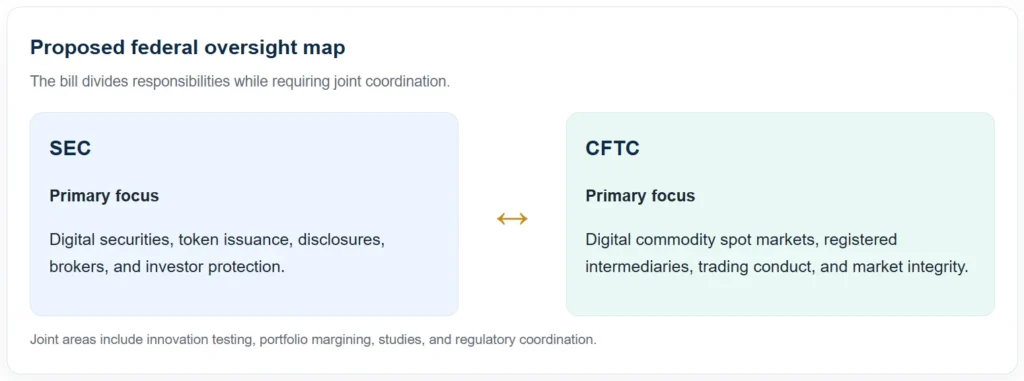
The bill aims to divide digital asset oversight more clearly between two federal regulators. The SEC would retain authority over securities and related issuance.
Meanwhile, the CFTC would gain clearer authority over digital commodity spot markets and registered intermediaries. This split targets a long-running jurisdictional problem.
The framework also creates disclosure duties for certain token issuers. In addition, it establishes federal rules for custody, trading, recordkeeping, and customer protections.
A regulated sandbox would let eligible firms test products under joint supervision. That could support tokenized securities, settlement tools, and new trading models.
Yet implementation would require extensive rulemaking. Consequently, passage would begin the regulatory process rather than complete it.
Stablecoin rewards remain the fault line
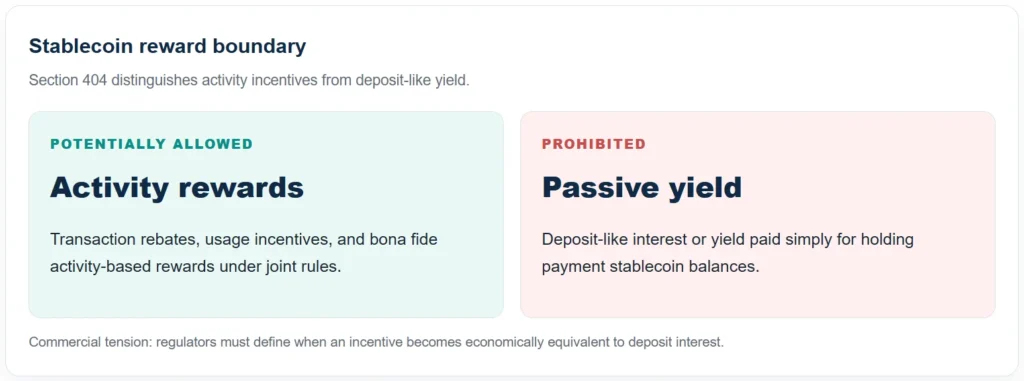
The sharpest dispute concerns rewards linked to payment stablecoins. The bill prohibits passive, deposit-like interest on customer balances.
However, it allows genuine transaction- or activity-based rewards under joint agency rules. That distinction sounds simple, but commercial models can blur the line between both categories.
Banking groups argue that broad rewards could pull deposits from regulated banks. They say weaker deposit funding could pressure community lending and funding costs.
Digital asset firms answer that rewards support competition and consumer choice. They also argue that transaction incentives differ from bank deposit interest.
This conflict explains why several financial institutions support the bill while seeking changes. The final wording will shape competitive outcomes across payments and banking.
Market impact could extend beyond crypto
A durable framework could unlock more institutional custody, tokenized funds, and blockchain settlement. It could also encourage traditional firms to expand digital product teams.
Investors may gain clearer disclosures and stronger protections. However, compliance costs could favor larger firms with established legal and technology budgets.
Smaller companies might benefit from certainty, yet struggle with registration and reporting expenses. Therefore, the law could support innovation while increasing industry concentration.
For capital markets, the near-term effect may be strategic rather than immediate. Boards can approve investment plans once legal responsibilities become easier to model.
That shift could deepen liquidity and improve operational standards.
The broader signal is clear. Wall Street increasingly views blockchain as part of future market infrastructure.
The remaining question concerns the framework’s balance. Lawmakers must protect consumers without preserving avoidable barriers or creating regulatory loopholes.
If Congress reaches that balance, the CLARITY Act could become a foundational United States financial law. If talks fail, uncertainty will continue shaping capital allocation.




