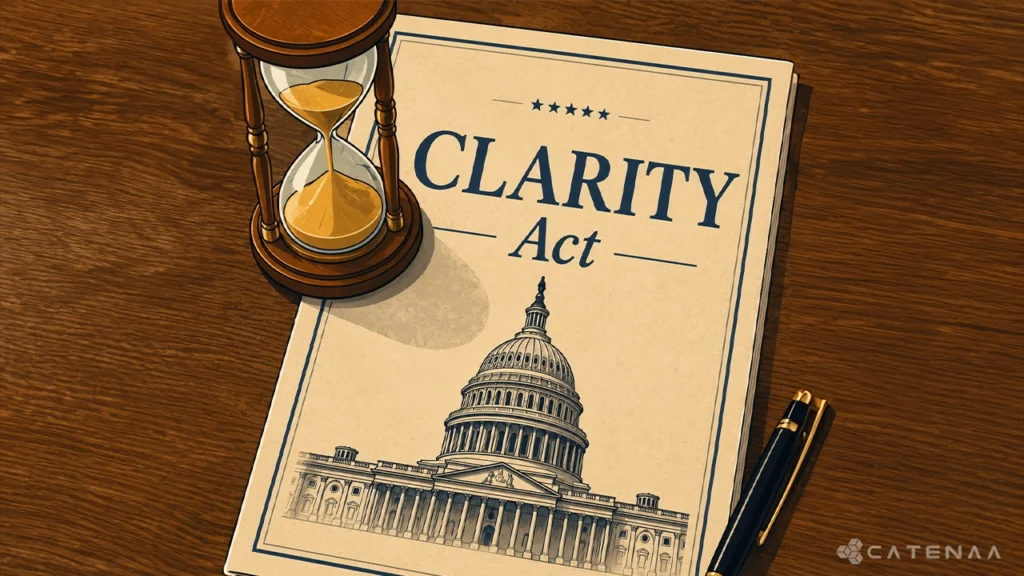


Catenaa, Thursday, July 09, 2026- The likelihood of the US Congress passing the landmark CLARITY Act this year has fallen below 50%, according to investment bank Jefferies, as procedural hurdles and a tightening Senate calendar threaten to delay one of the cryptocurrency industry’s most anticipated regulatory reforms.
In a research note, Jefferies analyst Andrew Moss said prediction market expectations for the bill’s passage by the end of 2026 have dropped to 48%, down sharply from around 70% recorded in mid-May.
The decline reflects mounting concerns that the Senate has insufficient time to complete multiple legislative steps before lawmakers leave Washington for the August recess.
Failure to meet that timeline could postpone the legislation until 2027 or longer, particularly if November’s midterm elections alter the political balance in the Senate.
The CLARITY Act cleared the Senate Banking Committee in May with bipartisan support, passing by a 15-9 vote.
However, significant procedural work remains before the legislation can reach the President’s desk.
Lawmakers must first reconcile separate versions approved by the Senate Banking Committee and the Senate Agriculture Committee before aligning the final legislation with the House-approved version of the bill.
Once unified, the legislation must also secure the 60 votes needed to overcome a Senate filibuster.
Analysts estimate that Congress has only about 20 legislative working days before the August recess to complete those steps.
Several unresolved policy issues continue to complicate negotiations.
Among them are ethics provisions added during committee deliberations, differing approaches to Commodity Futures Trading Commission oversight of digital commodities and disagreements surrounding decentralized finance provisions intended to address anti-money laundering concerns.
Industry observers say these issues could delay floor consideration even if bipartisan support for the broader legislation remains intact.
Jefferies warned that continued uncertainty could increase volatility across both cryptocurrency markets and publicly traded blockchain companies.
The bank identified Coinbase, Circle and Bullish among the firms most exposed to legislative outcomes because their business models are closely tied to future regulatory treatment of digital assets.
Without comprehensive legislation, cryptocurrency firms would continue operating under a regulatory framework shaped primarily by agency guidance rather than federal statute.
That distinction is viewed as particularly important because administrative guidance can be revised more easily than laws enacted by Congress.
Supporters argue the CLARITY Act would establish durable legal definitions for digital assets, clarify the responsibilities of federal regulators and reduce uncertainty surrounding cryptocurrency trading, custody and decentralized finance.
The legislation is widely regarded as the most comprehensive attempt to establish a long-term market structure for digital assets in the United States.
Analysts note that while recent guidance from agencies including the Securities and Exchange Commission, Commodity Futures Trading Commission and Office of the Comptroller of the Currency has improved regulatory clarity, those policies remain subject to future administrative changes.
Political timing is becoming an increasingly important factor.
If Congress fails to advance the bill before August, negotiations would likely resume after the midterm elections, when changes in Senate composition could complicate efforts to assemble the bipartisan support needed for passage.
For the cryptocurrency industry, that scenario would prolong regulatory uncertainty at a time when institutional adoption, tokenization and stablecoin markets continue expanding rapidly.
The CLARITY Act is considered the most comprehensive US cryptocurrency market structure legislation currently under consideration in Congress. The bill seeks to establish clear regulatory boundaries between the Securities and Exchange Commission and the Commodity Futures Trading Commission while creating a statutory framework governing digital assets, exchanges, brokers and decentralized finance platforms. The House of Representatives approved its version of the legislation in 2025 with bipartisan support, but the Senate must reconcile multiple committee versions before a final vote can occur. Industry participants view the legislation as a critical step toward providing long-term regulatory certainty for institutional investment, digital asset innovation and blockchain infrastructure in the United States.