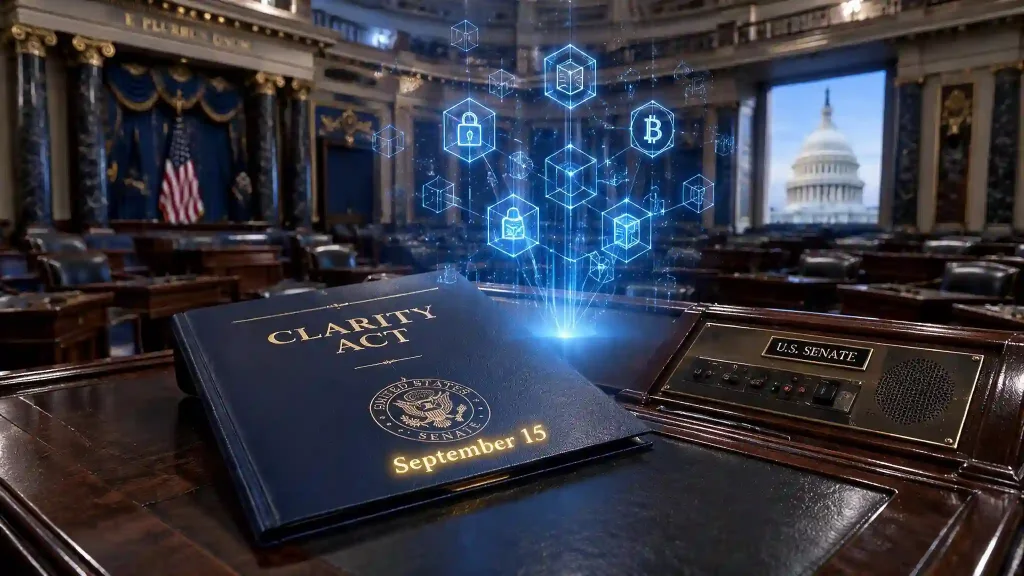


Catenaa, Sunday, August 09, 2026- The US Senate will hold a procedural vote on the CLARITY Act on Sept. 15 after Majority Leader John Thune filed cloture, as reported by the Press Gallery Report on Friday.
This ensures Washington’s flagship crypto market structure bill survives the August recess and returns immediately when lawmakers reconvene.
Meanwhile the CEO of the Crypto Council for Innovation Ji Hun Kim said in an X post on Friday that Thune’s filing for cloture was a critical step forward.
He said: “While we had hoped for full Senate consideration before recess, this begins an important process for Clarity.
“CCI thanks Leader Thune, Senator Lummis, Chairmen Boozman and Scott, and the bipartisan group of negotiators, along with their staff, who have brought this bill within reach.
“We will work with both parties over the August recess to build on this momentum and secure the votes needed for passage in September,” he said.
The move changes the immediate outlook for H.R. 3633, the Digital Asset Market Clarity Act. The legislation had appeared increasingly vulnerable to the congressional calendar after senators failed to bring it to the floor before leaving Washington.
But the Sept. 15 vote is not a vote to pass the CLARITY Act.
It is a vote on whether the Senate should proceed toward considering the legislation. If cloture is invoked, debate on the motion to proceed will be limited, clearing another procedural obstacle before senators can debate and eventually vote on the bill itself.
That distinction matters because the legislation still faces a difficult political test.
Republicans hold 53 Senate seats. Assuming all Republicans support cloture, Thune would still need at least seven Democrats or independents to reach the 60 votes required to advance the measure.
The Senate Banking Committee previously advanced the legislation 15-9, with support extending beyond Republicans.
The Sept. 15 showdown therefore becomes less a test of whether Washington wants crypto regulation and more a test of whether lawmakers can agree on what that regulation should contain.
Three disputes continue to threaten the coalition needed to move the CLARITY Act forward: government ethics, illicit finance provisions and reconciliation of legislation developed by Senate committees.
The ethics dispute has become particularly difficult because it intersects with President Donald Trump’s involvement in digital assets.
Sens. Thom Tillis, R-N.C., and Ruben Gallego, D-Ariz., have worked on a compromise that would strengthen restrictions involving digital assets issued or sponsored by federal officials.
The proposal would also broaden enforcement options by allowing state attorneys general to act against violations.
Those negotiations could become decisive during the August recess. Democrats whose votes are needed to overcome the Senate threshold have pressed for stronger safeguards governing public officials and crypto-related financial interests.
Republican votes cannot necessarily be taken for granted either.
Sen. Josh Hawley, R-Mo., has raised concerns about possible deposit flight from banks, adding another potential obstacle to the vote count.
The delay therefore gives negotiators something they badly needed: time.
But it simultaneously creates another problem. September offers Congress very little of it.
The Senate is scheduled to return Sept. 14, placing the CLARITY Act near the front of the chamber’s agenda.
That could concentrate political pressure on lawmakers who spent months negotiating the legislation.
More than 200 crypto companies and organizations previously urged Senate leaders to bring the bill to a vote. The coalition included major industry groups and companies seeking permanent federal rules for digital asset markets.
The Crypto Council for Innovation described Thune’s cloture filing as an important step and said it would continue working with lawmakers during the recess to build bipartisan support.
Yet the congressional calendar remains unforgiving.
After returning in September, senators face spending legislation and other government business before political attention increasingly shifts toward November’s midterm elections.
That narrowing window has already changed expectations.
Galaxy Research last month reduced its estimated probability that the CLARITY Act becomes law during 2026 to 30%, citing delays and the shrinking legislative calendar.
The Sept. 15 vote could therefore determine whether the legislation regains momentum or enters another prolonged period of uncertainty.
Behind the political maneuvering sits a much larger question for the crypto industry: Who regulates America’s digital asset markets?
The CLARITY Act is designed to establish clearer federal rules governing digital assets and market intermediaries while defining regulatory responsibilities across US. agencies.
Senate Banking Committee leaders have described the legislation as establishing clearer rules for digital assets while strengthening consumer safeguards, illicit-finance controls and regulatory accountability.
The regulatory division between securities and commodities has been one of the industry’s longest-running problems.
Bitcoin has long been treated as a commodity, but the regulatory status of many other digital assets has remained contested.
That uncertainty has affected exchanges, token issuers, brokers, custodians and other companies trying to determine which federal rules apply to their activities.
A statutory framework approved by Congress would carry greater permanence than regulatory interpretations that can change between presidential administrations.
That is why the CLARITY Act has become arguably the industry’s most consequential remaining legislative objective after Washington moved forward with federal stablecoin legislation.
Ironically, delaying the procedural vote could give lawmakers their clearest opportunity yet to resolve the disputes threatening the bill.
The Senate’s recess creates more than a month before the Sept. 15 vote.
Industry groups are expected to use that period to lobby lawmakers, while Senate negotiators attempt to bridge differences over ethics, illicit finance, banking concerns and regulatory jurisdiction.
The central challenge will be assembling a coalition broad enough to survive the Senate’s 60-vote threshold without changing the legislation so extensively that existing supporters abandon it.
The Banking Committee’s earlier 15-9 vote demonstrated that bipartisan agreement is possible. But committee support does not automatically translate into the votes required on the Senate floor.
Even passage by the Senate would not finish the process.
Differences between House and Senate legislation would have to be resolved before identical legislation could reach the president.
That leaves Washington with an unusually compressed timetable.
Failure would not leave US. crypto markets completely unregulated.
Federal agencies would continue developing policy using their existing statutory powers, while courts would continue shaping the boundaries between securities, commodities and other digital assets.
But the industry’s central complaint would remain unresolved: regulatory policy would continue depending heavily on agency interpretation rather than a dedicated market structure law enacted by Congress.
Regulatory classification decisions can affect crypto asset prices, trading activity and the willingness of financial institutions to enter digital asset markets.
The stakes therefore extend beyond whether another crypto bill passes Congress.
The larger question is whether the United States establishes a durable statutory framework for digital asset markets while other jurisdictions continue developing their own regimes.
For months, the biggest enemy of the CLARITY Act appeared to be the congressional calendar.
Thune’s early-morning cloture filing has prevented the clock from running out during the August recess.
It has not solved the political disagreements.
On Sept. 15, senators will determine whether those extra weeks produced enough compromise to give America’s long-running crypto market structure effort another life.
The Digital Asset Market Clarity Act, H.R. 3633, seeks to establish a federal market structure for digital assets and clarify oversight of crypto market participants.
The Senate Banking Committee advanced the legislation 15-9 in May after months of negotiations involving lawmakers, regulators, financial institutions, law enforcement and the digital asset industry.
More than 200 crypto organizations later urged Senate leaders to bring the measure to the floor.
Senate consideration stalled before the August recess amid disputes involving ethics, illicit finance and other provisions.
Majority Leader John Thune’s cloture filing now establishes Sept. 15 as the legislation’s next major procedural test.




