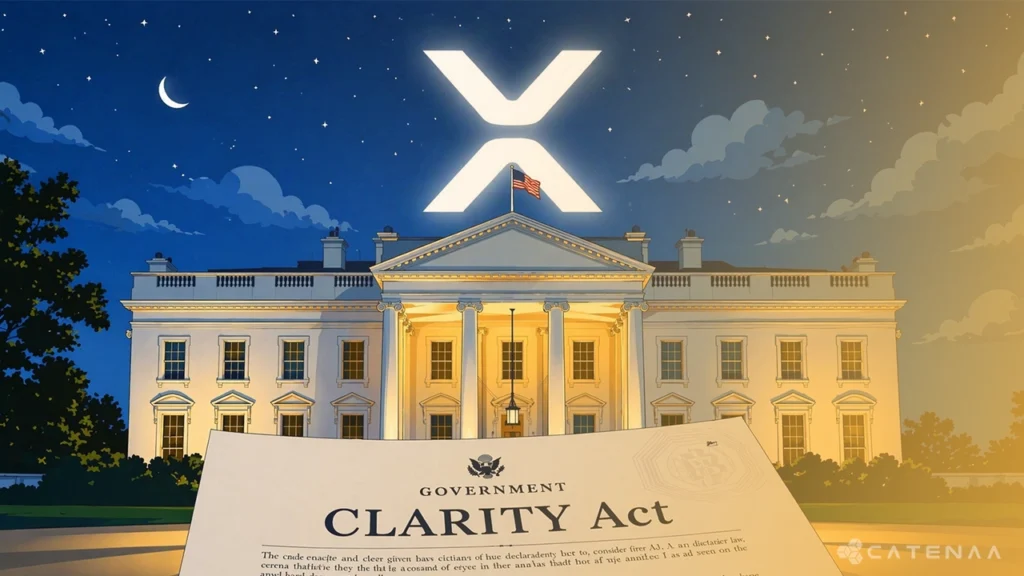


Catenaa, Thursday, April 16, 2026- The U.S. Senate’s CLARITY Act is entering a decisive legislative window, with implications for Ripple’s XRP, stablecoins, and broader institutional cryptocurrency adoption.
Market participants say the next three weeks may determine whether XRP can attract large-scale institutional capital or remain a speculative asset dependent on broader crypto cycles.
The CLARITY Act, if passed, would codify XRP’s status as a digital commodity under Commodity Futures Trading Commission oversight, stripping primary regulatory authority from the Securities and Exchange Commission.
The measure has advanced through the House and the Senate Agriculture Committee but is awaiting markup in the Senate Banking Committee. Without committee action by early May, analysts warn that midterm election dynamics could prevent the bill from reaching a floor vote in 2026.
Senator Bernie Moreno has publicly stated that failure to advance the CLARITY Act by May would likely doom the measure for the year. Industry sources indicate that banks, asset managers, and crypto custodians are closely monitoring the timeline, viewing legal certainty as a prerequisite for committing significant capital to XRP and other regulated digital assets.
Administrative classification by the SEC and CFTC, while supportive of the commodity status, does not provide the permanence institutions require for fiduciary-level investment.
XRP is currently trading near $1.34, up 2% on broader market sentiment, but analysts stress that price movements are secondary to regulatory clarity. Standard Chartered projects that approval could unlock $4 billion to $8 billion in ETF inflows, emphasizing the link between legislation and tangible capital deployment rather than short-term market hype.
Conversely, a stall past May could result in XRP tracking broader crypto trends and potentially falling toward $0.82 under negative macro conditions, according to 24/7 Wall St. analysis.
The Banking Committee’s delay has centered on DeFi provisions and tokenization rules. Senators Tillis and Alsobrooks reached a compromise in March, banning passive yield on stablecoin balances while permitting rewards linked to platform activity and payment usage. Senator Cynthia Lummis confirmed that DeFi provisions are finalized, signaling a potential markup in late April.
Analysts caution that each week of delay compresses the legislative calendar, making passage before the midterm recess increasingly challenging.
Institutional allocators view XRP not as a speculative instrument but as a potential component of regulated portfolio allocations, contingent on legal certainty and custodial infrastructure. Data shows that institutional inflows into XRP ETFs have already reached $41 million year-to-date, indicating investor interest ahead of full clarity. Custodians and fiduciary managers are reportedly structuring allocations with contingency plans tied to legislative outcomes, highlighting the importance of clear statutory treatment.
The distinction between administrative and statutory classification remains critical. While the SEC and CFTC jointly labeled XRP a digital commodity in March, that designation could be reversed by a future administration. Permanent codification under federal law would provide the predictability needed for institutional participation at scale, enabling banks and large asset managers to commit capital to XRP-based instruments and tokenized settlement applications.
Market strategists note that XRP’s price technicals, including a key level around $1.35–$1.40, are signals of institutional positioning rather than purely retail-driven speculation. Whales and large custodial allocations are drawing coins off exchanges, compressing supply and influencing volatility. For allocators, the focus is on risk budgeting, volatility profiles, and compliance-ready frameworks rather than short-term price targets.
Experts say this period represents a pivot for digital assets. The CLARITY Act’s potential passage could serve as a template for future legislation on other cryptocurrencies, stabilizing the regulatory landscape and enabling broader adoption in institutional portfolios. Portfolio managers are watching the law as a structural signal that may shift digital assets from a peripheral speculative category into a mainstream, regulated component of multi-asset portfolios.
Ripple’s XRP, first introduced in 2012, has long been a focal point in the debate over digital asset classification and utility. While administrative guidance has clarified some regulatory ambiguity, only statutory codification can assure institutional allocators of the permanence needed to move significant funds into XRP-based instruments and related tokenized financial products.
As the Senate Banking Committee prepares for a potential markup in the coming weeks, the market is evaluating not only XRP’s price movements but the broader implications for institutional adoption, portfolio structuring, and cross-border settlement infrastructure. The convergence of regulatory certainty and infrastructure maturity is poised to determine whether XRP and similar digital assets can transition from speculative trading instruments to regulated components of global investment portfolios.