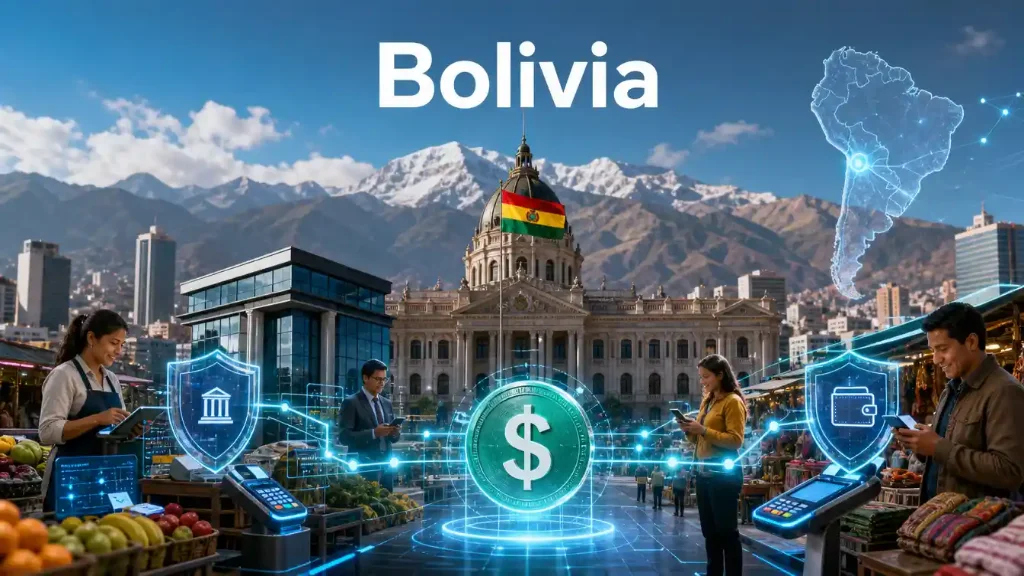


Catenaa, Tuesday, July 14, 2026- Bolivia is considering integrating Tether’s USDT stablecoin into its national payments system, a move that would mark another step toward the adoption of regulated digital dollars in everyday commerce despite the country’s ongoing efforts to strengthen financial oversight.
Bolivia’s Ministry of Economy confirmed it is studying whether USDT could be incorporated alongside existing payment methods while authorities develop regulations governing the use of crypto assets. The proposal follows the country’s decision in 2024 to lift restrictions on cryptocurrency transactions, a policy change that has accelerated digital asset adoption across the South American nation.
Officials stressed that any implementation would proceed cautiously because Bolivia remains on the Financial Action Task Force (FATF) grey list, requiring heightened attention to anti-money laundering and counterterrorism financing standards.
The development illustrates a growing global trend in which governments are evaluating stablecoins less as speculative assets and more as practical payment infrastructure.
Bolivia’s latest initiative reflects a broader shift taking place across emerging economies.
Rather than encouraging cryptocurrency investment, policymakers are increasingly examining whether dollar-backed stablecoins can improve domestic and cross-border payments.
USDT has become one of the most widely used digital payment assets in Latin America, particularly in countries experiencing currency volatility or limited access to US dollars.
Its relatively stable value and round-the-clock settlement capabilities have made it attractive for remittances, international trade and business payments.
Bolivia’s proposal suggests authorities are seeking to regulate that growing usage instead of allowing it to develop outside the formal financial system.
Government officials emphasized that regulatory safeguards remain the priority.
The Ministry of Economy confirmed it is preparing rules governing the responsible use of crypto assets while ensuring compliance with international financial standards.
Bolivia’s inclusion on the FATF grey list adds another layer of complexity.
Countries under increased monitoring are expected to strengthen measures against money laundering and terrorist financing before expanding access to new financial technologies.
As a result, any stablecoin integration is likely to be accompanied by strict customer identification, transaction monitoring and reporting requirements.
Rather than introducing USDT without oversight, Bolivia appears to be pursuing a regulated framework similar to approaches emerging in other jurisdictions.
Bolivia’s interest in USDT also reflects wider developments across Latin America.
The region has become one of the fastest-growing markets for stablecoins as businesses and households increasingly seek alternatives to volatile local currencies and expensive cross-border payment systems.
According to recent blockchain industry data, Bolivia processed approximately $14.8 billion in cryptocurrency transactions between July 2024 and June 2025, ranking among the region’s more active digital asset markets.
Institutional adoption has also expanded.
Banco Bisa, one of Bolivia’s largest financial institutions, introduced custody services for USDT in 2024, providing regulated storage and transfer capabilities for customers.
Those developments indicate that stablecoins are gradually becoming integrated into mainstream financial services rather than remaining confined to cryptocurrency exchanges.
Bolivia joins a growing list of countries evaluating stablecoins as part of national payment infrastructure.
Governments across Asia, Latin America and the Middle East are increasingly balancing innovation with regulatory oversight as stablecoins gain acceptance in commerce and finance.
Unlike central bank digital currencies, privately issued stablecoins can often be deployed more rapidly because the underlying infrastructure already exists.
For policymakers, the challenge is ensuring those payment systems operate within established financial regulations.
Bolivia’s review of USDT demonstrates how that balance is becoming an increasingly important policy objective.
If approved, the initiative would further reinforce the role of regulated stablecoins as mainstream financial infrastructure rather than simply digital trading instruments.
Bolivia prohibited cryptocurrency transactions for several years before reversing its position in 2024 as digital asset adoption accelerated across Latin America. Since then, regulators have gradually developed a legal framework governing cryptocurrency activity while monitoring international compliance standards. Tether’s USDT is the world’s largest stablecoin, with a market capitalization exceeding $184 billion, and has become widely used for cross-border payments, remittances and digital commerce. Across Latin America, stablecoins are increasingly serving as practical payment tools in economies where access to US dollars and efficient international settlement remains limited.