

August 02, 2026 – A $44 billion seven-year Treasury sale cleared at 4.473%. The Fed then held rates steady, yet long-dated yields climbed anyway.

In Summary
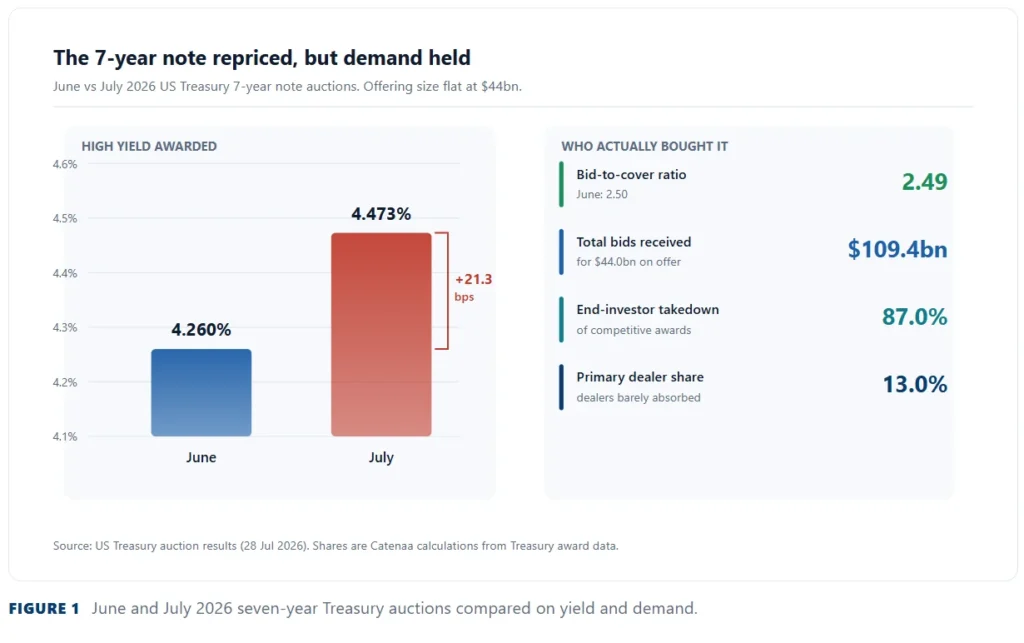
A $44bn seven-year Treasury sale cleared at 4.473%, some 21.3 basis points above June’s award.
Demand stayed normal. Dealers took only 13.0% of competitive awards, so end investors absorbed 87.0%.
The Fed held at 3.5% to 3.75% on a 9 to 3 vote, yet thirty-year yields still jumped 11 basis points.
On Fed day, seven-year real yields fell while nominal yields rose. Inflation compensation drove the whole move.
A buyer now locks in about 2.32% real per year, so Bitcoin must clear a guaranteed inflation-beating return.
The Bitcoin yield hurdle rose sharply in the last week of July. On July 28, the US Treasury sold $44 billion of seven-year notes. Buyers accepted a high yield of 4.473%.
That rate sits 21.3 basis points above June’s 4.260% award. Moreover, it landed one day before the Federal Reserve met. Investors could therefore lock in a state-backed return before policymakers spoke.
Bitcoin makes no such promise. It pays no coupon. Instead, it asks buyers to trust future price gains.
A repricing, not a buyer strike
Demand held up well. The sale drew $109.4 billion in bids. That works out to a bid-to-cover ratio of 2.49, just below June’s 2.50.
Furthermore, dealers barely had to step in. Primary dealers took only 13.0% of competitive awards. End investors absorbed the other 87.0%, per Catenaa calculations from Treasury data.
The label high yield sounds like praise. In truth, it simply names the highest accepted bid. Every winner pays that same rate.
Notably, the note cleared close to fair value. Seven-year yields sat near 4.47% in the secondary market that day. Buyers therefore demanded almost no extra discount.
So this was no failed sale. Rather, it reset what investors charged to hold medium-term debt.
The Fed held, yet the curve steepened
On July 29, the Fed kept its target range at 3.5% to 3.75%. However, the vote split 9 to 3. Beth Hammack, Neel Kashkari and Lorie Logan each backed a quarter-point hike.
Markets did not read that hold as dovish. Instead, long-dated yields sold off hard.
Two-year yields fell 4 basis points that day. Meanwhile, thirty-year yields jumped 11 basis points. Consequently, the gap between them widened from 83 to 98 basis points in one session.
By July 31, the pattern had deepened. Two-year yields sat just 2 basis points above their auction-day level. Thirty-year yields, by contrast, had climbed 18 basis points.
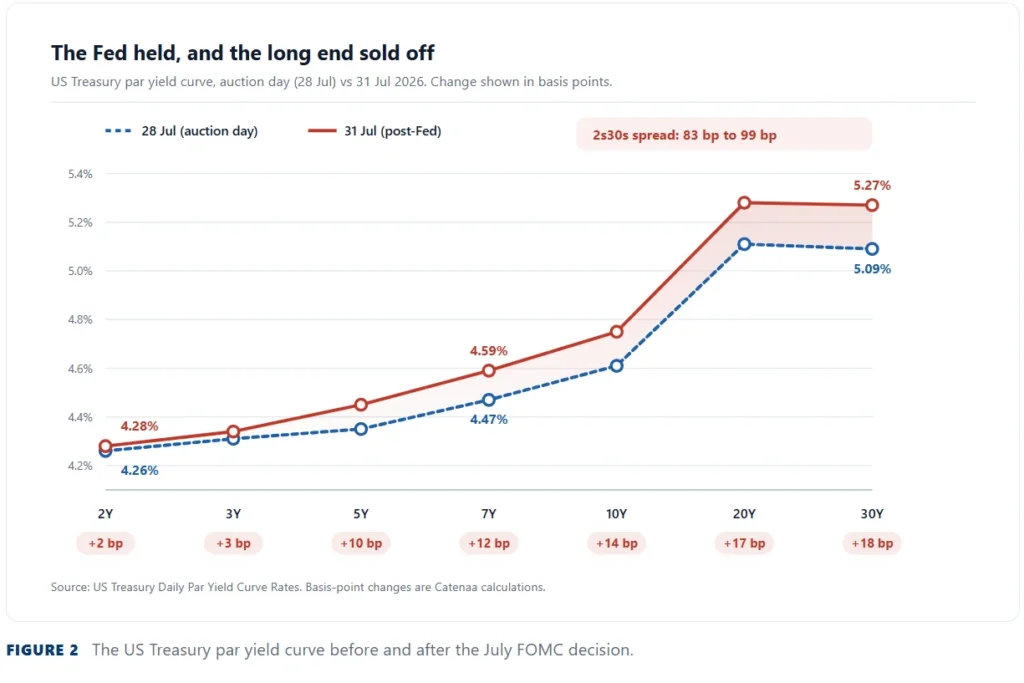
Zoom out, and July looks punishing for bondholders. Seven-year yields opened the month at 4.35%. They finished it at 4.59%.
Why the Bitcoin yield hurdle now bites
The sharpest signal came from real yields. On Fed day, seven-year nominal yields rose 4 basis points. Yet seven-year real yields fell 4 basis points.
In other words, the whole nominal move came from inflation expectations. Seven-year breakevens widened from 2.18% to 2.26%.
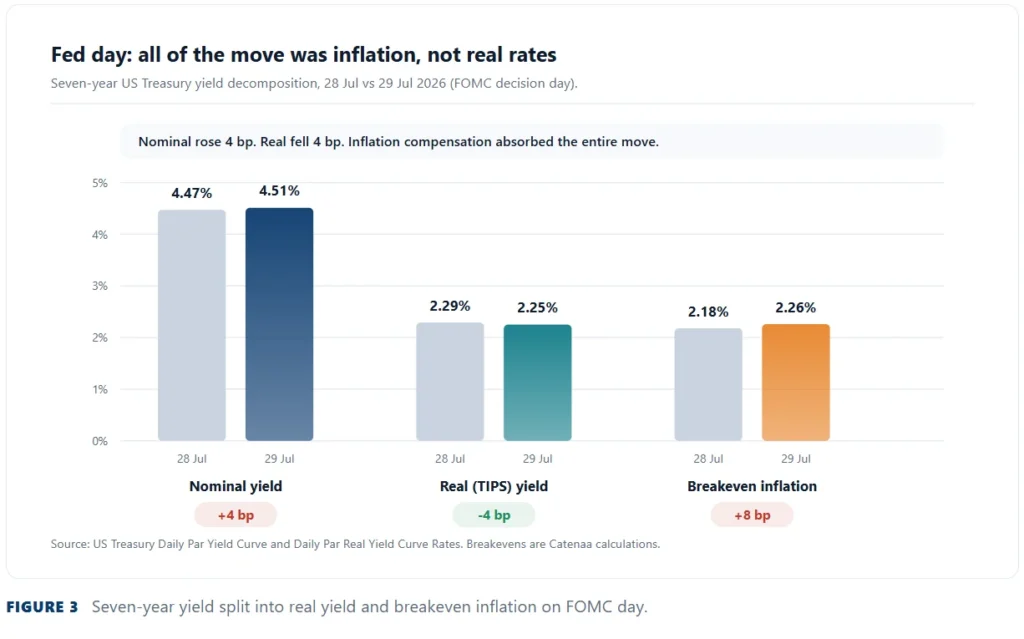
That split cuts both ways for crypto. Rising inflation expectations do support the hard-money case for Bitcoin. At the same time, the note still pays a guaranteed real return.
By July 31, the seven-year real yield reached 2.32%. A buyer therefore locks in roughly 17.4% of guaranteed purchasing power over seven years, per Catenaa calculations.

Higher yields bite through a second channel too. Traders pay more to borrow. Companies pay more to raise capital. As a result, managers grow warier of assets that pay nothing.
The scoreboard after the meeting
Nominal maths tells a similar story. Compounded, 4.473% delivers about 35.8% over seven years. Bitcoin thus needs a 36% gain simply to match a risk-free note.
Spot prices, meanwhile, barely moved. Bitcoin changed hands near $63,674 on July 28 and $64,777 on July 31. Since then, it has slipped back toward $63,400.
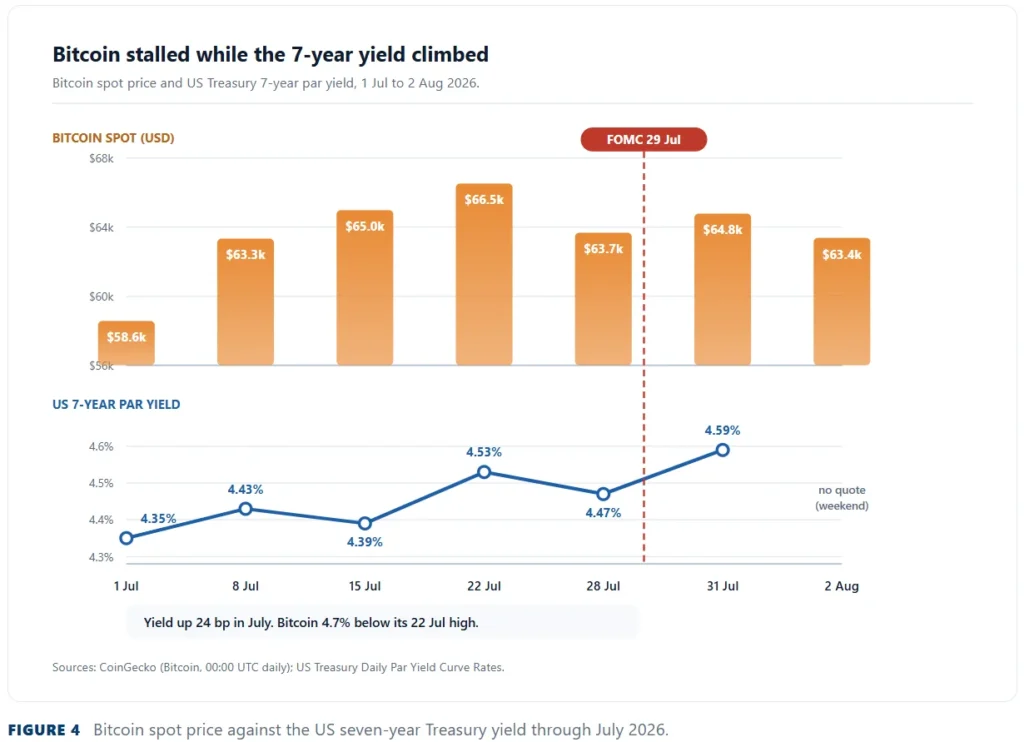
The wider July arc looks softer still. Bitcoin peaked near $66,521 on July 22. It has drifted lower ever since.
Auction buyers did not escape unscathed either. As yields climbed, the new note shed about 0.70% of its price by July 31.
Still, that dip fades for anyone holding to maturity. Bitcoin owners enjoy no such backstop.
What to watch next
Three variables now matter most. First, track the long end of the curve. Second, track breakeven inflation. Third, track spot demand.
A rising Bitcoin price alongside rising real yields would signal true crypto-specific buying. Conversely, fresh weakness would confirm that bonds keep winning the contest for new money.
The Fed sets the overnight rate. Investors, though, set almost everything beyond it. Right now, they want more.




