

Catenaa, Monday, May 18, 2026- Bitcoin paused near $83,000 this week after a strong months-long rally fueled by US crypto legislation progress, a new Federal Reserve chairman, easing geopolitical fears and heavy institutional buying, while traders now wait for fresh catalysts to extend gains.
Bitcoin climbed about 35% since February lows below $60,000 as investors reacted positively to several political and financial developments tied to cryptocurrency markets.
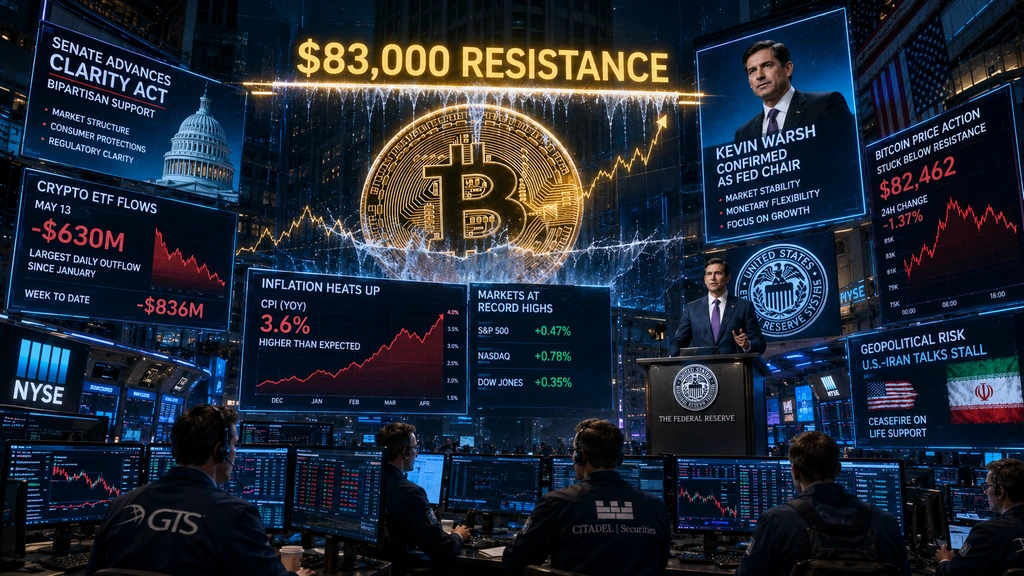
The latest push came after the US Senate Banking Committee advanced the CLARITY Act in a 15-9 vote. The bill would establish the first broad federal framework for digital assets in the United States. Markets also reacted to the Senate confirmation of Kevin Warsh as the next Federal Reserve chair.
Warsh has previously described Bitcoin as an important financial asset. Some investors believe his leadership could lead to lower interest rates and looser monetary policy, conditions often viewed as favorable for risk assets such as cryptocurrencies.
Still, momentum slowed last week as Bitcoin repeatedly failed to break above the $82,000 to $83,000 range.
Market Pause
Analysts said many short-term traders already locked in profits after Bitcoin reached major technical targets.
At the same time, fresh inflation concerns weakened appetite for risk across financial markets despite US stock indexes reaching record highs.
Data released last week showed inflation rising faster than expected. That triggered fears the Federal Reserve could delay future rate cuts. Spot Bitcoin exchange-traded funds also recorded heavy outflows. Net withdrawals reached $836 million by Thursday, including a single-day outflow of $630 million on May 13, the largest since January.
Some traders linked the withdrawals to concerns over inflation and uncertainty surrounding future Fed policy under Warsh.
New Drivers
Attention is now shifting toward new political and institutional developments that could shape Bitcoin’s next move.
Investors are closely monitoring quarterly Form 13F filings, which disclose institutional investment holdings. Markets expect the filings to reveal whether major funds increased or reduced exposure to crypto-related assets during the first quarter.
Traders are also waiting for updates regarding the proposed US Strategic Bitcoin Reserve.
At the Consensus Miami conference, Patrick Witt, executive director of the President’s Council of Advisors for Digital Assets, said an announcement could arrive within weeks.
Witt also said passing the CLARITY Act by July 4 would become a symbolic milestone during celebrations marking America’s 250th anniversary.
Political Risks
Geopolitical tensions remain another pressure point for crypto markets.
US-Iran peace talks stalled during President Donald Trump’s state visit to China last week. Trump reportedly rejected Iran’s latest proposal and warned the current ceasefire was “on life support.”
Crypto traders have spent months tracking global conflict risks alongside regulation and monetary policy because geopolitical instability often influences capital flows into alternative assets such as Bitcoin and gold.
The CLARITY Act remains one of the crypto industry’s biggest policy goals this year.
The legislation would divide oversight of digital assets between the Securities and Exchange Commission and the Commodity Futures Trading Commission. It would also establish clearer rules for exchanges, token issuers and decentralized finance platforms.
The bill still faces hurdles before becoming law. It must clear a full Senate vote and overcome political disagreements surrounding ethics rules and federal oversight.
Some Democrats continue demanding tougher conflict-of-interest restrictions tied to Trump family crypto ventures.
Market participants still view the committee approval as a major step toward regulatory certainty after years of legal ambiguity surrounding digital assets in the United States.
Institutional interest also remains strong despite recent ETF outflows.
Several large asset managers, banks and sovereign wealth funds expanded crypto-related holdings during the first quarter, according to recent SEC disclosures.
That trend has strengthened expectations that traditional finance firms will continue increasing exposure to Bitcoin and crypto investment products during 2026.
For now, traders appear caught between optimism over regulation and institutional adoption, and caution surrounding inflation, monetary policy and global political risks.