


June 01, 2026 – Thirteen leading AI systems weigh in on Bitcoin’s year-end destination. The spread runs from $50,000 to $145,000.
In Summary
Bitcoin fell roughly 4% this week, settling near $73,500 on Friday, May 30.
U.S. spot Bitcoin ETFs recorded over $2.8 billion in outflows across nine consecutive trading days.
Thirteen AI models gave year-end 2026 BTC price targets ranging from $50,000 to $145,000.
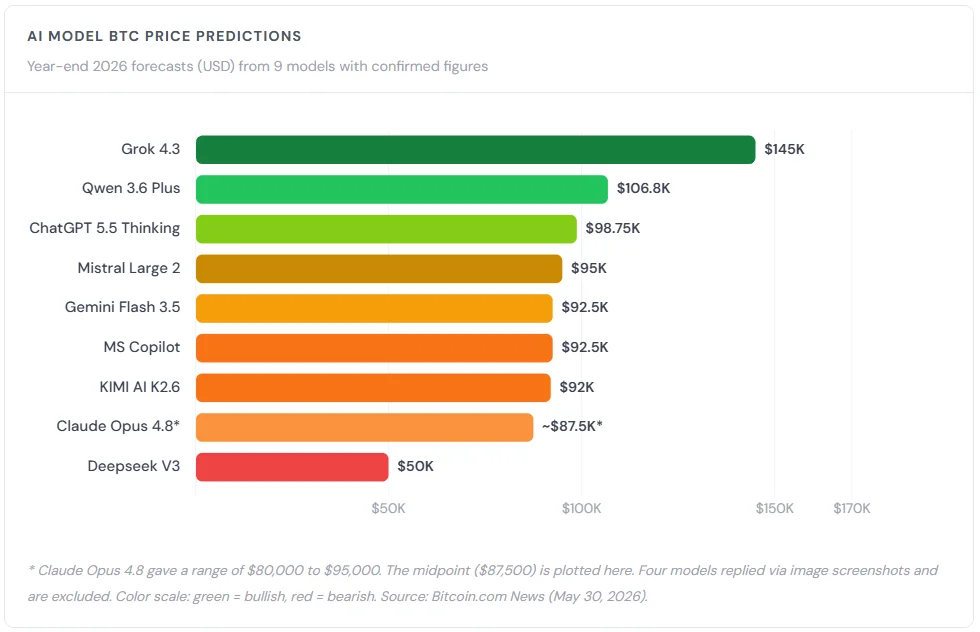
Grok 4.3 Expert Mode set the highest target at $145,000, citing ETF inflows and institutional adoption.
Deepseek V3 is the lone bear, projecting $50,000 based on historical cycle drawdown patterns.
The AI consensus midpoint is between $95,000 and $99,000 as of December 31, 2026.
Bitcoin started the week of May 26 near $77,000. By Friday, it had settled near $73,500. That is a roughly 4% weekly decline. U.S. spot Bitcoin ETFs posted over $2.8 billion in outflows across nine consecutive trading days. A single session on May 27 saw $733 million exit Bitcoin funds. BlackRock’s IBIT accounted for $528 million of that daily figure alone. Geopolitical tension pushed traders toward the U.S. dollar. Stubborn inflation data also held back rate-cut expectations. Spot buyers stepped in near $72,000, helping stabilize prices heading into the weekend close.
Why This Pullback Stands Out
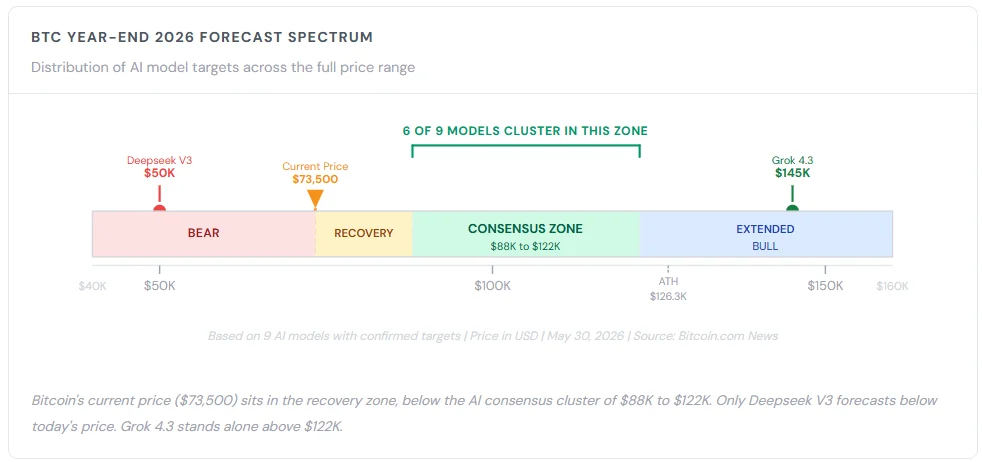
Bitcoin reached an all-time high of $126,272 in October 2025. The current price sits 41% below that record. Such a drawdown follows a familiar pattern in Bitcoin cycles. However, this cycle carries significant structural differences from prior ones. Spot ETFs launched in early 2024 now hold billions in assets under management. Corporate treasury buyers add another layer of demand above retail investors. Furthermore, on-chain data shows exchange reserves near multi-year lows. Long-term holders are not rushing to exit their positions. Therefore, while the pullback looks sharp, the broader market structure remains relatively intact.
Thirteen AI Models Give Their Forecasts
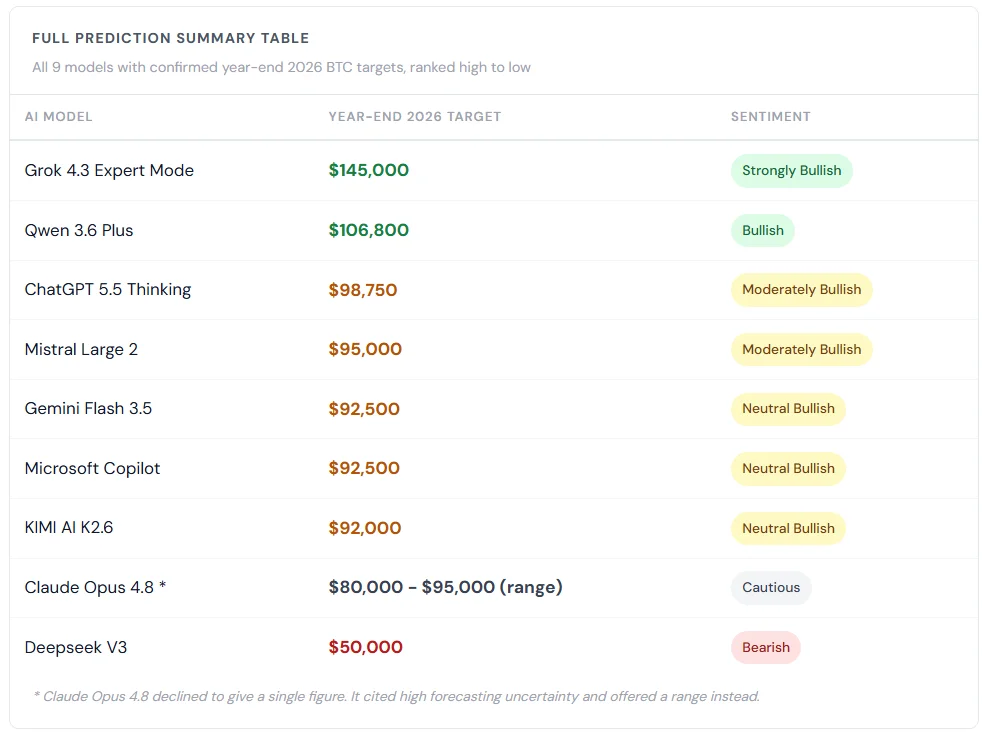
Bitcoin.com News queried 13 leading AI models on May 30, 2026. Each model received the same structured prompt. The prompt asked for a definitive BTC closing price on December 31, 2026. BTC was trading near $73,900 at the time of the query. The answers covered a remarkably wide range. Grok 4.3 Expert Mode came in highest at $145,000. It cited growing ETF inflows and accelerating institutional momentum. Deepseek V3, however, was the most bearish at $50,000. It pointed to historical drawdowns of 70-80% from prior cycle peaks. Most models, moreover, clustered between $88,000 and $122,000. For example, Qwen 3.6 Plus predicted $106,800. ChatGPT 5.5 Thinking estimated $98,750. Gemini Flash 3.5 and Microsoft Copilot both projected $92,500. KIMI AI gave $92,000, and Mistral Large 2 forecasted $95,000.

The Bull Case
Several models share a clear bullish outlook for the second half of 2026. Bitcoin’s April 2024 halving cut daily new supply from 900 BTC to 450 BTC. Historically, that supply shock precedes strong price rallies 12 to 18 months later. Additionally, institutional ETF demand remains structurally significant. Analysts at Franklin Templeton projected BTC above $100,000 by year-end 2026. Furthermore, a Federal Reserve pivot toward rate cuts would broadly lift risk assets. Grok’s $145,000 target reflects maximum optimism on these combined factors. Arthur Hayes has also publicly targeted $145,000, citing fiscal stimulus tailwinds and balance-sheet expansion.
The Bear Case
Deepseek V3 stands alone with its $50,000 projection. Its reasoning draws directly on prior Bitcoin cycle data. From 2017 to 2018, Bitcoin fell 84% from its peak. From 2021 to 2022, it dropped 77%. Applying similar percentages to the $126,272 ATH gives a potential floor of $20,000 to $38,000. Deepseek’s $50,000 is therefore more conservative than pure cycle math would produce. Claude Opus 4.8 also urged caution. Rather than a single precise number, it offered a range of $80,000 to $95,000. It explicitly flagged the inherent uncertainty of year-end point forecasts.
Key Drivers to Watch
Three main factors will shape Bitcoin’s path through the rest of 2026. First, ETF flows must reverse from outflows to inflows. Nine straight days of net outflows created significant selling pressure. Any sustained reversal could act as a powerful price catalyst for Q3. Second, Federal Reserve rate decisions will set the macro backdrop for H2. A rate cut in Q3 or Q4 would likely meanfully boost Bitcoin. Third, on-chain supply metrics remain supportive at current levels. Miner selling pressure has largely been absorbed since the April 2024 halving. Moreover, long-term holder wallets continue to accumulate at these prices. As a result, any sudden rise in demand could produce outsized upward price moves.
The AI Consensus
Across the nine models with confirmed price targets, the outlook leans cautiously bullish. The consensus midpoint sits near $95,000 to $99,000. That represents a 29-35% gain from current levels near $73,500. However, no model predicts a new all-time high for Bitcoin in 2026. Moreover, most agree the $126,272 record will not be retested this calendar year. The spread from $50,000 to $145,000 reflects genuine market uncertainty. Nevertheless, the clustering of most forecasts around $92,000 to $107,000 points to a moderate recovery as the base case. Ultimately, whether that recovery arrives depends on macro signals that no AI model can fully predict today.




