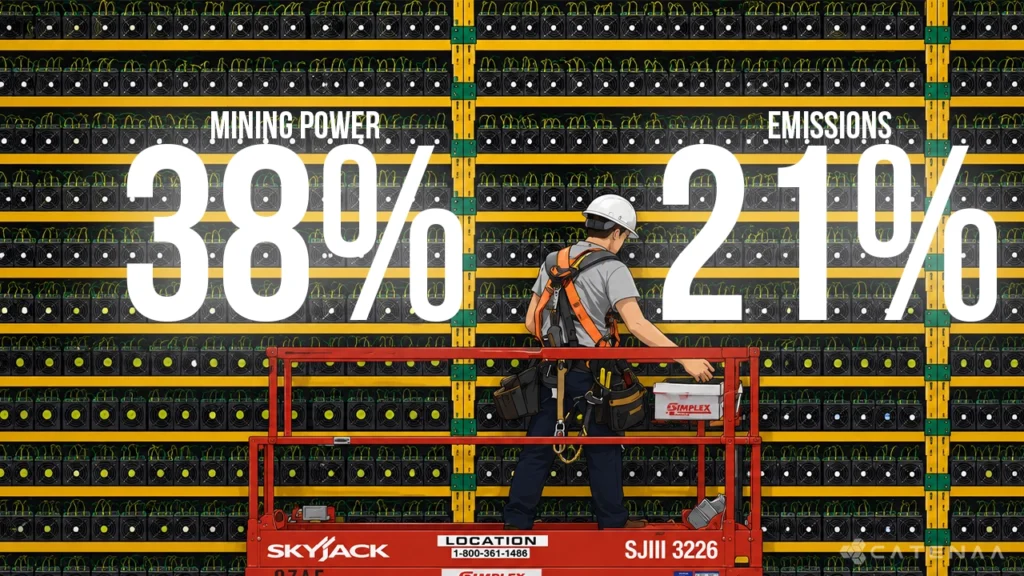


July 27, 2026 – Cambridge’s preliminary data puts annualised network demand near 190 TWh. Hydropower has overtaken gas, and the carbon per kilowatt-hour is falling fast.

In Summary
Bitcoin mining power reached about 190 TWh a year in December 2025, up 38% from June 2024.
Emissions climbed only 21%, so implied carbon intensity fell from roughly 288 to 253 grams per kWh.
Hydropower overtook natural gas as the largest single source, lifting the low-carbon share to 59.4%.
Wider survey coverage in hydro-rich markets such as Ethiopia may explain part of that greener mix.
Only 10% of miners have live AI or HPC loads, and TeraWulf shows compute revenue replacing mining income.
Bitcoin mining power demand climbed to roughly 190 terawatt hours a year by December 2025. That marks a 38% jump from 138 TWh in June 2024. However, greenhouse gas output grew far more slowly across the same 18 months.
Alexander Neumueller of the Cambridge Centre for Alternative Finance presented the early numbers in Dallas. He spoke in July at the Energy Investors Forum. Moreover, Cambridge expects to publish its full second-edition report later in 2026.
Power climbs faster than the carbon bill
Estimated emissions rose from about 40 million tonnes to 48 million tonnes of CO2 equivalent. Therefore, power use grew 38% while emissions grew only 21%. That gap reflects a cleaner reported fuel mix.
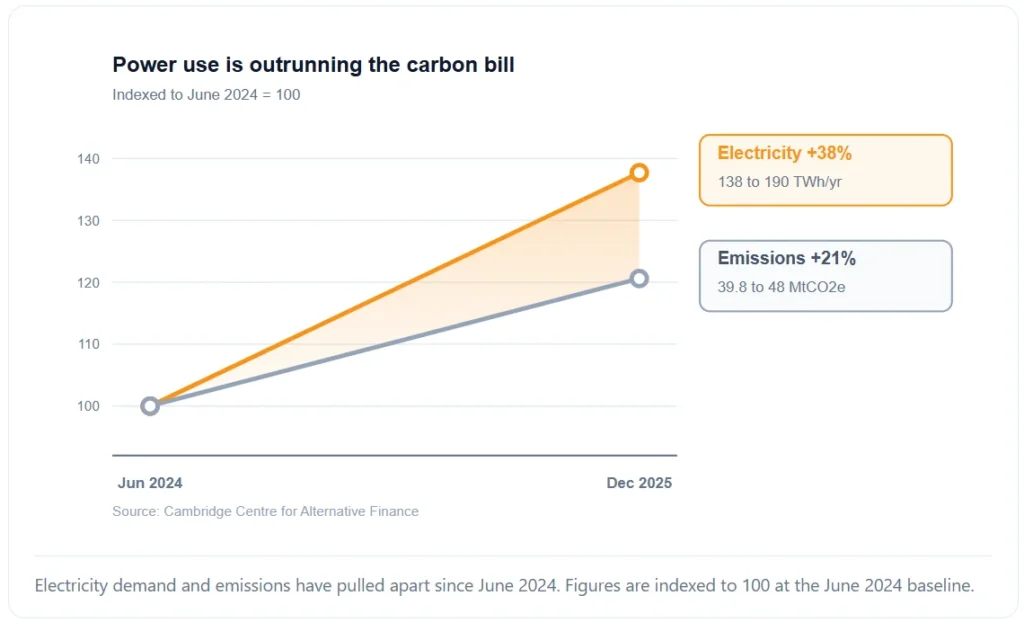
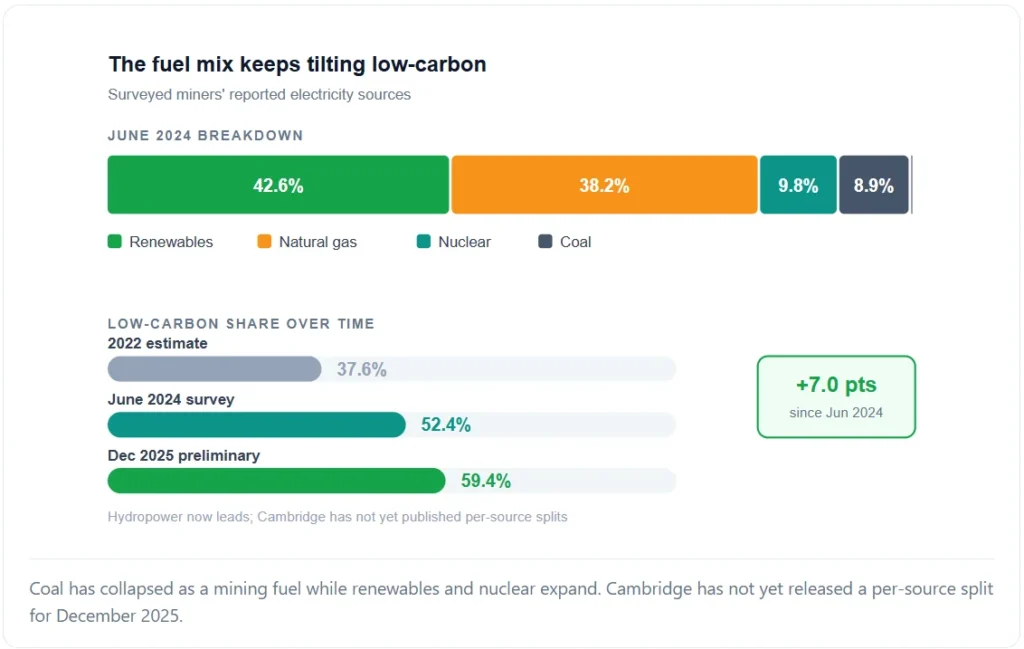
Low-carbon sources supplied 59.4% of surveyed miners’ electricity, up from 52.4%. Furthermore, hydropower overtook natural gas as the single largest source. Gas had held 38.2% of the mix in the previous study.
The shift extends a longer trend. Coal supplied 36.6% of mining electricity back in 2022. By mid-2024, that share had already fallen to 8.9%.
Carbon intensity tells the sharper story
Catenaa divided each emissions figure by its matching power figure. In June 2024, the network averaged about 288 grams of CO2e per kilowatt hour. By December 2025 that fell to roughly 253 grams.
The 12% drop carries real weight. Had intensity stayed flat, 190 TWh would have released nearly 55 million tonnes. Instead, the cleaner mix trimmed close to 7 million tonnes.
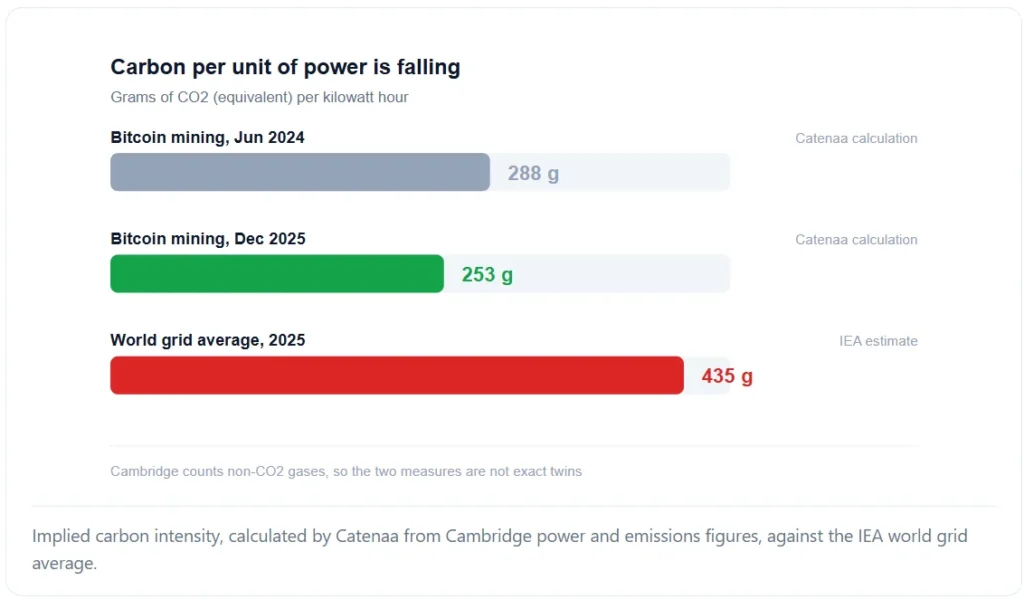
Global grids averaged 435 grams of CO2 per kilowatt hour during 2025, the IEA estimates. Bitcoin mining power therefore looks about 42% cleaner than the world average. Still, the two measures differ slightly, since Cambridge also counts non-CO2 gases.
Growth remains the harder problem. Bitcoin mining power added 52 TWh in just 18 months. That pace works out to near 24% a year. On Cambridge’s own 2024 yardstick, mining now draws close to 0.7% of world electricity.
Better coverage, or a genuine shift?
Neumueller linked part of the hydro gain to wider survey reach. Ethiopia, for instance, now hosts miners drawing on large dam output. Consequently, the mix may look greener partly because researchers simply found more hydro miners.
Method choice matters just as much. Cambridge put 2024 emissions at 39.8 million tonnes using survey data. Yet a location-based model produced 69.6 million tonnes instead.
The first edition drew on 49 firms covering 268 exahashes per second. Coverage has since widened beyond half of global hashrate. Cambridge also warned that heavy US participation skewed its earlier country split. Readers should therefore treat the mix data as directional rather than exact.
Intent to look into it is not commitment to deploy.
-Alexander Neumueller, Cambridge Centre for Alternative Finance
The AI pivot stays mostly on paper
Only about 10% of surveyed miners had already moved power into AI or accelerated computing. Meanwhile, more than 40% of the rest said they were exploring the option. Just 10% ruled it out entirely.
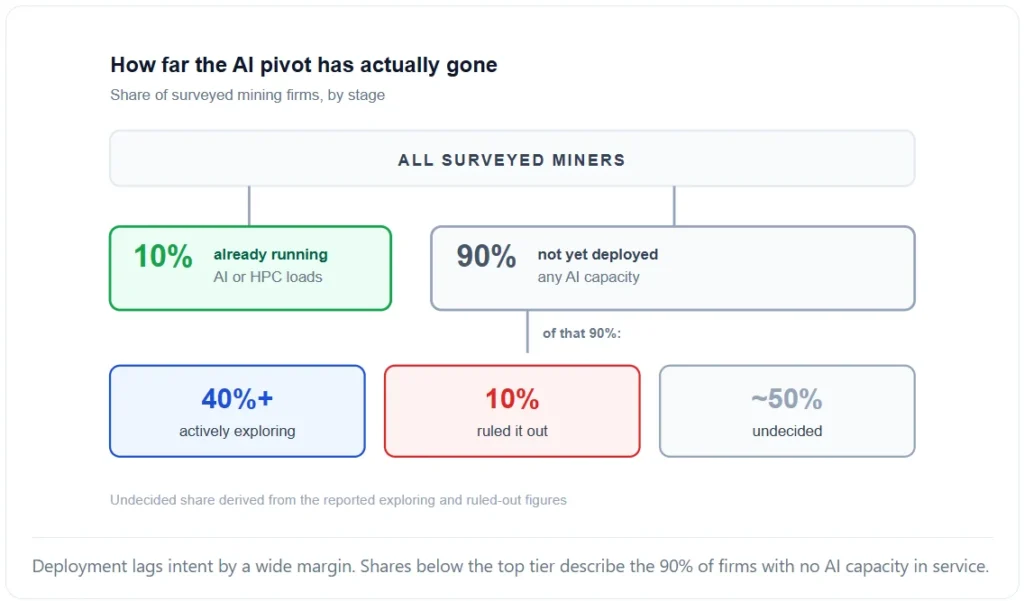
“Intent to look into it is not commitment to deploy,” Neumueller said. Capital cost topped the list of barriers. AI tenants also demand steady power, better cooling and stronger credit terms.
Miners can switch off quickly when power prices spike. By contrast, AI customers expect near-constant uptime. That single difference explains much of the delay.
One miner shows what the switch really costs
TeraWulf offers a useful test case. The company booked $21.0 million of HPC lease revenue during the first quarter of 2026. Digital asset revenue reached $13.0 million.
Look closer, though, and the picture changes. Total revenue landed at $34.0 million, barely below $34.4 million a year earlier. Mining revenue meanwhile fell 62%.
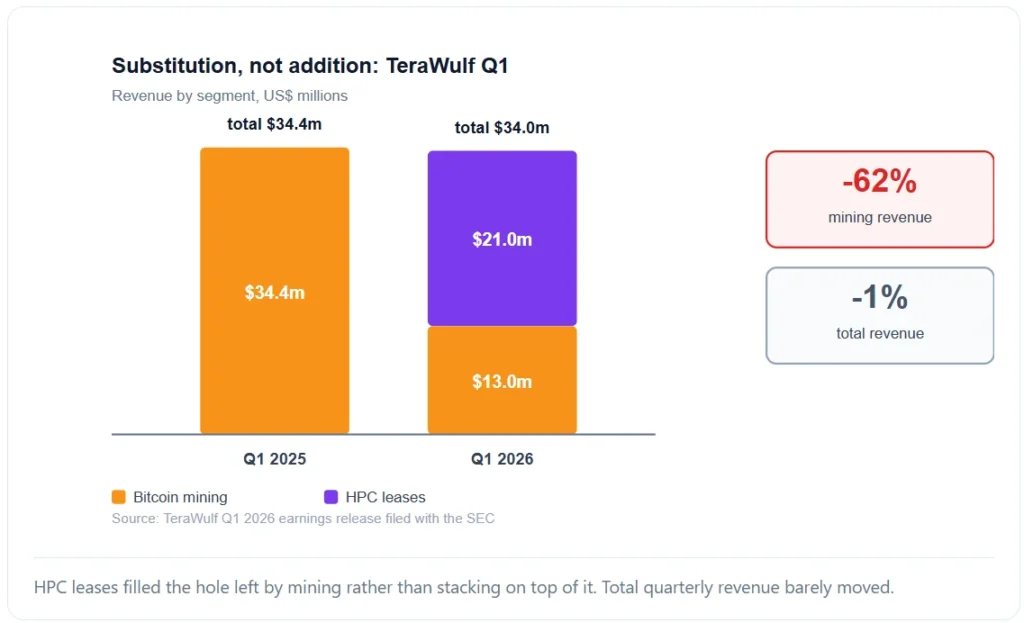
In other words, compute hosting replaced mining income rather than adding to it. Diversification therefore looks less like growth and more like substitution. Investors pricing miners as AI plays should watch that distinction closely.
What to watch next
Cambridge will release its final methodology and full energy breakdown later this year. Until then, the 190 TWh estimate remains preliminary. Annualised demand also assumes December’s rate held for a whole year.
Efficiency gains alone no longer keep pace. Hardware reached about 28.2 joules per terahash by mid-2024. Yet fleet growth still pushed total demand sharply higher.
Two trends now run side by side. Bitcoin mining power keeps climbing, yet its carbon load climbs more slowly. Meanwhile, miners are testing whether their power contracts can serve AI instead.