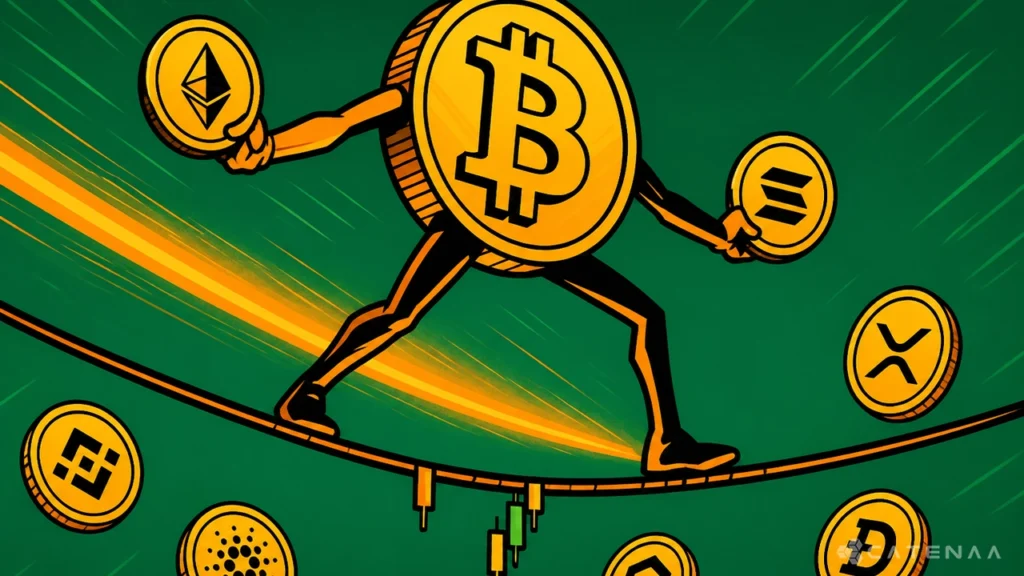


Catenaa, Sunday, May 03, 2026- Fidelity Digital Assets reports early signs of stabilization across the crypto market in its Q2 2026 Signals Report, pointing to improving onchain activity, profitability metrics, and momentum indicators even as prices remain range-bound.
The firm said bitcoin continues to act as the primary anchor for digital asset markets, with capital concentrated in the most liquid and widely held cryptocurrency.
Bitcoin dominance has gradually increased after declining through late 2025, while trading levels hovered near $77,000 at the time of the report. Analysts said the market is moving through a corrective phase that may be laying the groundwork for more stable conditions ahead, even if price strength has yet to fully reflect underlying network improvements.
Bitcoin Market Role
Bitcoin remains central to market structure during the current consolidation period, according to Fidelity analysts led by Daniel Gray. The report said unrealized profit levels and dominance trends show investors continuing to hold BTC as the preferred risk-adjusted asset in uncertain conditions. While price movements have been muted, bitcoin’s role as a liquidity hub has strengthened relative to other digital assets.
This pattern reflects investor behavior that favors established assets during periods of macroeconomic uncertainty, including inflation pressure, shifting interest rate expectations, and geopolitical tensions affecting broader risk sentiment. Analysts noted that bitcoin’s stability contrasts with more volatile movements in smaller assets, reinforcing its position as the sector’s core benchmark.
Ethereum and Solana Trends
Ethereum and Solana showed diverging signals between price action and network usage, according to the report. While both assets have experienced lagging valuations compared to bitcoin, onchain activity levels suggest continued demand at the protocol level.
Ethereum’s usage remains supported by decentralized finance applications and tokenized infrastructure, while Solana activity continues to reflect strong engagement in high-throughput applications and retail-driven ecosystems.
Fidelity said this divergence highlights a disconnect between short-term pricing and longer-term network utility. Analysts added that sustained usage trends indicate underlying demand remains intact even during periods of price consolidation across major altcoins.
Macro Pressure Factors
Broader market conditions continue to influence digital asset performance, with macroeconomic uncertainty weighing on risk appetite. Inflation trends, central bank policy expectations, and global trade tensions have contributed to uneven investor positioning across asset classes.
Regulatory developments in major jurisdictions have also added caution among institutional participants. Despite these pressures, the report said crypto markets are showing early signs of structural improvement. Momentum indicators suggest that the recent downturn may be transitioning into a corrective stabilization phase rather than continued contraction. This shift is reflected in gradual changes in capital flow patterns and reduced downside volatility compared to earlier periods in 2025.
Institutional Market Positioning
Institutional behavior remains a central factor in shaping market dynamics, with Fidelity noting that capital concentration in bitcoin reflects risk management preferences during uncertain cycles. Large investors continue to favor liquidity and depth, which has reinforced bitcoin’s dominance relative to other digital assets. Market data suggests that while speculative positioning has cooled, long-term holders remain active, contributing to reduced sell pressure.
Analysts said this environment is typical of mid-cycle consolidation phases, where asset prices stabilize before potential reacceleration. However, they cautioned that sustained recovery depends on broader macro stabilization and renewed inflows from institutional channels.
Network Activity Signals
Onchain metrics across major networks provide additional context for the current market phase. Ethereum and Solana have maintained steady transaction activity levels, even as price performance has lagged.
Fidelity said this pattern often signals sustained user engagement despite valuation compression. Network usage trends are being closely monitored as indicators of underlying demand strength, particularly in decentralized finance, tokenization, and blockchain-based applications.
Analysts said that continued protocol-level activity may support longer-term market resilience, even if short-term price action remains constrained by macroeconomic conditions and liquidity cycles.
Structural Market Outlook
The report concluded that the digital asset market is showing early signs of stabilization following a period of volatility and consolidation. Bitcoin remains the primary stabilizing force, while Ethereum and Solana reflect mixed signals between usage and valuation.
Fidelity said the current phase appears corrective rather than directional, with structural improvements emerging across key indicators. Market participants are watching whether these signals translate into sustained recovery or remain part of a prolonged consolidation cycle.
The outlook remains dependent on macroeconomic clarity, institutional inflows, and continued strength in onchain activity across major blockchain networks.




