


July 11, 2026 – Spot bitcoin funds shed $95.3 million on Thursday. Ether funds lost $52.2 million, breaking a five-session inflow run. Prices, however, rallied anyway.
In Summary
US spot bitcoin ETFs lost a net $95.3 million on 9 July 2026.
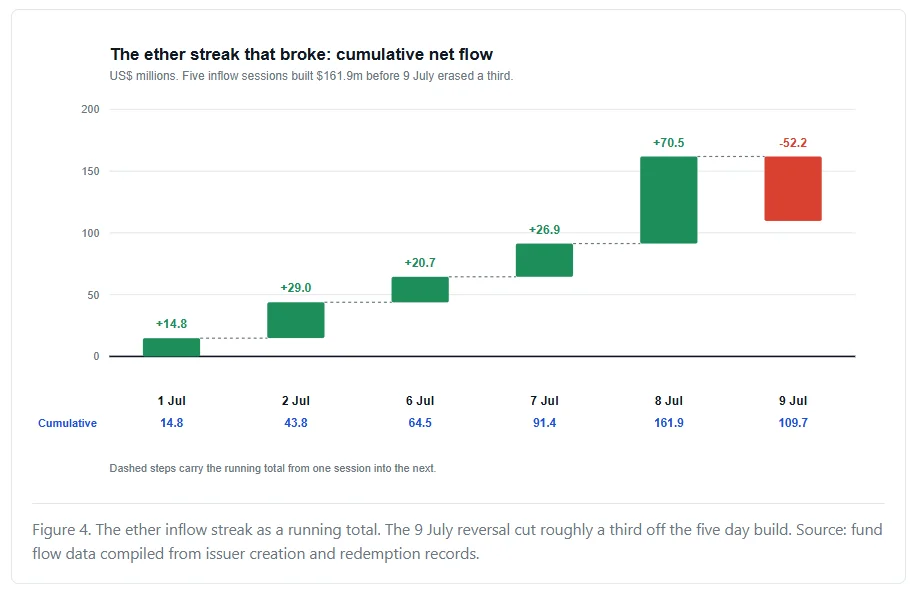
Ether funds shed $52.2 million, ending a five-session, $161.9 million inflow run.
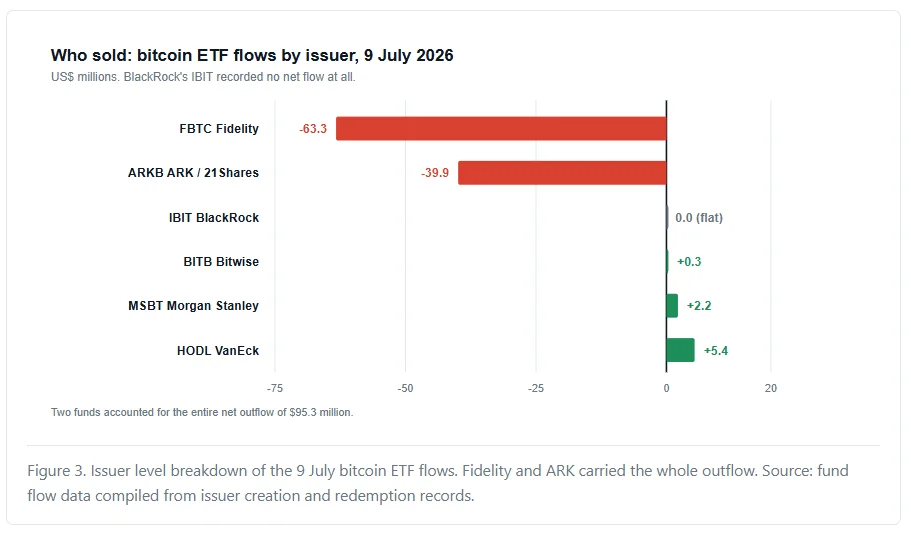
Fidelity’s FBTC and ARK’s ARKB drove the entire bitcoin outflow. BlackRock’s IBIT stayed flat.
Bitcoin rallied 3.5% on Friday to roughly $64,000, so flows and price now disagree.
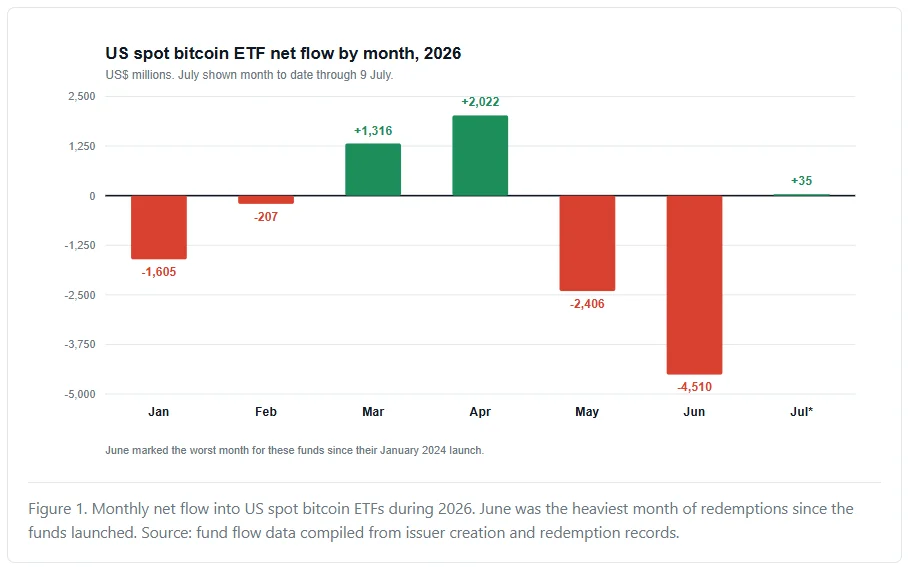
June’s $4.51 billion exodus still anchors 2026 net flows near a $5.36 billion loss.
Bitcoin ETF outflows returned on Thursday, and ether funds joined the retreat for the first time this month. U.S. spot bitcoin funds lost a net $95.3 million on July 9. Ether funds shed $52.2 million in the same session. Therefore, the one steady bid in crypto’s institutional flow picture has now vanished.
Prices, meanwhile, went the other way. Bitcoin climbed 3.5% on Friday to roughly $64,000. Ether added 2.6% to about $1,760. So the tape and the fund flows now tell different stories.
Why Bitcoin ETF Outflows Look Uneven This Week
Thursday’s damage came from just two funds. Fidelity’s FBTC gave up $63.3 million. ARK and 21Shares’ ARKB lost $39.9 million. BlackRock’s IBIT, however, recorded exactly zero flow.
That zero matters a great deal. IBIT holds $44.76 billion in net assets, far more than any rival. Because the largest fund remained unchanged, today’s bitcoin ETF outflows reflect a narrow group of sellers.
Two products still drew fresh money. VanEck’s HODL took in $5.4 million. Morgan Stanley’s MSBT added $2.2 million. Bitwise’s BITB posted a token $0.3 million. Yet those gains never came close to offsetting the losses elsewhere.
Ether Funds Snap a Five-Day Run
Ether’s reversal looked broader and cleaner. Every listed ether fund finished the session flat or negative. No one posted an inflow.
Fidelity’s FETH led the decline at $34.0 million. BlackRock’s ETHA followed at $12.7 million. Its staking sibling, ETHB, slipped by $2.7 million, while Bitwise’s ETHW dropped by $2.8 million.
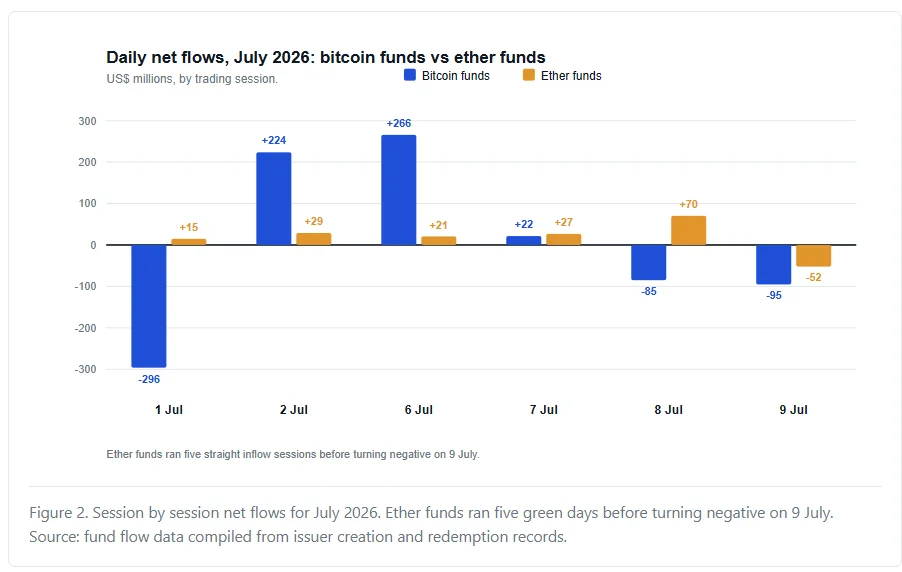
The streak that ended had real substance. Ether funds pulled in $161.9 million across five sessions from July 1 to July 8. Furthermore, that run arrived while bitcoin ETF outflows were still churning. Traders had begun treating ether as the safer institutional bet. Thursday punctured that idea.
Flows Lag the Price Tape
Here lies the central tension. Bitcoin finished the week up 4.2%, yet institutional money did not chase the move.
The rally started in Asia, not on Wall Street. Semiconductor shares surged on renewed optimism about AI demand. As a result, risk appetite lifted crypto alongside global equities.
Leverage did the rest of the work. Traders cut positions when geopolitical headlines hit, then reloaded within hours. Such round trips move far faster than genuine allocation decisions.
Fund flows, by contrast, settle slowly. Authorised participants create and redeem shares in response to real demand. Consequently, the flow tape offers a cleaner read on conviction than any price chart.
The gap also carries a timing quirk. Flow data lands one session after the trade. Thursday’s numbers therefore miss Friday’s rally entirely. Analysts will only see the response next week.
June Still Casts a Long Shadow
Context explains the current caution. Bitcoin funds bled $4.51 billion across June, their worst month since launch in January 2024. Moreover, that single month pushed the 2026 total firmly negative.
Add the year together and the picture sharpens. Net flows for 2026 now sit near a $5.36 billion loss. April was the only strongly positive month, at $2.02 billion. May then reversed course with a $2.41 billion outflow. June’s bitcoin ETF outflows simply finished the job.
July, though, has stabilised somewhat. Bitcoin funds sit at a modest $34.5 million net inflow month to date. Ether funds hold a $109.7 million gain. Still, both figures look tiny against the June damage.
The Structural Numbers Have Not Moved
Cumulative totals tell a longer story. U.S. spot bitcoin ETFs have absorbed $51.2 billion since launch. IBIT alone accounts for $60.2 billion of gross inflow. Grayscale’s GBTC, meanwhile, has leaked $27.3 billion over the same period.
Ether products have gathered $10.98 billion in total. BlackRock’s ETHA drove most of that figure, at $11.2 billion.
Grayscale’s fee drag explains much of the gap. GBTC still charges 1.50%, six times the IBIT rate. It’s Ether Trust, ETHE, which charges 2.50%. Investors keep rotating out of both. Hence, the headline totals understate genuine demand for cheap spot exposure.
These franchises are not shrinking. Rather, they are pausing. Daily bitcoin ETF outflows of $50 million to $100 million barely register against balances of that size. Redemptions at this pace signal hesitation, not exit.
What Comes Next for Investors
Three signals now deserve close attention. First, watch whether IBIT resumes buying. Its flat sessions often precede sharp directional moves.
Second, track the ether streak’s return. If either funds rebuild an inflow run, the rotation story regains credibility.
Third, follow the macro calendar. Rate expectations have driven most of this year’s crypto allocation decisions. Indeed, they explain the June exodus better than any crypto-specific event.
Fee competition adds a further wrinkle. MSBT charges just 0.14%, against 0.25% at IBIT and 0.25% at FBTC. Cheaper wrappers keep winning small but consistent inflows. Over time, that drift reshapes the league table.
Bitcoin has now traded between roughly $59,000 and $66,000 for a month. Institutional money has largely sat out that range. Until flows and price agree again, traders should treat rallies with caution.
Nothing here suggests outright panic. Instead, the data shows plain hesitation. Fund managers are waiting for a clearer catalyst, and July has not yet delivered one.




