


August 04, 2026 – Bitcoin closed 3 August 2026, almost unchanged. Behind that flat print, US spot funds bought $170.1 million, factory data ran hot, and a wallet exploit widened again.

In Summary
Bitcoin closed 3 August at $63,527, down only 0.07%, after a 2.9% intraday swing.
US spot Bitcoin ETFs drew $170.1 million, nearly matching the whole July net figure.
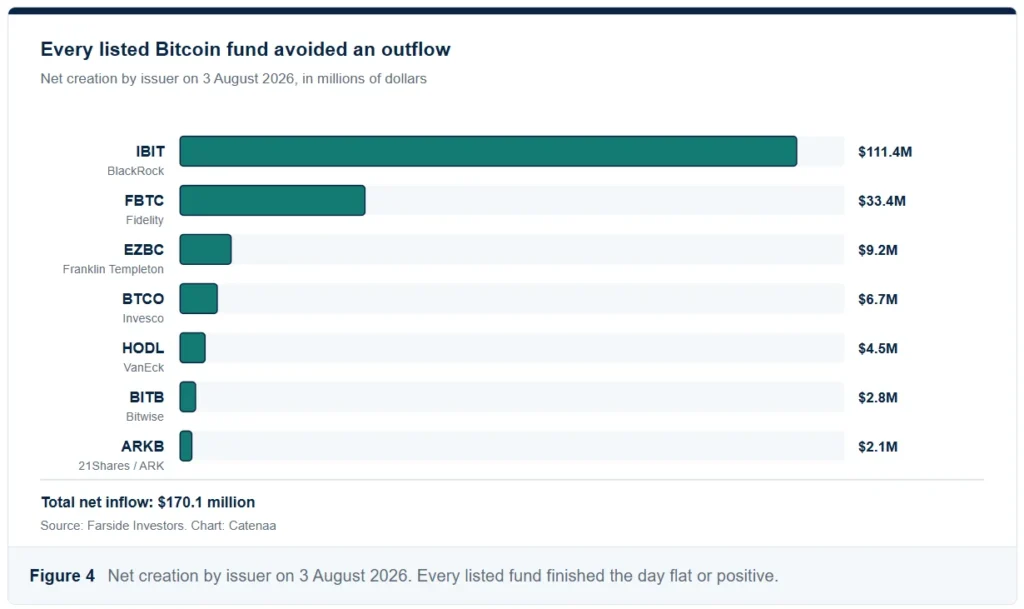
Not one of the twelve listed Bitcoin funds posted an outflow during the session.
US spot Ether ETFs went the other way and shed $11.9 million on the same day.
ISM manufacturing hit 55.6%, the strongest reading since May 2022, yet Bitcoin held firm.
The Coldcard firmware exploit widened again, with roughly 1,816 Bitcoin now moved.
DeFi deposits rose 1.0% to $74.33 billion, while stablecoin supply held near $306.9 billion.
The global crypto market ended Monday almost exactly where it started. Bitcoin closed the August 3 session at $63,527, down just 0.07%. However, that calm daily print hid a busy day underneath.
Traders absorbed three separate shocks. First, US factory data came in far hotter than forecast. Second, a hardware wallet exploit widened for a fourth time. Third, US spot Bitcoin funds bought again after a heavy Friday sell-off.
Crypto market ends flat while the trading range widens
Bitcoin opened Monday at $63,574 and closed at $63,527, according to OKX daily candles. Meanwhile, the coin swung between $62,300 and $64,086 during the session. That range works out to 2.9% of the daily low.
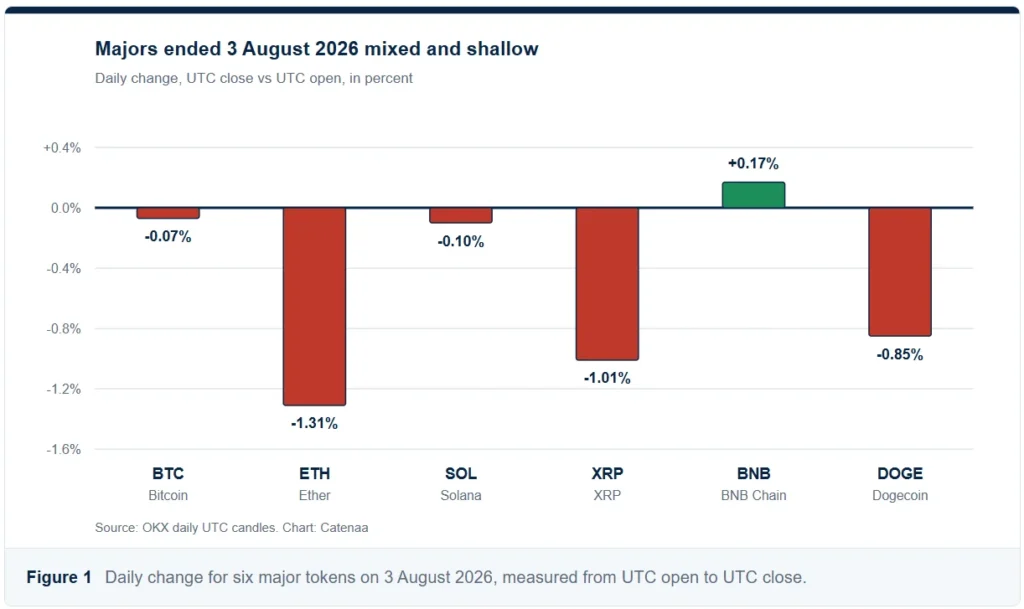
Ether fared worse. The token slipped 1.31% to $1,860 by the daily close. Solana barely moved at all, easing 0.10% to $73.57. XRP lost 1.01%, while Dogecoin gave up 0.85%. BNB bucked the trend with a 0.17% gain.
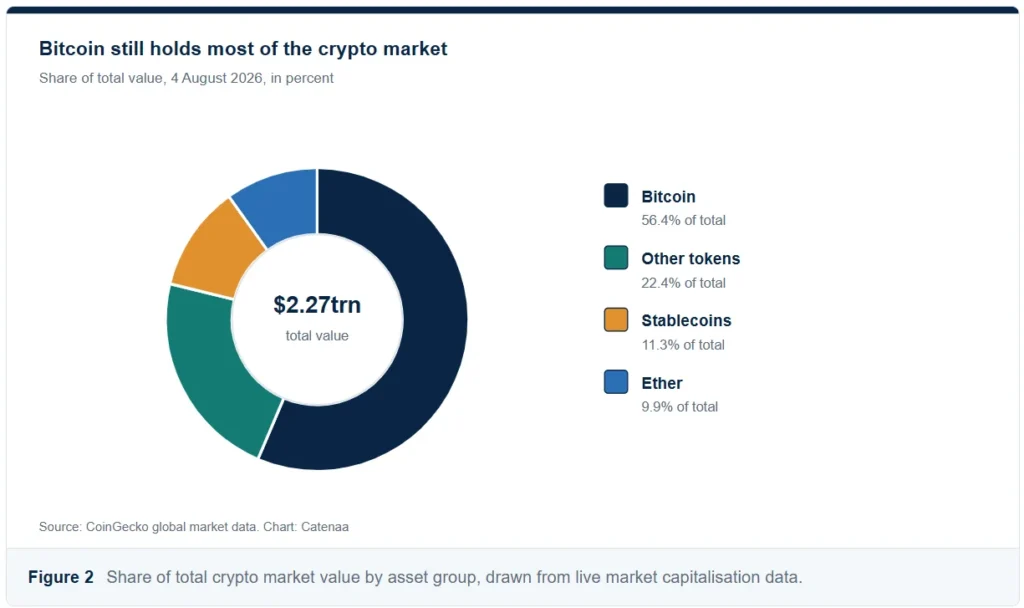
Total crypto market value now sits near $2.27 trillion, CoinGecko data shows. Bitcoin still commands 56.4% of that figure. Ether holds 9.9%, and dollar-pegged tokens account for another 11.3%, split between Tether and USDC.
Bitcoin ETF buyers erased a month of caution in one day
US spot Bitcoin ETFs pulled in $170.1 million on August 3, Farside Investors data shows. Crucially, that single session nearly matched the entire July net figure of $172.8 million.
BlackRock’s IBIT led with $111.4 million. Fidelity’s FBTC added $33.4 million. Products from Franklin Templeton, Invesco, VanEck, Bitwise and 21Shares also took in money. Notably, not one of the twelve listed funds reported an outflow.
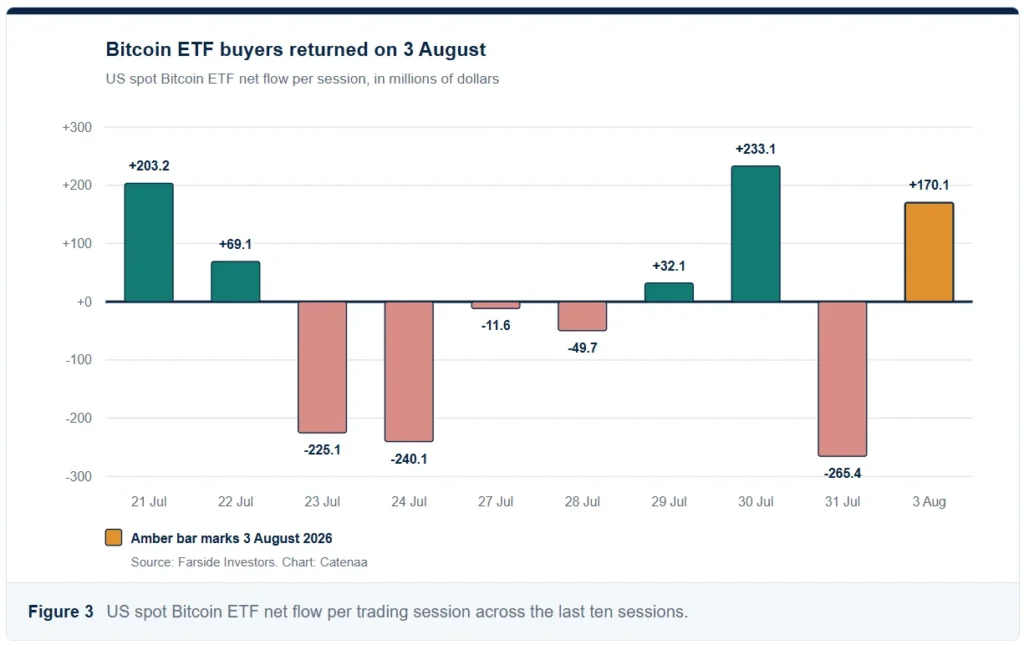
The reversal matters because Friday looked grim. On July 31, the same complex shed $265.4 million in one session. Therefore, Monday’s print flipped the tone quickly.
Catenaa calculates that $170.1 million buys roughly 2,680 Bitcoin at Monday’s closing price. By comparison, the Coldcard theft has moved about 1,816 Bitcoin since Thursday. In short, one day of fund demand outweighed five days of stolen coins.

Ether funds moved the other way
Ethereum products told a different story. US spot Ether ETFs lost $11.9 million on the same day. BlackRock’s ETHA shed $9.0 million, while Grayscale’s ETHE gave up $7.8 million.
Only one Ether fund gained real ground. BlackRock’s ETHB took in $5.8 million. Cumulative net inflows across the group still stand at $11.2 billion since launch.
That split explains the price gap neatly. Bitcoin held flat, yet Ether dropped more than a percent. Consequently, the Ether to Bitcoin ratio slipped to roughly 0.0293.
Hot US factory data raised the bar
The Institute for Supply Management released July manufacturing figures on Monday morning. Its headline index hit 55.6%, up 2.3 points from June. Moreover, that reading marks the strongest print since May 2022.
New orders climbed to 56.7%. Production jumped to 58.5%. Employment returned to growth at 52.8% for the first time in 33 months.
The prices index eased to 71.1% from 73.0%. Even so, that level stays historically high. Strong output plus sticky input costs usually trim rate cut hopes. As a result, risk assets often struggle on such days.
Bitcoin did not. Instead, the coin absorbed the data and closed flat. That resilience stands out.
The Coldcard exploit widened to a fourth wave
Monday also brought fresh losses for self-custody users. Investigators flagged a fourth sweep tied to a Coldcard firmware flaw. Running losses reached roughly 1,816 Bitcoin across more than 5,200 addresses.
Coinkite, the Canadian maker, published a security advisory on July 30. The company traced the fault to seed generation on affected firmware. In plain terms, the device used weak randomness when creating wallet backups.
Coinkite says fixed firmware now covers every affected model. However, an update alone cannot repair a seed created earlier. Owners therefore need fresh seeds and a careful migration.
The episode carries a wider lesson. Cold storage removes exchange risk, yet it adds firmware risk. Neither route removes risk entirely.
DeFi and stablecoins held their ground
Decentralised finance shrugged off the noise. Total value locked rose to $74.33 billion on August 3, up 1.0% from Sunday. Ethereum accounts for $40.6 billion of that pool.
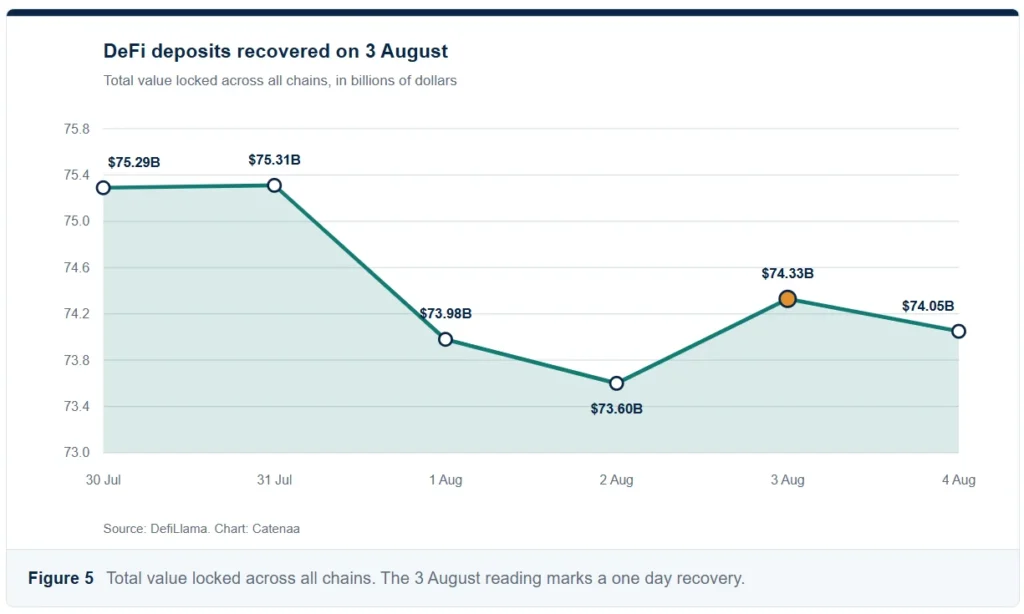
Tron, BNB Chain, Solana and Base follow next. Each holds between $4.5 billion and $4.9 billion. Bitcoin-based protocols hold $3.6 billion.
Stablecoin supply tells a steadier story. Total dollar-pegged supply sits near $306.9 billion. Tether alone accounts for $183.1 billion, while USDC holds $72.2 billion.
That pile matters because it acts as dry powder. Buyers can deploy it quickly once sentiment turns.
Washington still hangs over the crypto market
Traders keep one eye on the Senate. The Digital Asset Market Clarity Act passed the House in July 2025. Since then, the bill has waited for a floor vote.
The Senate Banking Committee advanced its version in May 2026. Lawmakers then placed the bill on the Senate Legislative Calendar in June. Yet the chamber has not scheduled floor time.
Senators leave for their state work period in mid-August. Should the bill miss that window, it likely slips toward 2027. Consequently, exchanges and token issuers face another stretch without clear rules.
What to watch next
Three things deserve attention this week. First, watch whether fund inflows extend beyond a single session. Second, track the Coldcard recovery for any fifth wave. Third, follow Senate scheduling ahead of the recess.
Funding rates offer one more clue. Bitcoin perpetual funding on OKX averaged about 0.0037% per eight-hour window on Monday. That works out to near 4.1% a year. Put simply, leverage looks calm rather than crowded.
A quiet close, therefore, hides a market that still awaits direction.