

August 20, 2026 – Korean chip stocks led a violent global risk unwind on Wednesday. Bitcoin barely flinched.
In Summary
The Kospi closed 5.80% lower at 6,471.17 after the Korea Exchange fired a sell-side sidecar at 9:06 a.m.
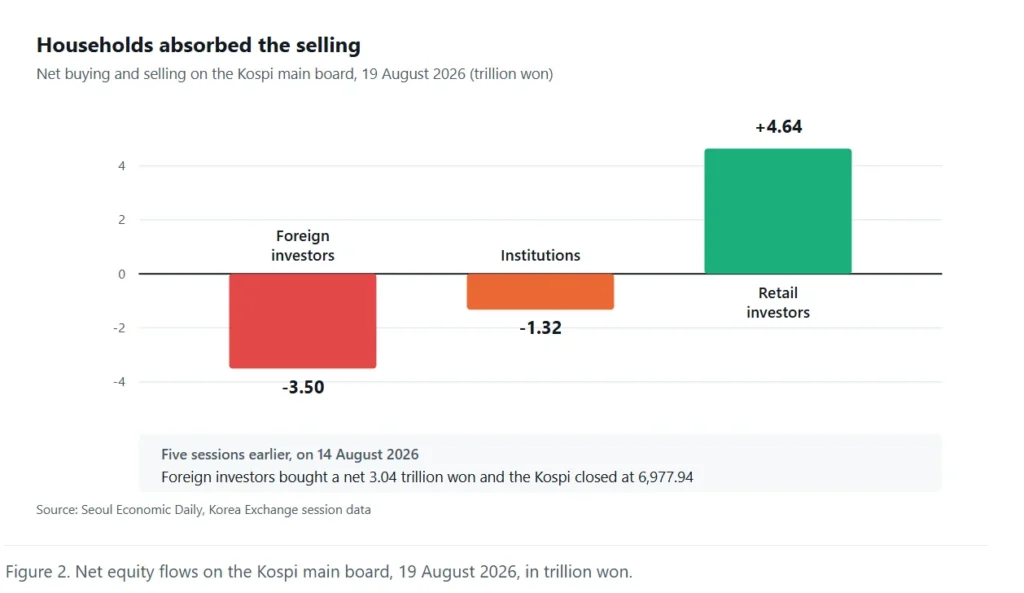
Foreign investors sold a net 3.50 trillion won of Korean shares, their heaviest single-day exit this month.
Bitcoin traded near $64,878, up 0.3% on the day and 1.8% over the week.
A 30-year US Treasury yield of about 5.33% drove the rout, not a crypto shock.
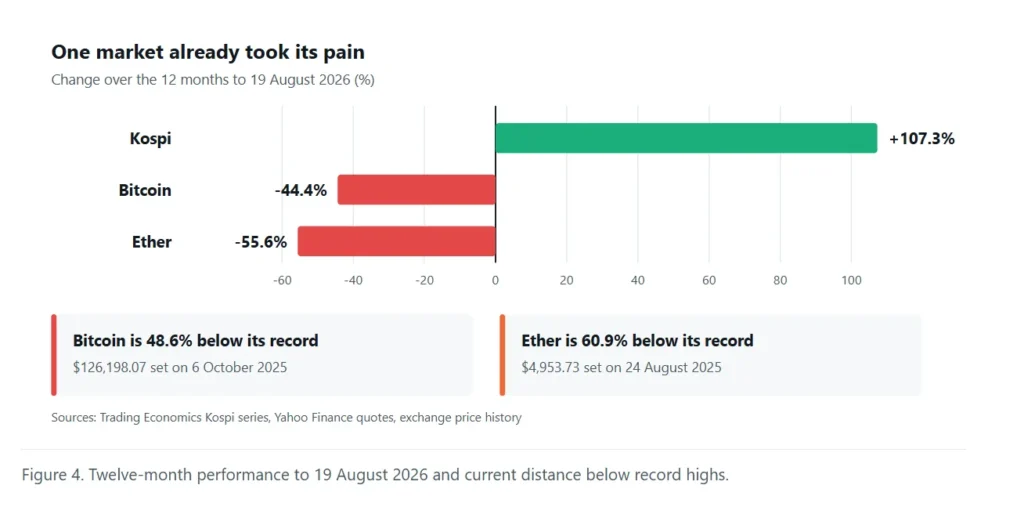
Bitcoin sits 44.4% lower over 12 months. The Kospi is still up 107% across the same span.
Asian equity markets buckled on Wednesday. Crypto did not.
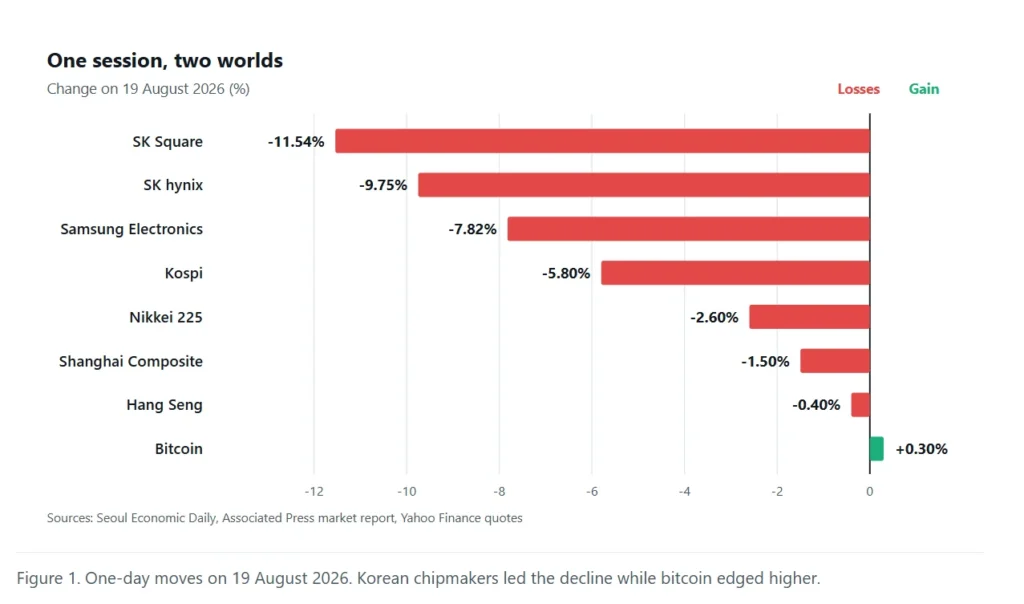
South Korea’s benchmark Kospi closed 5.80% lower at 6,471.17, shedding 398.66 points. By contrast, Bitcoin held near $64,878 and gained 0.3% over 24 hours. Bitcoin decoupling from equity risk has become the defining trait of this cycle.
Korea’s chip trade cracks again
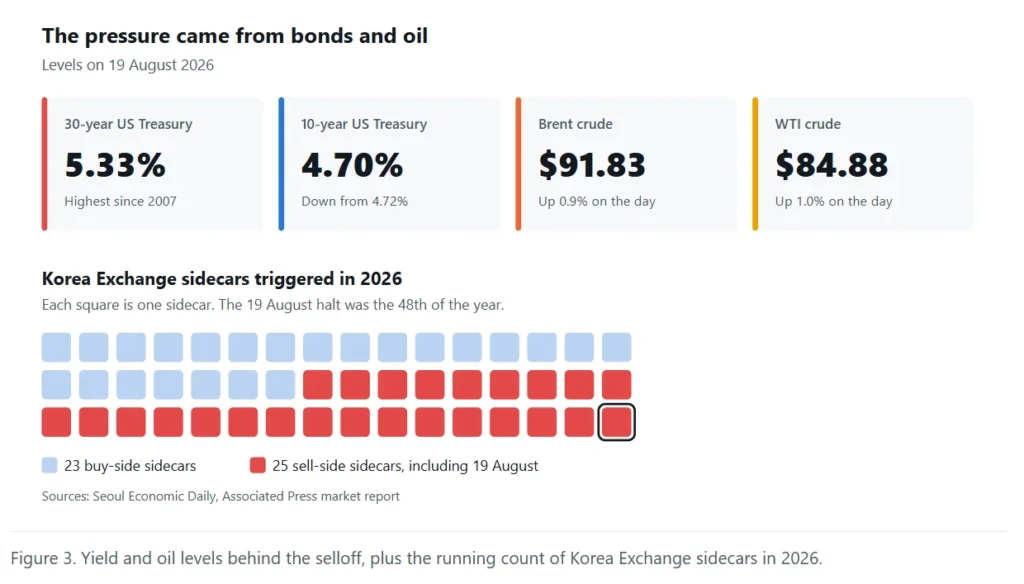
The Korea Exchange fired a sell-side sidecar at 9:06 a.m. local time. In fact, it was the 48th sidecar of 2026 and the 25th on the sell side. Program sold orders paused for five minutes. Selling resumed anyway.
SK hynix sank 9.75%. Similarly, Samsung Electronics dropped 7.82%. SK Square lost 11.54%. The index touched an intraday low of 6,400.81 before the close.
Foreign investors dumped a net 3.50 trillion won of Korean stock. Indeed, that was their heaviest one-day exit this month. Local funds sold another 1.32 trillion won. Meanwhile, retail buyers took the other side and absorbed 4.64 trillion won.
Five sessions earlier, the mood was inverted. Foreigners bought a net 3.04 trillion won on 14 August, and the index closed at 6,977.94. Momentum flipped inside three trading days.
Bond yields did the damage
Blame sat in Washington, not Seoul. The 30-year US Treasury yield touched roughly 5.33%, its highest level since 2007. Above all, long yields punish distant earnings hardest. Asian chipmakers carry the longest earnings duration in the region.
Oil added to the squeeze. Brent rose 0.9% to $91.83 a barrel after US and Iranian talks failed to extend a ceasefire. WTI added 1% to $84.88.
The damage spread unevenly, however. For example, Japan’s Nikkei 225 slipped 2.6% to 65,703.78. Shanghai fell 1.5%, Taiwan 1.4%, and Hong Kong only 0.4%. Seoul absorbed most of the pain because Seoul carried most of the leverage.
Why Bitcoin decoupling looks structural
Crypto sat out the panic for a plain reason. It crashed first. Moreover, Bitcoin now trades about 48.6% below its October 2025 record of $126,198.07. Over 12 months, it has shed 44.4% of its value.
Korean equities tell the opposite story. The Kospi remains up 107% year on year, even after Wednesday’s slide. In short, one market has already purged its leverage. The other has not.
Margin data shows the same split. Korean margin lending sat near $23bn this summer, and more than 1.2 million leveraged accounts faced calls by mid-July. Crypto endured its own forced selling far earlier.
Policy news helped as well. The SEC proposed an exemption route for token issuers raising capital. Mature networks could later drop out of securities rules. As a result, Ether gained 0.2% to about $1,936.
The correlation maths has changed
Back in 2022, digital assets led equities lower. Today, they lag equities in both directions. Spot Bitcoin funds already absorbed roughly $3.3bn in net redemptions during the first half of 2026. Few marginal sellers remain.
That calm is not strength, though. It is exhaustion. After all, assets that have halved rarely fall another 6% on a bond move. Meanwhile, an index that doubled in a year has plenty of room to give back.
Risks to the divergence
Higher yields eventually reach every risk asset. Should the long bond push past 5.5%, dollar liquidity tightens further. In that case, crypto would not stay immune. Korea’s retail bid could also tire, and forced selling would then accelerate.
The won adds another risk. A weaker won lifts hedging costs for global funds, so foreign selling can feed on itself. Traders should therefore treat Wednesday’s calm in crypto as conditional, not permanent.
What traders watch next
Federal Reserve minutes land later on Wednesday. Moreover, investors want proof that July’s hold was not a pause before a hike. Jackson Hole follows on 27 August, with Chair Kevin Warsh due to speak.
For now, one contrast frames the session. Korean equities fell 5.80%, while Bitcoin rose 0.3%. That single line explains why buyers keep rebuilding crypto books at prices nobody wanted a year ago.




