

June 29, 2026 – Short-term holders dumped coins at a loss this week. On-chain data flags real stress, yet long-term buyers quietly absorbed a record supply.
In Summary
Roughly 50,000 BTC were sent to exchanges at a loss in a single day.
Short-term holders realized that the cap fell to $237.7 billion, the lowest since October 2024.
Long-term wallets absorbed a record 181,000 BTC, nearly double the 2022 peak.
The print signals stress, but analysts warn it does not confirm a bottom.
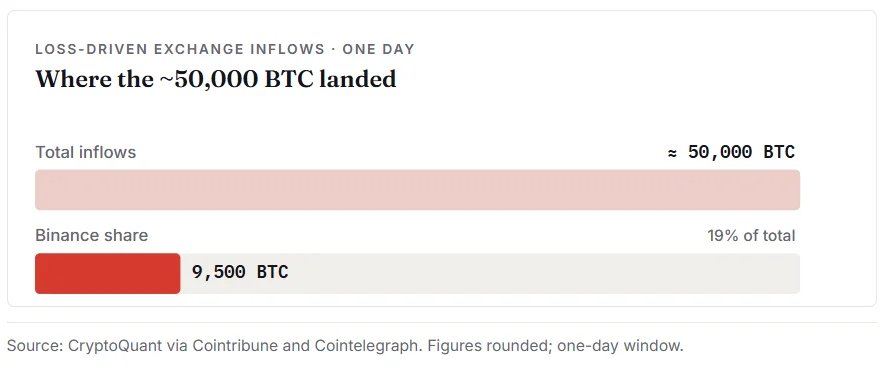
Bitcoin capitulation fears returned this week. Roughly 50,000 BTC moved to exchanges at a loss within a single day, Cointelegraph reported. The cohort behind the move was short-term holders. These traders bought their coins within the past 155 days.
The price backdrop explains their pain. Bitcoin recently changed hands near $59,900. That level sits far below the cycle peak. Consequently, many buyers from 2026 now hold losing positions.
A textbook Bitcoin capitulation print
Analysts label this behaviour capitulation. Newer buyers sell into weakness rather than wait for recovery. Consequently, exchange inflows spike while the price stays soft. Binance alone absorbed about 9,500 BTC of that flow. Moreover, that intake marked the venue’s heaviest single-day load since early June.
The wider transfer was also the largest loss-driven wave since June 4. However, the headline number alone tells only half the story. To read it properly, traders must look at where those coins landed.
The data behind the stress
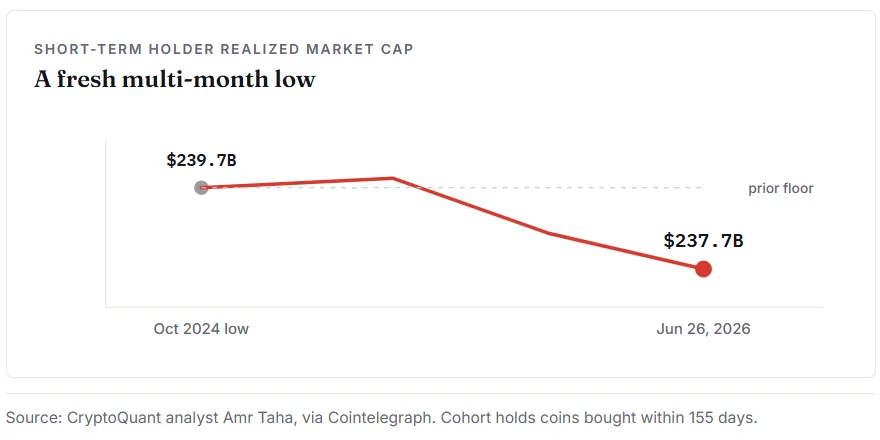
The pressure shows clearly in on-chain metrics. According to CryptoQuant, the short-term holder realized market cap fell to $237.7 billion on June 26. Furthermore, that reading was the lowest since October 2024. Back then, the same metric hovered near $239.7 billion.
This indicator tracks the value of recently bought coins. A falling figure, therefore, signals widespread unrealized losses. In plain terms, recent entrants are now paying for late buying. Their coins are worth less than what they spent.
The drop also carries a clear message. It marks the cohort’s weakest reading in over a year. By comparison, the October 2024 floor briefly held before a recovery. Yet history offers no promise of a repeat. Each cycle ultimately writes its own path.
Long-term holders quietly stepped in
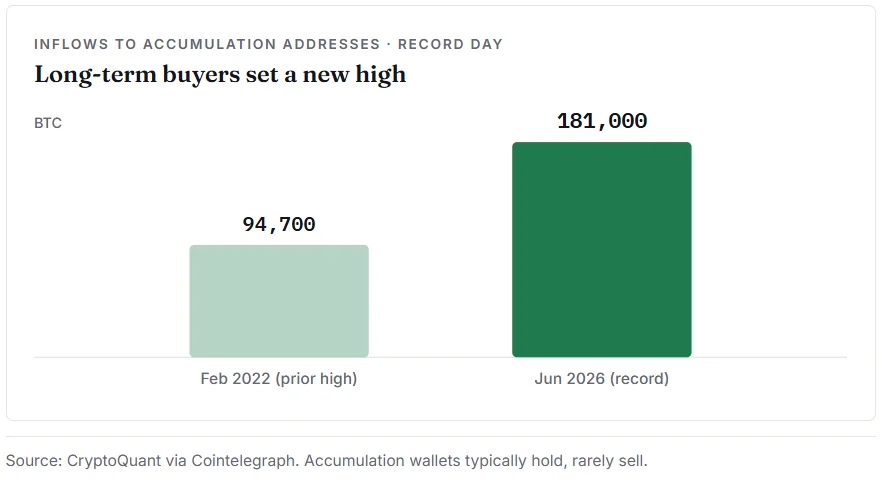
While newcomers panicked, seasoned investors accumulated. Bitcoin inflows to accumulation addresses hit a record 181,000 BTC on Thursday. Notably, that figure nearly doubled the previous high of 94,700 BTC from February 2022.
These wallets rarely spend their coins. As a result, the supply they absorb leaves the liquid market. This rotation shifts coins from weak hands to strong ones. Historically, such transfers often precede periods of price stabilization.
Sentiment turns fearful
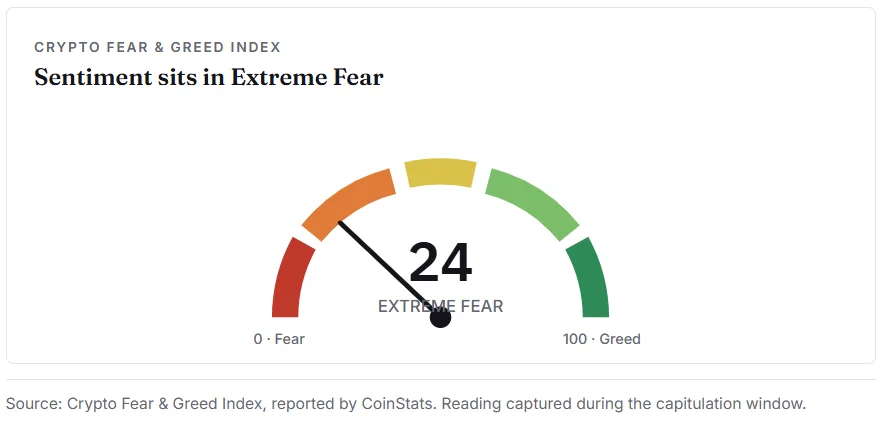
Market mood matches the on-chain stress. The Crypto Fear and Greed Index sat at 24, deep in “Extreme Fear”, CoinStats data showed. Extreme fear often marks defensive positioning rather than a fresh opportunity.
Institutional demand stayed soft alongside retail panic. Extreme fear often marks defensive positioning rather than a fresh opportunity. Investors who buy here need patience and a strong stomach.
Institutions stay on the sidelines
Large funds offered little support during the slide. United States spot Bitcoin ETFs logged heavy net outflows this week. According to CoinStats data, those outflows neared capitulation extremes. Therefore, professional money mostly sat out the move.
The Coinbase Premium Index reinforced that caution. The gauge stayed below zero for 40 straight days. A negative reading signals weaker buying on United States venues. In short, American desks have stepped back since mid-May.
Still, one detail hinted at fatigue. ETF selling slowed briefly before the latest flush. However, a single quiet session does not confirm a turn. Traders want several days of steady flows first.
What traders should watch next
This print is a stress marker, not a guaranteed bottom. NewsBTC cautioned that one extreme day proves little on its own. Confirmation depends instead on what follows the spike.
Traders should now watch whether loss-driven inflows fade. Falling inflows alongside steady prices would strengthen the bullish case. Conversely, sustained selling over the coming days would deepen the flush.
For now, the market sits between two forces. Short-term fear pushes coins onto exchanges. Meanwhile, long-term conviction pulls them into cold storage. The winner of that tug-of-war will likely set Bitcoin’s next direction.
Investors should still treat single-day signals with care. Wallet transfers do not always mean immediate selling. Likewise, exchange labelling can distort raw inflow data. Therefore, verification across several metrics remains the safer path.
Above all, patience now matters more than prediction. A confirmed floor usually forms over weeks, not hours. Therefore, chasing one green candle carries real risk. Disciplined investors will wait for the data to align.