


August 19, 2026 – The largest corporate holder raised $333.7m in a week and sent none of it into bitcoin, choosing dividends, buybacks and dollars instead.

In Summary
Strategy Inc reported no Bitcoin purchases or sales between 10 and 16 August 2026.
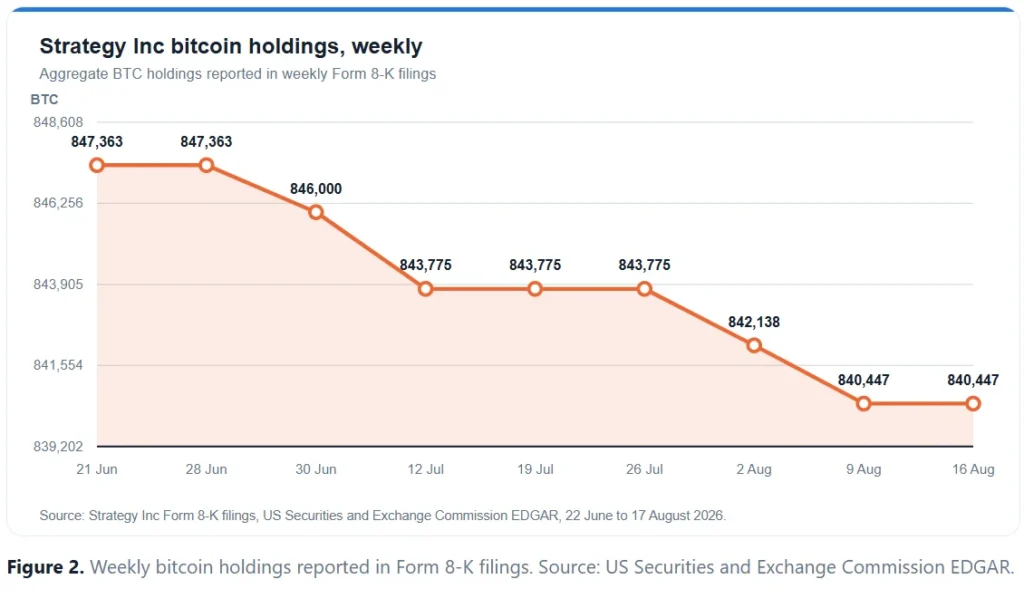
Holdings stayed at 840,447 BTC, carried at an average cost of $75,385 a coin.
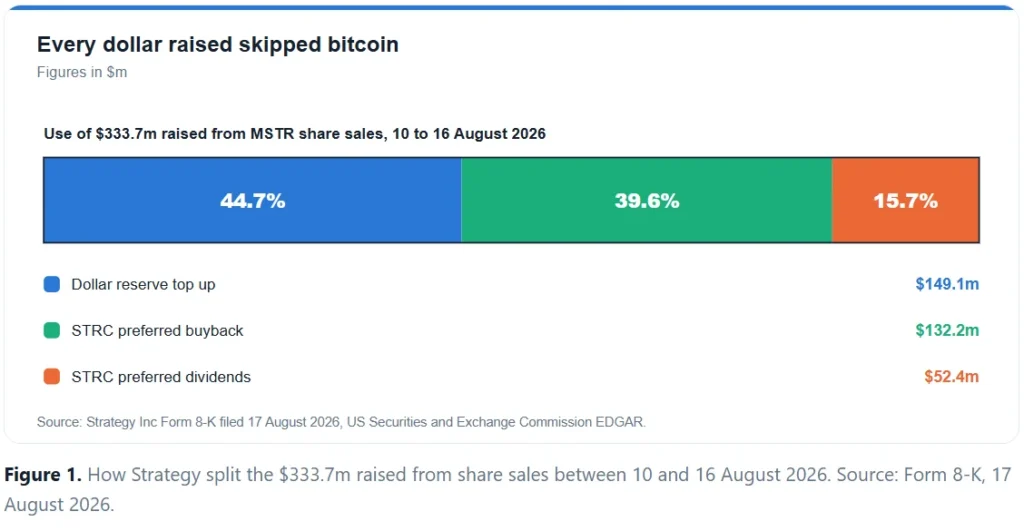
The company raised $333.7m from MSTR share sales and spent it on dividends, buybacks, and cash.
Its dollar reserve climbed to $4.80bn, up from $4.65bn a week earlier.
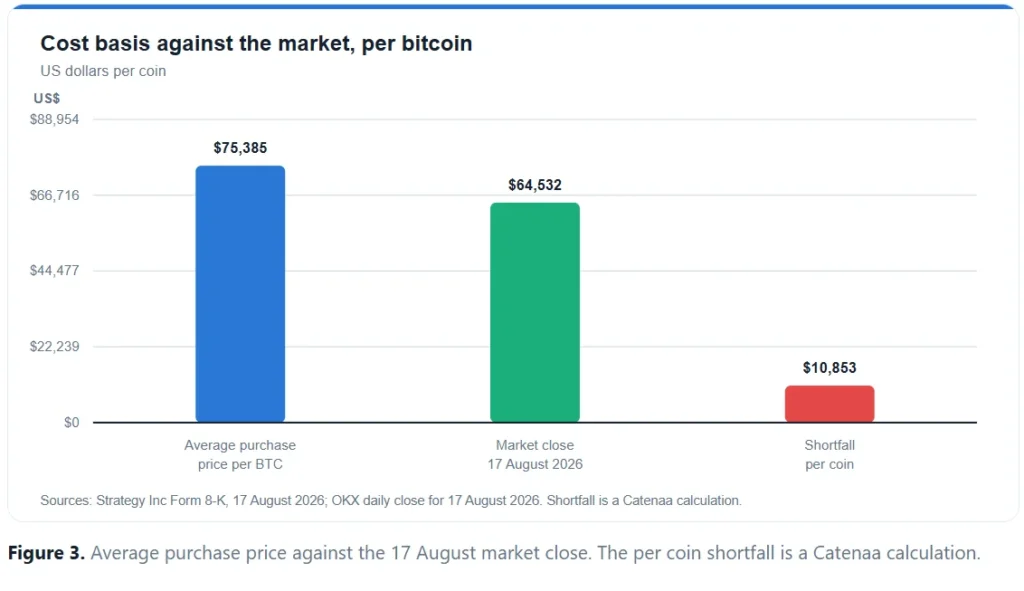
Bitcoin closed on 17 August at $64,532.40, leaving the average cost 14.4% above market.
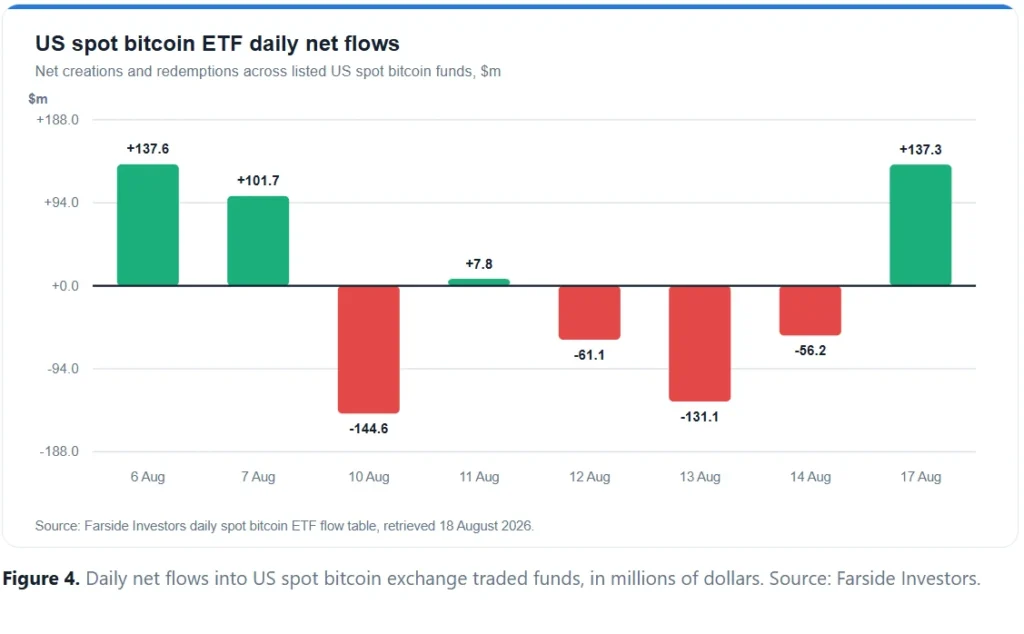
US spot Bitcoin funds took in $137.3m on 17 August after four negative sessions.
Strategy Inc paused Bitcoin buying for an eighth straight week, a filing on Monday showed. The company bought and sold nothing between 10 and 16 August 2026. Its stack therefore stayed at 840,447 BTC.
Yet the treasury desk stayed busy. Strategy raised $333.7m by selling 3,458,866 of its own shares. However, none of that cash went into Bitcoin.
Instead, the money covered dividends, buybacks, and cash reserves. That split marks a clear break from the playbook that built the position.
Where the $333.7m actually went
The 8-K breaks the proceeds into three buckets. First, dividends on the STRC preferred stock totaled $52.4m. Second, buybacks of that same preferred stock absorbed $132.2m, or 1,388,720 shares. Finally, the remaining $149.1m topped up the dollar reserve.
That reserve now holds $4.80bn as of 16 August. A week earlier, it held $4.65bn. Moreover, Strategy keeps the pot to fund preferred dividends and debt interest.
Firepower remains for more of the same. Some $653.0m still sits unused under the digital credit securities repurchase programme. In addition, another $1.0bn remains untouched under the common stock buyback.
Both programmes date from 29 June 2026. Since then, the company has leaned on them repeatedly.
Bitcoin buying stops as the discount bites
The maths behind the pause looks straightforward. Strategy carries its 840,447 coins at an average of $75,385 each. Aggregate cost therefore reaches $63.36bn.
Bitcoin closed 17 August at $64,532.40 on OKX. Consequently, the average cost sits 14.4% above the market price. Catenaa calculations put the paper shortfall near $9.1bn.
Adding coins at these levels would deepen that gap. Repurchasing its own securities, by contrast, shrinks the claims sitting above the bitcoin.
The company already leaned that way earlier this month. In the week to 9 August, it sold 1,690 BTC for $108.6m, at an average of $64,262. Holdings had peaked at 843,775 coins on 26 July.
The tape offered a small reprieve
Prices actually rose while the filing landed. Bitcoin gained 2.6% on 17 August, closing at $64,532.40 after $62,903.90 the day before. Similarly, Ether closed at $1,913.66 from $1,876.17.
Momentum then faded on Tuesday. Bitcoin traded near $64,276, while Ether hovered near $1,903.
Wider gauges stayed soft, though. Total crypto market value sat near $2.28tn, with Bitcoin dominance at 56.5%. Meanwhile, daily spot turnover reached roughly $52.5bn.
Spot ETFs flipped back to inflows
American spot Bitcoin funds turned positive on 17 August. Net creations reached $137.3m after four negative sessions in a row. Cumulative net inflows since launch now stand at about $51.99bn.
The prior run had looked grim. Redemptions hit $144.6m on 10 August, then $131.1m on 13 August. Between those dates, the funds barely held level.
Ether funds moved far less. Because demand stayed thin, they took in just $5.0m on 17 August. That lifted cumulative inflows to roughly $11.47bn.
So passive demand still works, albeit weakly. Corporate demand, however, has clearly stalled.
The second quarter set the tone
Strategy’s own results already flagged the strain. It reported a net loss of $8.22bn for the second quarter of 2026. An unrealised digital asset loss of $8.32bn drove almost all of it.
Software revenue barely registered against that number. The unit brought in $122.4m, while the operating loss reached $8.33bn.
Management still pointed to its own yield metric. BTC Yield ran at 4.5% for the year to date, the company said. Even so, accounting rules now push every price swing straight through the income statement.
That volatility explains the fresh caution. Because mark-to-market losses hit reported earnings, a paused bid protects the next print.
Why the pivot matters beyond one balance sheet
Strategy pioneered the leveraged treasury model. Dozens of listed companies copied it during 2024 and 2025. Its retreat therefore reads as a signal, not an isolated choice.
Three pressures explain the shift. First, preferred dividends demand steady cash regardless of the Bitcoin price. Second, equity issuance turns dilutive once the shares trade near net asset value. Third, a long drawdown tests every covenant and every credit line.
Strategy answered all three by hoarding dollars. As a result, its reserve has swelled while its coin count has flatlined.
Rivals face the same arithmetic. Smaller treasuries hold less cash and have shorter runways, so pressure arrives faster for them. Some have already sold coins to meet coupons.
What to watch from here
Weekly 8-K filings remain the cleanest signal. A resumed purchase would flip the story immediately. Continued silence, meanwhile, points to a longer defensive stance.
Reserve balances deserve attention too. Another jump would suggest management expects a slower recovery. A drawdown would suggest the opposite.
Fund flows offer the third read. Sustained creations above $100m a day would ease pressure on corporate holders. Renewed redemptions would tighten it again.
For now, the largest corporate holders bank dollars rather than coins. That alone reshapes the demand picture for the rest of 2026.